We talk about artificial intelligence as though it lives in the
air. In reality, every answer begins in a building full of chips, pipes,
cables, fans and electrical switchgear.
Ask an AI system a question and almost nothing visible happens. A
cursor pauses. A few seconds later, words arrive.
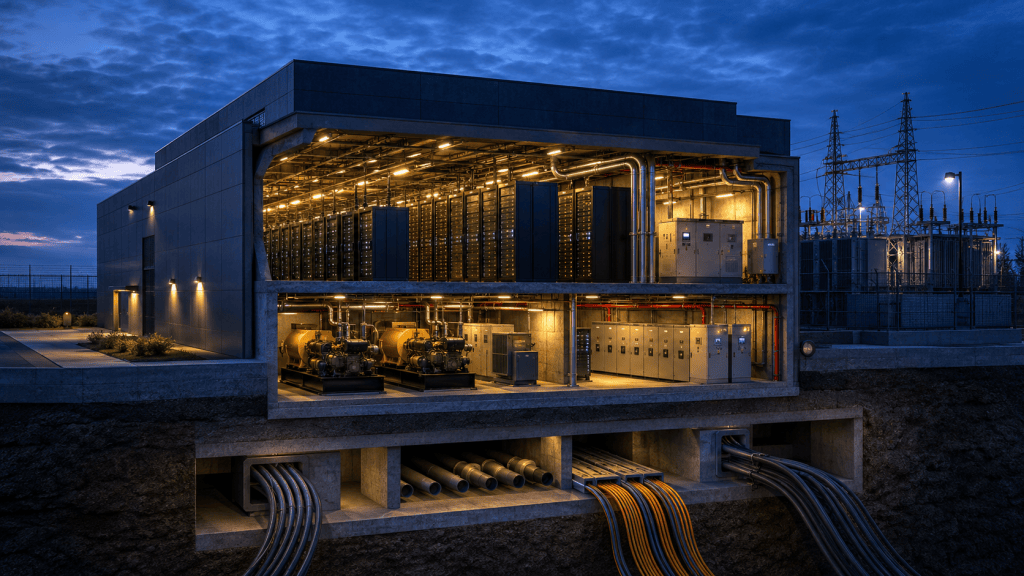
The machinery behind that small convenience is easier to imagine as a
factory than as a cloud. A modern data centre is a carefully controlled
industrial site. Electricity enters at high voltage. Transformers and
switchgear distribute it. Computer processors turn much of it into heat.
Cooling equipment carries that heat away. Batteries and generators wait
for interruptions. Fibre-optic cables connect the building to the wider
world.
The recent argument over AI data centres is partly an argument about
scale. The International Energy Agency expects global data-centre
electricity consumption to more than double by 2030, to around 945
terawatt-hours. AI is not the only thing these centres do, but it is the
largest new driver of that growth.
So what does one of these apparently weightless services physically
need?
A warehouse designed
around electricity
From the road, a data centre can look oddly uneventful: a large,
windowless box behind security fencing. Inside, the basic unit is a rack
— a tall cabinet holding servers, network switches and power
equipment.
Ordinary websites can be served by fairly conventional machines.
Training and running large AI models relies heavily on accelerators such
as graphics processing units. These chips are very good at performing
enormous numbers of similar calculations in parallel. They are also
power-dense. A rack built for AI can demand far more electricity, and
produce far more heat, than an older rack designed for routine business
computing.
That changes the building around it. The data hall is only part of
the site. There may also be substations, transformers, cooling towers or
chillers, pumps, water-treatment equipment, battery rooms and banks of
standby generators. The computers are the productive machinery; much of
everything else exists to keep them supplied and within a safe
temperature range.
Why the power bill
is not just the computers
The industry uses a measure called power usage effectiveness, or PUE.
It compares all the electricity entering a data centre with the amount
actually reaching its computing equipment.
A PUE of 2 would mean that for every watt used by the servers,
another watt was being consumed by cooling, power conversion, lighting
and other supporting systems. A figure nearer 1 is better. Large, modern
centres can be highly efficient, but even a very good ratio does not
make a huge computing load small. Improving the efficiency of an engine
does not necessarily reduce fuel use if the fleet grows fast enough.
Location matters too. A data centre is a very large electrical
customer that cannot simply be attached anywhere. It needs a suitable
grid connection, and often enough capacity to grow. Proposed projects
may reserve more power than they eventually use, producing what energy
planners call speculative or “ghost” demand. Grid operators then face a
difficult question: how much new infrastructure should be built for
projects that may change, shrink or never appear?
The heat has to go somewhere
Almost all the electricity used by a processor eventually becomes
heat. If that heat is not removed, components slow down or fail.
Traditional server rooms often move large quantities of cooled air
through raised floors and along carefully arranged hot and cold aisles.
More powerful AI hardware has encouraged liquid cooling, in which water
or another fluid passes close to the chips and carries heat away more
efficiently.
Water use is therefore complicated. Some centres use water directly
in evaporative cooling. Others rely more heavily on air cooling or
closed liquid loops. There is also indirect water use in generating
electricity. Climate, design, power source and the time of year all
affect the total. A centre in a cool, wet region faces different choices
from one in a hot, water-stressed area.
That is why a single claim that “an AI query uses this much water”
can mislead. The underlying issue is real, but the amount depends on the
model, hardware, utilisation, cooling system, electricity mix and
location.
Why backup power matters
A supermarket can tolerate a brief power cut. A data centre promises
something closer to continuous service. Its electrical system is
designed in layers.
Batteries or flywheels bridge the first seconds of an outage. Standby
generators can then take over for longer interruptions. Important
systems are duplicated, and the most demanding facilities are built so
that one component can be removed for maintenance without stopping the
computers.
This resilience has a footprint. Generators need fuel and testing.
Batteries require minerals, space and replacement. Redundant equipment
may spend most of its life waiting, yet it is essential to the service
being sold.
The network is part of the
machine
An AI data centre is useful only if information can enter and leave
quickly. Multiple fibre routes reduce the risk that one damaged cable
will isolate the site. Within the building, specialised networks move
data between thousands of processors.
For large AI models, the processors often have to work together on
the same task. A slow connection between them is like a factory in which
every worker must wait for parts to arrive. The network inside the data
hall can therefore be almost as important as the chips themselves.
What does the local area
receive?
The public debate is not simply about whether data centres are good
or bad. It is about trade-offs, and about who carries them.
Construction can bring substantial investment and temporary
employment. Once a centre is running, however, it may employ fewer
people than a conventional factory occupying a similar site. Local
authorities may receive business rates or other benefits, while
residents experience construction traffic, generator noise, pressure on
water or competition for grid capacity.
Waste heat can sometimes warm nearby buildings, but only when there
is a suitable heat network and a customer close enough to use it. New
electricity generation can be built, but transmission lines and
substations take time. Promises must be judged against the specific
design rather than the word “green” in a planning document.
The cloud was always a place
The great trick of digital life has been to hide its machinery.
Photographs appear on every device. Films begin instantly. An AI answer
arrives without smoke, vibration or an obvious supply chain.
But the cloud is not a substance. It is a collection of other
people’s buildings, connected by cables and supplied by physical grids.
AI has not invented that infrastructure; it has made its appetite harder
to ignore.
Understanding a data centre does not settle the planning argument. It
does give us better questions. How much power is reserved, and how much
is likely to be used? What cooling system is proposed? Where will the
water and electricity come from? What happens during an outage? What
lasting benefit will remain locally?
Behind every effortless digital answer is a very material
arrangement. The intelligence may be artificial. The land, energy, water
and engineering are not.
Quick facts
- The IEA expects global data-centre electricity consumption to reach
about 945 TWh by 2030. - AI accelerators make many modern racks considerably more power-dense
than conventional server racks. - PUE compares all facility energy with the energy used by computing
equipment. - Cooling can use air, evaporation, chilled water or liquid delivered
close to the chips. - Batteries and generators are normally part of a layered backup
system.
Sources and further reading
- International
Energy Agency — Energy and AI: Executive summary - International
Energy Agency — Energy demand from AI - Google Data Centers
— Efficiency and PUE - Nature
npj Clean Water — Data-centre water consumption - Reuters
— Texas and the problem of “ghost demand”, 1 September 2026 - The
Guardian — The global backlash against data centres, 2 September
2026




 The Knowledge Back Catalogue
Leave a comment