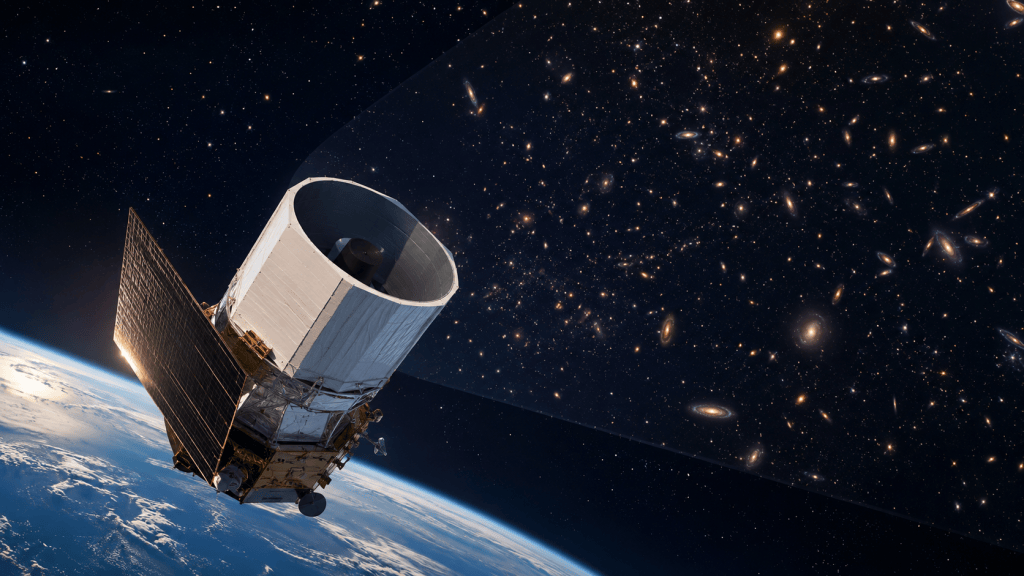
The Nancy Grace Roman Space Telescope has a mirror much like
Hubble’s, but it is designed to look at far more sky. That difference
changes the questions it can answer.
There are photographs from the Hubble Space Telescope in which a
handful of galaxies seem to float in perfect isolation. Then there are
Hubble’s deep fields, where a patch of apparent emptiness turns out to
contain thousands of them.
Both kinds of image are powerful because Hubble can inspect a small
part of the sky in exquisite detail. NASA’s newly launched Nancy Grace
Roman Space Telescope has been built around a complementary idea: keep
much of that sharpness, but widen the view.
Roman launched on 30 August 2026 and is travelling roughly a million
miles from Earth to the second Sun–Earth Lagrange point, known as L2.
Once commissioned, it will survey the infrared universe at a speed NASA
estimates to be about 1,000 times Hubble’s.
It is tempting to describe every new telescope as a replacement for
the last. Roman makes more sense as a different kind of tool.
A telescope is a
choice about what to notice
No telescope can do everything. Engineers choose which wavelengths it
will detect, how large an area it will see, how sharply it will resolve
detail and how often it can return to the same place.
Hubble is often used like a telephoto lens. Astronomers point it at a
carefully selected target and gather very detailed observations. Roman’s
Wide Field Instrument is closer to a panoramic camera. Its 300-megapixel
detector will capture an area of sky much larger than Hubble can see in
one exposure while retaining comparable sharpness.
That makes Roman well suited to surveys: repeated, systematic
observations of millions or billions of objects. A survey does not
merely produce attractive pictures. It creates a statistical map from
which astronomers can find rare objects, compare populations and see how
the universe changes across enormous distances.
Why infrared light matters
Roman observes mainly in near-infrared light, just beyond the red end
of human vision.
Very distant galaxies are racing away from us as the universe
expands. Their light is stretched to longer wavelengths, a process
called redshift. Radiation that began in the visible part of the
spectrum can therefore reach us as infrared. Dust that blocks visible
light is also more transparent at many infrared wavelengths.
Infrared telescopes can consequently reveal objects hidden inside
dusty regions and study light that has travelled for much of cosmic
history. Roman overlaps with the James Webb Space Telescope in
wavelength, but not in role. Webb has a larger mirror and can make
exceptionally sensitive, detailed observations of selected objects.
Roman is designed to find patterns and targets across broad areas.
One can survey the neighbourhood; the other can inspect a particular
house.
Mapping an invisible
universe
Roman’s largest questions concern dark energy and dark matter — names
that reveal how incomplete our understanding remains.
Dark matter does not emit light, but its gravity affects galaxies and
bends the path of light passing near it. By measuring the subtle
distortion of millions of distant galaxies, Roman should help map where
this unseen matter lies.
Dark energy is the label given to whatever is causing the expansion
of the universe to accelerate. Roman will approach it in several ways,
including measuring the distribution of galaxies and finding large
numbers of Type Ia supernovae. These exploding stars can act as distance
markers. Comparing their apparent brightness and redshift helps
reconstruct how cosmic expansion has changed over time.
The strength comes from scale. One galaxy can be unusual. Millions
reveal a pattern.
A census of other solar
systems
Roman will also look inward, towards the crowded centre of our Milky
Way, to search for planets using gravitational microlensing.
Microlensing occurs when a foreground star passes almost directly in
front of a more distant star. The nearer star’s gravity bends and
magnifies the background light. If the foreground star has a planet, the
planet can add a small, brief disturbance to that brightening.
The method can find worlds far from their stars and even planets
wandering through space without a star at all. It complements the
transit method, which detects the tiny dimming caused when a planet
crosses its star’s face. Again, different instruments notice different
parts of the same universe.
The
instrument that may prepare the next generation
Roman also carries a coronagraph technology demonstration. A
coronagraph blocks a star’s glare so that much fainter material nearby
can be seen.
Doing this from space with the precision needed to detect planets is
extremely difficult. Tiny optical errors scatter starlight across the
image. Roman’s system will test mirrors and controls that correct those
errors in real time. Its main purpose is to demonstrate technology, not
to conduct a complete survey of Earth-like worlds, but success could
help future telescopes photograph and analyse planets more directly.
Why L2?
Roman’s destination, L2, is not a platform or a fixed parking space.
It is a region where the combined motion and gravity of the Sun and
Earth allow a spacecraft to maintain a useful orbit while keeping the
two bodies in roughly the same direction.
That geometry helps a telescope shield itself from heat and light
while maintaining communications with Earth. The James Webb Space
Telescope also operates near L2. Roman will orbit around the point
rather than sit motionless upon it.
The distance makes servicing difficult, so systems are tested and
duplicated with extraordinary care. It also allows long, stable
observations away from the rapid heating and cooling experienced by a
low-Earth-orbit telescope.
A flood of
ordinary-looking pictures
Roman is expected to return around 1.4 terabytes of data each day.
Most individual frames will not instantly become famous. Their value
will lie in combination.
Software will align and compare them. Astronomers will search for
objects that move, brighten, fade or distort the shapes of things behind
them. The telescope’s legacy will be not only a sequence of discoveries
but a public archive that researchers can ask new questions of for
years.
This is the quiet power of a survey instrument. Hubble taught us what
can happen when a telescope stares deeply at a chosen patch of sky.
Roman will show what happens when comparable vision is spread across a
much wider cosmic landscape.
The universe has not changed. We have changed the size of the
window.
Quick facts
- Roman launched on 30 August 2026.
- It is travelling to the Sun–Earth L2 region, around a million miles
from Earth. - Its primary mirror is 2.4 metres across.
- The Wide Field Instrument uses a 300-megapixel infrared camera.
- NASA expects Roman to survey the universe about 1,000 times faster
than Hubble. - First images are expected after commissioning, in early 2027.





Leave a Reply