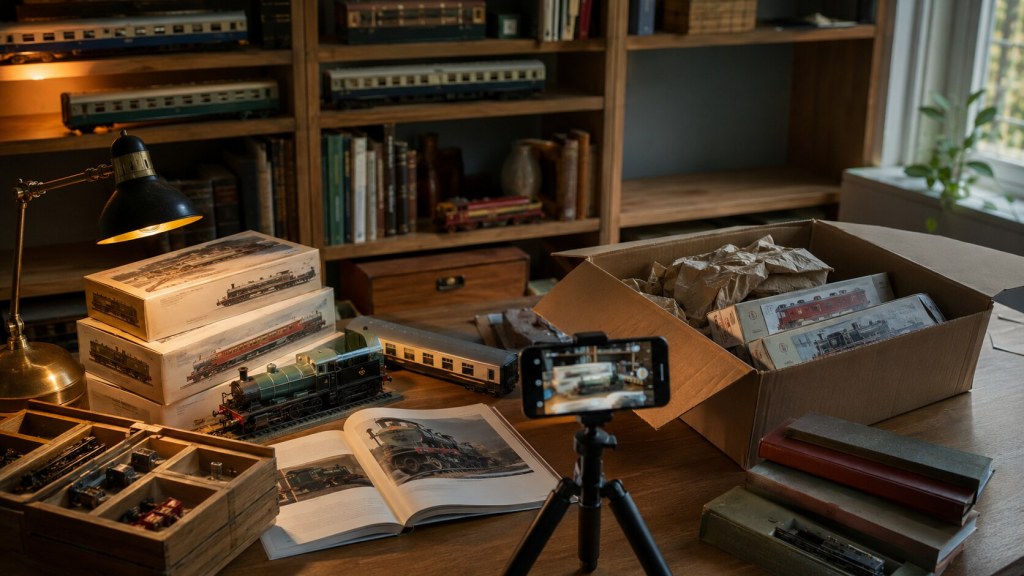
The difficult object is often not the rarest one.
It is the ordinary box halfway down the stack: bought with a plan,
opened perhaps once, kept through several reorganisations and still
waiting for the future in which it will finally become useful.
On paper, the decision is simple. If an object is not being used and
its sale would release money or space, list it. Yet collections resist
paper logic. A person can spend an evening sorting items into “keep”,
“sell” and “unsure”, only to discover that “unsure” has swallowed most
of the room.
This is not necessarily greed, laziness or poor discipline.
A collection is rarely just an inventory. It can be a record of past
enthusiasm, a store of expertise, a social identity and a set of
promises made to a future self. Selling an item may therefore register
as several losses at once—even when keeping it has become a burden.
Psychology offers some useful explanations for that resistance. It
also suggests a kinder way through it.
Ownership changes value
One of the best-known explanations is the endowment effect: people
often value an object more highly once they own it.
In classic experiments published in 1990, Daniel Kahneman, Jack
Knetsch and Richard Thaler randomly gave some participants coffee mugs
and then created markets in which the mugs could be traded. Owners
typically demanded more to give up a mug than non-owners were willing to
pay to acquire one. Far fewer exchanges took place than conventional
economic assumptions predicted.
The important point is not that everybody irrationally loves mugs.
Ownership changes the frame of the decision.
Before purchase, the object is one possible gain among many. After
purchase, selling becomes a loss of something already incorporated into
the owner’s world. Later research has debated the precise mechanisms
behind the effect, including loss aversion, attention and the
associations ownership creates between an object and the self. The broad
pattern remains familiar: “mine” is not a neutral category.
This helps explain the gap between a seller’s expectations and the
second-hand market. The owner remembers the search, the excitement, the
postage, the limited production run and what the object cost new. The
buyer sees one used item among several competing listings.
Both may be acting honestly. They are valuing different stories.
We collect versions of
ourselves
Consumer researcher Russell Belk described possessions as part of the
“extended self”. The idea is straightforward: what we own can help
express, maintain and remember who we are.
A collection makes this unusually visible.
Books say what a person wants to understand. Records preserve taste
and time. Tools represent practical competence. Models can embody
fascination with engineering, history or design. Toys may connect adult
collectors with childhood, creativity or a community of people who know
why one tiny variation matters.
The collection can also represent an aspirational identity. An
unopened kit says, “I am someone who will build this.” A shelf of
reference books says, “I am becoming knowledgeable about this subject.”
Materials kept for a project preserve the possibility that the
project—and the version of us who completes it—still exists.
Selling the object can therefore feel like contradicting the
self-story attached to it.
That is why purely functional questions sometimes fail. “Have I used
this in the past year?” may work for a spare kitchen utensil, but it can
feel absurd when applied to an heirloom, a specialist collection or a
project deliberately intended to take years.
The better question is not whether the object has been used recently.
It is whether the relationship still deserves the space, money and
attention it occupies now.
The project trapped inside
the box
Collections often contain two different things: objects enjoyed as
objects, and projects waiting to happen.
The distinction matters because unfinished projects create their own
pressure. A kit is not only plastic, card, wood or metal. It carries
assembly, painting, research, display and storage tasks. Forty unbuilt
kits may quietly become forty promises.
This pressure can remain invisible until life changes. Time becomes
scarcer. A room needs another use. Financial priorities shift. The
collection which once represented possibility begins to resemble an
obligation.
One small study of 60 dual-income couples, published by Darby Saxbe
and Rena Repetti in 2010, analysed how participants described their
homes. Among the women in the study, language associated with clutter
and unfinished projects correlated with less favourable daily cortisol
patterns and worsening mood across the day. The study was limited and
does not prove that clutter directly causes ill health, but it captured
an experience many people recognise: a home full of pending tasks may
not feel restorative.
An unfinished object can demand attention without ever appearing on a
to-do list.
Selling it may bring sadness. It may also cancel a task which no
longer deserves to be done.
“But I have already spent so
much”
Then there is sunk cost.
A sunk cost is an investment which has already been made and cannot
be recovered in full: money spent, hours worked or effort devoted.
Rationally, that past cost should not decide what happens next. The
decision should depend on future costs and future benefits.
Humans do not find that easy.
Hal Arkes and Catherine Blumer’s influential work on the psychology
of sunk cost described the increased tendency to continue an endeavour
after investing money, effort or time in it. The investment makes
stopping feel wasteful, even when continuing would add more cost without
producing enough value.
Collections create ideal conditions for this effect. An item may have
been expensive. Completing a set may have required years. A project may
already have consumed dozens of hours. Selling below the original
purchase price feels as though it crystallises a loss which keeping the
object allows us to postpone acknowledging.
But keeping does not recover the money either.
The original price is gone whether the item remains in a cupboard or
is sold tomorrow. The useful comparison is between the choices still
available: the value of owning it from now onwards versus the money,
space and relief its sale could create.
That reframing can feel severe, but it protects the past from
becoming a permanent claim on the future.
Why collectors imagine
the highest price
Pricing introduces another emotional trap.
Owners naturally notice the record auction result, the optimistic
dealer listing or the one online sale achieved by a perfect example with
its original packaging. These numbers confirm that the collection was
worthwhile. Lower completed-sale prices feel like bad evidence and are
easier to dismiss.
The market, however, does not pay for effort or affection. It pays
what a particular buyer will offer for a particular object in its
present condition, through a particular sales channel, at a particular
time.
This creates three different values:
- Acquisition value: what the owner paid.
- Personal value: what the item means to the
owner. - Market value: what another person is likely to pay
now.
Confusing them makes every offer feel insulting. Separating them
allows an honest decision. An item can have high personal value and low
market value; that may be a good reason to keep it. Another can have low
personal value and unexpectedly high market value; that may make it an
excellent candidate to sell.
No single price reveals what an object was “really worth”. It answers
only one of those questions.
A collection is not a moral
test
Discussions of decluttering often become strangely moral. Keeping
things is framed as failure. Selling is framed as liberation. Minimalism
becomes evidence of virtue, while attachment is treated as weakness.
That is unhelpful.
Collections can provide knowledge, pleasure, friendship, continuity
and a form of creative expression. The fact that possessions contribute
to identity does not make the attachment false. A carefully chosen shelf
can be more meaningful than an empty one.
The problem begins when ownership no longer supports the life around
it—when storage prevents use, maintenance produces guilt, buying outruns
enjoyment or one collection blocks a more important priority.
The aim is not to own as little as possible. It is to make the
collection and the present life agree.
How to make selling gentler
Because the difficulty is emotional as well as practical, a good
selling process should protect meaning while reducing friction.
Separate the core from the backlog. Identify the
small part of the collection which best represents the interest. A
focused collection often preserves identity better than an
indiscriminate one.
Start with duplicates and low-emotion items. Early
sales teach packaging, pricing and postage without forcing the hardest
decision first. Progress becomes a routine rather than a dramatic
purge.
Use completed sales, not asking prices. A listing
shows what a seller hopes to receive. A completed sale shows that a
buyer existed at that price.
Give the proceeds a named purpose. “Turning this
shelf into £300” can feel like loss. “Using this shelf to reduce a debt,
fund one active project or create a usable room” gives the value
somewhere to go.
Preserve the record without preserving every object.
Photographs, a simple inventory and notes about memorable pieces can
keep the story of a collection after parts of it leave.
Create a decision deadline. An “unsure” box is
useful only if it has a review date. Without one, uncertainty becomes
permanent storage.
Allow a few irrational keeps. Not every object needs
to defend itself in court. A collection is allowed to contain items kept
simply because they make their owner happy.
These steps do not eliminate attachment. They make it possible to act
without pretending the attachment is meaningless.
Letting go without erasing
the past
Selling a collection can feel like admitting that the original plan
failed.
Often, it means something more ordinary: circumstances changed.
The enthusiasm was real. The research was enjoyable. The object may
have served its purpose before it was ever built, read, displayed or
completed. It prompted anticipation, conversation and knowledge. Passing
it on does not travel backwards through time and cancel those
things.
Nor must reducing one collection mean abandoning the interest behind
it. Sometimes selling the backlog protects the core hobby by removing
financial pressure and restoring usable space. Fewer objects can create
more contact with the ones that remain.
The most useful question is not, “Can I justify getting rid of
this?”
It is, “Would I choose to give this space in my life again
today?”
If the answer is no, selling is not a betrayal of the collector you
were.
It is a decision made by the person the collection helped you
become.
Quick facts
- The endowment effect is the tendency for ownership
to increase the value a person assigns to an object. - The extended self describes the way possessions can
contribute to identity and self-understanding. - A sunk cost is money, time or effort already spent
and not recoverable; it should not determine whether further resources
are committed. - Asking prices show sellers’ hopes; completed sales provide stronger
evidence of current market value. - Photographing and recording a collection can preserve its history
without requiring every object to be retained.
Sources and further reading
- Daniel
Kahneman, Jack L. Knetsch and Richard H. Thaler — “Experimental Tests of
the Endowment Effect and the Coase Theorem”, Journal of Political
Economy - Carey
K. Morewedge and Colleen E. Giblin — “Explanations of the Endowment
Effect: An Integrative Review”, Trends in Cognitive Sciences - Russell
W. Belk — “Possessions and the Extended Self”, Journal of Consumer
Research - Sara
Loughran Dommer and Vanitha Swaminathan — “Explaining the Endowment
Effect through Ownership”, Journal of Consumer Research - Hal
R. Arkes and Catherine Blumer — “The Psychology of Sunk Cost”,
Organizational Behavior and Human Decision Processes - Darby E. Saxbe
and Rena Repetti — “No Place Like Home: Home Tours Correlate With Daily
Patterns of Mood and Cortisol”, PubMed - American
Psychological Association — What our possessions mean to us, with
Russell Belk




 The Knowledge Back Catalogue
Leave a comment