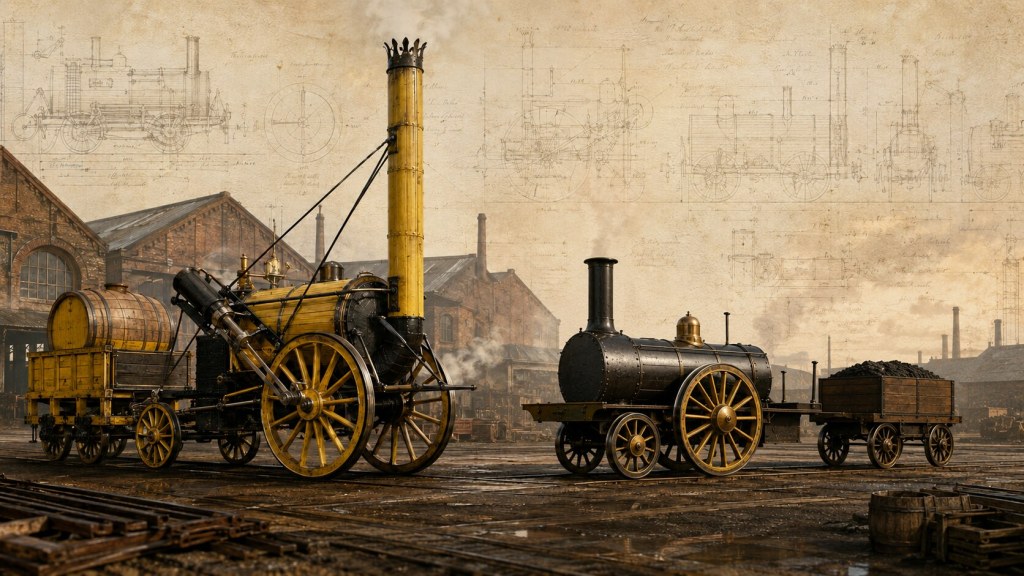
Ask someone to draw the birth of the railway and there is a good
chance they will draw Rocket.
They may not reproduce it accurately, but the ingredients will be
familiar: a tall yellow chimney, a barrel-like boiler, large wooden
driving wheels and cylinders mounted at an improbable angle. It looks
halfway between a piece of industrial machinery and an illustration from
a children’s book.
That visual strangeness is part of Rocket’s power. It appears to have
arrived before anybody knew what a steam locomotive was supposed to look
like.
Then look at Planet, built by the same company in 1830, only a year
later.
The boiler is low and horizontal. The chimney and smokebox sit at the
front. The machinery is tucked between the frames instead of being
displayed on the outside at an angle. Behind the engine is a separate
tender carrying fuel and water. It is still unmistakably primitive, but
its family resemblance to later steam locomotives is far stronger.
Rocket looks like an invention.
Planet looks like the beginning of a product.
What Rocket actually proved
Rocket deserves its fame. In October 1829, the directors of the
Liverpool and Manchester Railway held the Rainhill Trials to identify
“the most improved locomotive engine” for their new line.
The railway was an unprecedented undertaking. It would link two major
industrial cities and carry both freight and passengers. Its promoters
needed to decide whether trains should be hauled by moving locomotives
or by ropes worked from stationary steam engines. A locomotive could not
merely achieve a dramatic burst of speed. It had to be efficient,
dependable and capable of repeating the work.
Five machines appeared at Rainhill: Rocket, Sans Pareil, Novelty,
Perseverance and the horse-powered Cycloped. The trials took place over
nine days on a specially prepared length of line. The National Railway
Museum notes that the test was intended to simulate a 30-mile journey by
requiring repeated runs over a 1.5-mile course. Loads, water and fuel
were measured.
Rocket was the only competitor to complete the ordeal successfully.
The Science Museum Group records an average speed of 12 mph and a top
speed of 30 mph. Its victory brought the Stephensons the £500 prize and
helped secure the case for locomotive power.
Its importance was not that every part was entirely new. Rocket
brought several useful ideas together in one effective machine. A
multi-tube boiler passed hot gases through numerous small tubes,
increasing the surface through which heat could reach the water. Exhaust
steam was directed into the chimney through the blast pipe, drawing the
fire more fiercely as the engine worked harder.
That combination made a locomotive which could produce steam rapidly
enough to sustain useful speed. Rocket was not the first steam
locomotive, but it was powerful evidence that locomotives could run a
serious inter-city railway.
A prototype in public
The Rainhill Trials had something modern about them. They were a
technical competition, a public spectacle and an accidental marketing
event at the same time.
More than 10,000 people reportedly attended the first day. Newspapers
described the machines as though covering a race meeting. Novelty
impressed spectators with its speed before mechanical failures forced it
out. Sans Pareil performed well but was overweight and also suffered a
breakdown. Cycloped’s horse fell through its moving belt.
Rocket did not merely win. It won in front of a crowd.
That gave it a story which could be retold simply: rival machines
assembled, conditions were set, Rocket completed the test and the
railway age followed. History likes a competition because it provides
characters, jeopardy and a finish line.
Engineering rarely stops at the finish line.
The Science Museum Group notes that Rocket was substantially rebuilt
within 18 months and laid aside within ten years. The machine preserved
today is historically priceless, but its appearance and components also
record later alteration. Rocket was an experimental answer produced at a
moment when the questions were still changing.
Almost immediately, Robert Stephenson and his colleagues began
improving it.
One year, an enormous change
Several intermediate locomotives linked Rocket to Planet,
particularly Northumbrian, built for the Liverpool and Manchester
Railway’s opening in September 1830. The evolution was rapid because the
new railway converted engineering theory into daily experience.
Planet, Liverpool and Manchester Railway No. 9, followed later that
year. Robert Stephenson & Co. placed its two cylinders horizontally
beneath the smokebox, inside the frames. They drove a cranked axle
connected to the large driving wheels.
This arrangement changed the engine’s silhouette. Rocket’s
conspicuous angled cylinders disappeared from the flanks. The boiler
could sit in the clean longitudinal arrangement that would become
familiar. Leading carrying wheels supported the front of the locomotive,
while a single pair of large driving wheels provided traction. The 2-2-0
wheel arrangement became known as the Planet type.
The design was not the final form of the steam locomotive. Nothing in
1830 was. Crank axles created their own manufacturing and maintenance
challenges, while locomotives would soon need larger boilers, more
driving wheels and better stability. Robert Stephenson’s later Patentee
type added a trailing axle, creating a 2-2-2 arrangement which became
widely used for early passenger engines.
Yet Planet matters because its machinery and proportions pointed
towards the mainstream rather than the experimental fringe. The
spectacular apparatus was becoming a repeatable working locomotive.
From one engine to a type
There is another difference between a prototype and a product: other
people order the product.
The original Planet was not preserved. What visitors can see at the
Science and Industry Museum in Manchester is a full-sized working
reproduction, completed by museum friends and volunteers in 1992 after a
research and construction project which itself revealed how much
knowledge can be recovered by rebuilding an old machine.
The original engine entered service on the Liverpool and Manchester
Railway, and the design was repeated. Six more Planet-type locomotives
were ordered from Robert Stephenson & Co.; three were built by
Murray and Wood in Leeds from supplied drawings. The precise details
varied as locomotive design continued to develop, but the important
change was organisational as much as mechanical.
A railway could now acquire a family of related engines rather than
commission a fresh experiment every time.
That repeatability helped create the railway engineering industry.
Standard patterns made it easier to train crews, hold spare parts,
compare performance and improve the next batch. Locomotive building
would remain full of individual classes and competing ideas, but it was
becoming manufacture rather than invention alone.
Why Rocket kept the fame
Planet has all the disadvantages of being the second chapter.
Rocket has the contest, the distinctive shape and the name. “Rocket”
sounds like speed and the future. “Planet” is a fine name, but its
achievement is subtler. It represents rearrangement, refinement and the
slow victory of a practical configuration.
The survival of the original Rocket also matters. Museums,
illustrations, replicas and toys repeatedly reinforce its silhouette.
Planet’s original was gone by the early 1840s; the modern reproduction
had to be reconstructed from drawings, documentary evidence and careful
engineering judgement.
There is no injustice in remembering Rocket. The mistake is treating
invention as a single triumphant moment.
Most technologies pass through at least three kinds of achievement.
Someone demonstrates that an idea is possible. Someone combines the
necessary features into a convincing prototype. Then people perform the
less glamorous work of making it reliable, repeatable and useful.
Those stages can involve the same engineers—as they did here—but
history tends to place the spotlight on the first machine with a
dramatic story.
The more revealing model
This is why Planet can be the more interesting locomotive to a
modeller or museum collector.
Rocket represents the moment the argument was won. Planet represents
the questions which arrived the following morning.
Where should the cylinders go? How should the weight be supported?
What layout will be easier to reproduce? How does an experimental engine
become part of a fleet? What must change when a machine leaves a trial
ground and begins carrying ordinary passengers every day?
A model of Planet also sits at a fascinating visual threshold. Place
it beside Rocket and the speed of development becomes obvious. Place it
beside a locomotive from the late nineteenth century and the ancestry
begins to appear. It is not yet the familiar steam engine, but many of
the parts have moved towards their lasting positions.
Rocket supplied railway history with its icon.
Planet showed what happened after the applause.
Quick facts
- Rocket won the Rainhill Trials in October 1829.
- Five locomotives entered; Rocket was the only one to complete the
full trial successfully. - Planet was built by Robert Stephenson & Co. in 1830 for the
Liverpool and Manchester Railway and became its No. 9. - Planet placed its horizontal cylinders inside the frames beneath the
smokebox and used a cranked driving axle. - The original Planet did not survive; the full-sized working
reproduction in Manchester was completed in 1992.
Sources and further reading
- National
Railway Museum — Stephenson’s Rocket, Rainhill and the rise of the
locomotive - Science
Museum Group Collection — Rocket locomotive - Science
Museum Group Collection — Reproduction of the 1830 Planet steam
locomotive - Science
and Industry Museum — Travelling by train through time - Science
and Industry Museum — Power Hall reopening: Planet’s place after
Rocket - Michael
R. Bailey — “Learning Through Replication: The Planet Locomotive
Project”, Transactions of the Newcomen Society


Leave a Reply