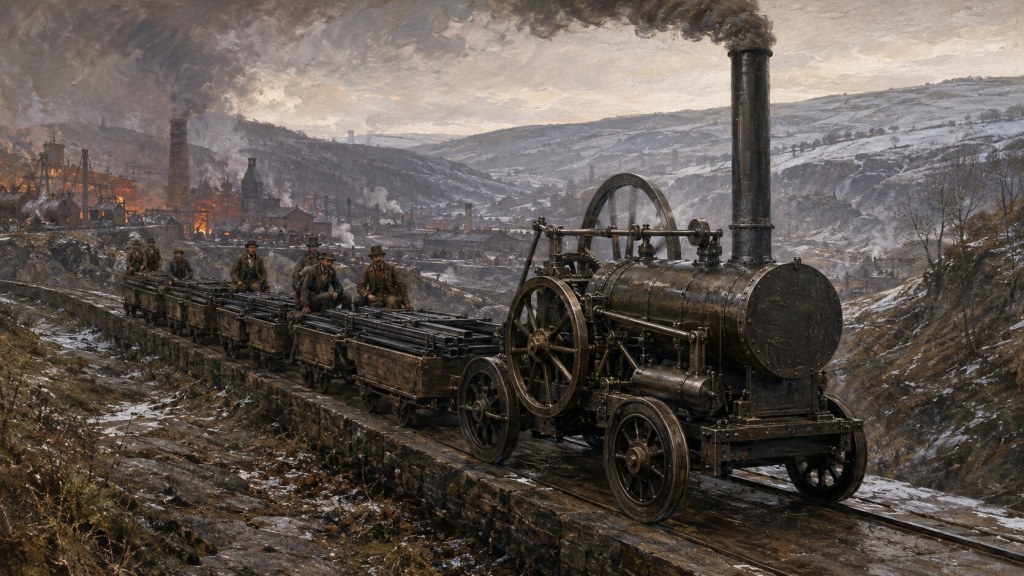
The railway age did not begin with a polished locomotive at a grand
station.
It began with an industrial wager, a load of iron and a machine that
was too heavy for its own track.
On 21 February 1804, Richard Trevithick’s steam locomotive set out
from the Penydarren Ironworks at Merthyr Tydfil. It hauled five wagons
carrying ten tons of iron towards the Glamorganshire Canal at Abercynon,
about nine miles away. Around 70 men climbed aboard for the journey.
The engine succeeded. It also damaged the brittle cast-iron
tramplates beneath it. After further runs and more broken rails, the
experiment was abandoned.
That can sound like failure. It was actually one of the most
important incomplete successes in transport history: the first recorded
or authenticated journey in which a steam locomotive hauled a load on
rails.
It happened in South Wales, 25 years before Rocket won the Rainhill
Trials.
Why Merthyr Tydfil?
The setting was not accidental.
At the beginning of the nineteenth century, Merthyr Tydfil was
becoming one of the great centres of iron production. The district’s
ironworks needed raw materials brought in and finished iron carried out
in enormous quantities. Before modern railways, the region already
possessed an intricate transport system of tramroads and canals.
The Merthyr or Penydarren Tramroad had been built in the 1790s.
Horse-drawn wagons ran on L-shaped cast-iron plates, which guided
ordinary flanged wagon wheels. The line linked ironworks around Merthyr
with the canal basin at Abercynon. From there, iron could travel by boat
down the Glamorganshire Canal towards Cardiff and the sea.
This was already a railway landscape—just not yet a locomotive
railway.
That distinction matters. The steam locomotive was not invented in
isolation and then given rails. It emerged where established rails,
heavy industry, skilled metalworking and an urgent transport problem met
one another.
South Wales provided all four.
The Cornish engineer
and the ironmaster
Richard Trevithick came from Cornwall, another landscape transformed
by mining and steam power. His crucial contribution was the development
of compact engines using high-pressure steam.
Earlier stationary engines, particularly those influenced by James
Watt, were large and relied on relatively low steam pressure with a
separate condenser. They were immensely useful for pumping mines, but
their size made them difficult to move. Trevithick accepted higher
pressures, allowing more power from a smaller and lighter engine.
That created the possibility of self-propelled steam vehicles.
Samuel Homfray, the owner of the Penydarren Ironworks, encouraged
Trevithick to adapt one of his engines for the tramroad. The familiar
version of the story includes a wager between Homfray and the
neighbouring Cyfarthfa ironmaster Richard Crawshay. Museum Wales records
the traditional stake as 500 guineas each: could the locomotive haul ten
tons of iron to Abercynon and return with the empty wagons?
The bet supplied the immediate drama. The iron industry supplied the
deeper reason.
If steam could replace horses on these routes, a works might move
more material with greater regularity. The reward was not novelty. It
was industrial capacity.
A boiler placed on wheels
The Penydarren locomotive looked very little like the steam engines
that came later.
A large horizontal boiler sat on four wheels. Its single cylinder was
partly set into one end of the boiler, with the piston’s movement
transmitted through rods and a large flywheel to gears driving the
axles. There was no cab, no tender in the later sense and none of the
balanced symmetry associated with Victorian locomotives.
It was closer to a mobile industrial engine because that was what it
was.
Its high-pressure boiler made locomotion possible. The exhaust steam
also helped draw the fire by being directed towards the chimney, an
important principle in later locomotive development. Yet early rail
travel depended on more than the engine. The track had to survive it,
gradients had to be manageable, and enough adhesion had to exist between
smooth iron wheels and smooth iron rails.
Some engineers suspected that a locomotive would simply spin its
wheels unless teeth or some other mechanical grip were provided.
Trevithick’s machine helped show that ordinary adhesion could move a
useful load.
The more immediate weakness was beneath it.
Ten tons of iron—and 70
opportunists
Trevithick described the journey in a letter written the following
day. Museum Wales reproduces his account: the train carried ten tons of
iron in five wagons, with 70 men riding on them, and the engine reached
nearly five miles an hour while working.
The passengers were not part of a timetabled service. Cadw describes
most of them as last-minute opportunists. Their presence nevertheless
gives the event an unexpectedly human scale.
Imagine the noise and novelty. The engine moved without a horse.
Steam and smoke filled a route built for familiar animal power. Workers,
ironmasters and bystanders watched an industrial machine pull both a
commercial load and a crowd of people through the landscape.
The train passed through the tunnel beneath the charging area of the
Plymouth Ironworks at Pentrebach. To make room, the double line of
tramplates in the tunnel had been replaced by a single central track.
The surviving tunnel remains a scheduled monument because it brings the
early tramroad and locomotive stories together in one physical
place.
The journey reached Abercynon. The wager’s outward requirement had
been met.
But the locomotive had taken more than four hours, including
stoppages, and its weight broke tramplates. The return portion of the
wager was not completed as originally imagined. Repeated operation only
produced more damage. The engine was eventually taken off its wheels and
returned to stationary industrial work.
A success that
could not yet become a service
It is tempting to tell technological history as a procession of
successful inventions. A machine works, everybody recognises its value
and the world changes.
Penydarren shows what usually happens instead.
Trevithick had proved that a steam locomotive could haul a
substantial load on rails. He had not created an entire railway system
capable of using it economically. The locomotive and the track had been
designed for different worlds: one for concentrated high-pressure power,
the other for light horse-drawn wagons.
The engine was ahead of the infrastructure.
Later railway development had to solve both halves of the problem.
Stronger edge rails replaced fragile plateways. Locomotive weight was
distributed more effectively. Boilers, cylinders, valves and frames
improved. Engineers learned how to balance power, reliability, track
strength and operating cost.
Progress then shifted towards the coalfields of north-east England,
where engineers including William Hedley, Timothy Hackworth and George
Stephenson developed more durable locomotives for colliery railways. By
the time the Stockton and Darlington Railway opened in 1825 and Rocket
appeared in 1829, steam locomotion had accumulated a quarter-century of
experiments after Penydarren.
The Welsh journey was not a complete railway revolution. It was proof
that the central act of that revolution was physically possible.
Why the story is less
famous than Rocket
Rocket has several advantages in public memory. Its original remains
survive. Its yellow chimney and large driving wheels give it an
unforgettable shape. It won a competition in front of a huge crowd and
became associated with the opening of the Liverpool and Manchester
Railway, a recognisably modern inter-city line.
Penydarren left no original locomotive. Its journey belonged to an
industrial tramroad, and its immediate commercial future disappeared
beneath broken track.
There is also an awkwardness in the language of “firsts”. Trevithick
had built an earlier rail engine at Coalbrookdale, but firm evidence
that it worked there has not survived. Other pioneers can claim the
first public railway, the first regular passenger service, the first
main-line locomotive or the first modern inter-city railway.
The careful claim for Penydarren is still remarkable: it made the
first recorded or authenticated steam-hauled railway journey.
Museum Wales built a full-sized working replica in 1981–82. It is now
held at the National Waterfront Museum in Swansea. The replica is more
than a visitor attraction. Like any well-researched reconstruction, it
turns surviving drawings and descriptions into physical questions about
materials, clearances, controls and the behaviour of the machine.
It also restores scale to the story. Penydarren was not an abstract
step on the way to Rocket. It was a large, hot, awkward piece of
machinery attempting a real job in a working industrial landscape.
The railway began as a
connection
The most revealing way to remember Penydarren is not as a lone
engine.
It belonged to a chain.
Iron left the works in wagons. The tramroad carried it to Abercynon.
The canal took it towards Cardiff. Ships moved it into wider markets.
Horses, rails, steam, water and maritime trade were not separate
chapters; they were parts of a connected transport system.
The locomotive mattered because it attempted to change one link in
that chain.
That is why South Wales was not merely the backdrop to the first
journey. Its geography and iron industry created the need, the
materials, the route and the people willing to try.
The rails broke. The engine was taken away. Horses returned.
But after 21 February 1804, nobody could say that steam had never
hauled a train.
Quick facts
- Date of the journey: 21 February 1804.
- Route: Penydarren Ironworks at Merthyr Tydfil to the canal basin at
Abercynon, roughly nine miles. - Load: five wagons carrying ten tons of iron, plus around 70
people. - Designer: Cornish engineer Richard Trevithick, working with
Penydarren ironmaster Samuel Homfray. - Immediate problem: the locomotive’s weight broke cast-iron
tramplates designed for horse-drawn traffic. - Surviving connection: a full-sized working replica is held by Museum
Wales at the National Waterfront Museum in Swansea.
Sources and further reading
- Museum
Wales — Richard Trevithick’s steam locomotive - Museum
Wales — Birth of the Railway Locomotive - Museum
Wales Collections Online — Trevithick’s Penydarren locomotive
replica - Science
Museum Group Collection — Richard Trevithick - Cadw
— Merthyr Tramroad Tunnel scheduled monument report - Royal
Commission on the Ancient and Historical Monuments of Wales — Tracks
into the Archive - National
Railway Museum — Stephenson’s Rocket, Rainhill and the rise of the
locomotive




Leave a Reply