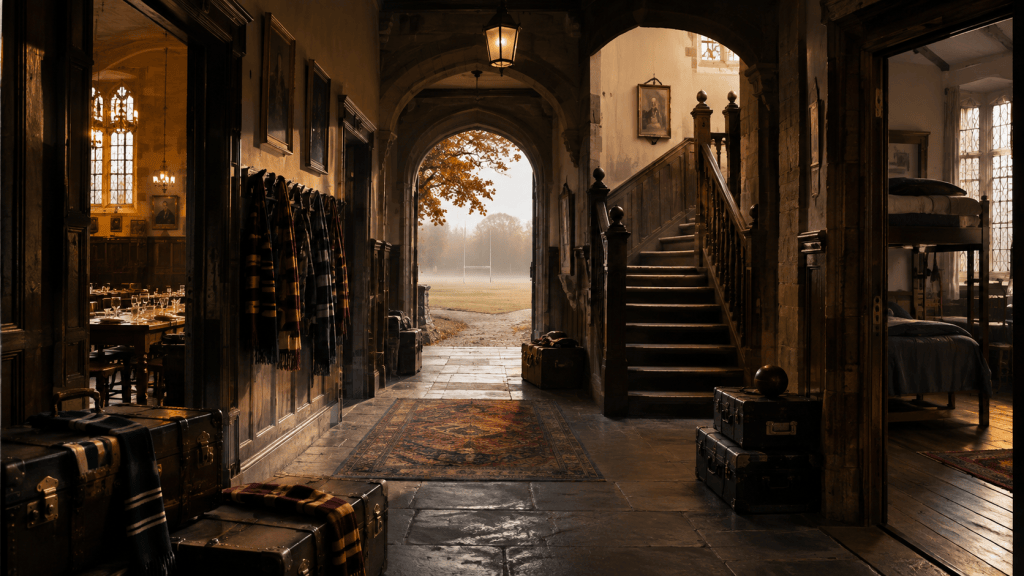
Long before Hogwarts, British writers discovered that a boarding
school was a nearly perfect story machine: a sealed world with its own
geography, tribes, rituals, dangers and rules.
Hogwarts feels instantly recognisable even though it contains moving
staircases, ghosts and a forest full of magical creatures. New pupils
arrive by train. Older students explain customs. Houses compete.
Teachers guard mysteries. The school year gives the story a beginning,
middle and end.
J. K. Rowling added magic to a form that British children’s
literature had been refining for more than two centuries. The fictional
boarding school is powerful because it is both a miniature society and a
world temporarily separated from adults at home.
A world with a front gate
Stories need boundaries. A detective novel has a crime; a voyage has
a ship; a school story has a campus and a timetable.
Boarding schools intensify that boundary. Pupils do not go home at
the end of the day. Classrooms, dormitories, dining halls, playing
fields and corridors become the whole known world. A character cannot
easily escape an enemy, a rumour or an embarrassing mistake. Friendship
matters because the same people are present at breakfast, lessons and
lights-out.
The setting is large enough to contain secret passages and rival
territories but small enough for readers to learn. Within a few
chapters, the house table, the forbidden room and the distant edge of
the grounds carry emotional meaning. This is worldbuilding achieved
through routine.
Before Tom Brown
The school-story tradition did not begin with one book. Sarah
Fielding’s The Governess, or The Little Female Academy appeared
in 1749, and many school tales followed.
Thomas Hughes’s Tom Brown’s School Days, published in 1857
and set at Rugby School, gave the boys’ boarding-school story enormous
influence. It established ingredients that would recur for generations:
the newcomer learning unwritten rules, the bully, loyal friendships,
sport, house identity and the belief that school tests character as much
as knowledge.
Later writers varied the recipe. Rudyard Kipling’s Stalky &
Co. made school life more mischievous and morally ambiguous. Frank
Richards’s Billy Bunter stories turned it comic. Girls’ school stories
created their own traditions of friendship, independence, midnight
feasts and rivalry. St Trinian’s eventually parodied the whole
institution.
Real boarding schools were experienced by a minority of British
children. Fiction made their imagined rituals familiar to millions.
Children inherit the
institutions
In ordinary life, adults control most spaces. In a school story,
adults are powerful but intermittent. Teachers can award punishments,
set rules and conceal information, yet much of the social world belongs
to pupils.
That gives child characters meaningful authority. A house captain can
matter. A friendship can cross a formal division. A rule invented by
generations of pupils may feel stronger than one written by the
headteacher.
The structure also turns growing up into visible progress. Each new
term changes a character’s status. The frightened newcomer becomes the
older pupil who knows the way. Readers can measure time through
examinations, matches, holidays and moving up a year.
Why houses work so well
Dividing a school into houses instantly creates belonging and
competition. A child receives colours, a reputation and a ready-made
group. The device lets an author sort a large cast into understandable
loyalties without making every conflict personal.
Hogwarts houses are a particularly explicit version: each is
associated with qualities and symbols. But the emotional machinery is
older. House points make small actions contribute to a collective
result. A sporting contest turns private friendship into public
allegiance.
For readers, choosing a house extends the fiction beyond the page. It
invites the question: where would I belong?
Hogwarts and the inherited
grammar
Harry Potter enters the magical world as both an orphan and a new
pupil. That lets the reader learn everything alongside him. The train
journey creates a threshold. The Sorting Ceremony assigns identity. Each
year repeats a reassuring framework while enlarging the danger.
Magic makes familiar school-story devices literal. A forbidden
corridor can hold an actual monster. A disliked teacher may be hiding
more than favouritism. The old school’s traditions reach into national
history.
Yet the series also changes the form. The conflict eventually
overwhelms the timetable, and Hogwarts becomes a battlefield. What
begins as an enclosed childhood world is revealed as part of a larger
society.
The school that readers can
possess
Fictional boarding schools endure because they balance security and
danger. Meals arrive, bells ring and the year has a pattern—but beyond
the lit corridor there is always somewhere forbidden to explore.
Most readers would not want every part of the real institution:
separation from home, hierarchy, bullying and loneliness are central to
the genre for good reason. The fictional version offers something more
controllable. It is a complete world that can be learned, joined and
revisited whenever the book is opened.
Quick facts
- School stories existed before Tom Brown’s School Days,
including Sarah Fielding’s 1749 The Governess. - Thomas Hughes’s 1857 novel popularised many conventions of the boys’
school story. - Houses create instant belonging, rivalry and an understandable
structure for a large cast. - The school year naturally supplies recurring beginnings, climaxes
and endings. - Hogwarts combines this inherited form with fantasy
worldbuilding.



 The Knowledge Back Catalogue
Leave a comment