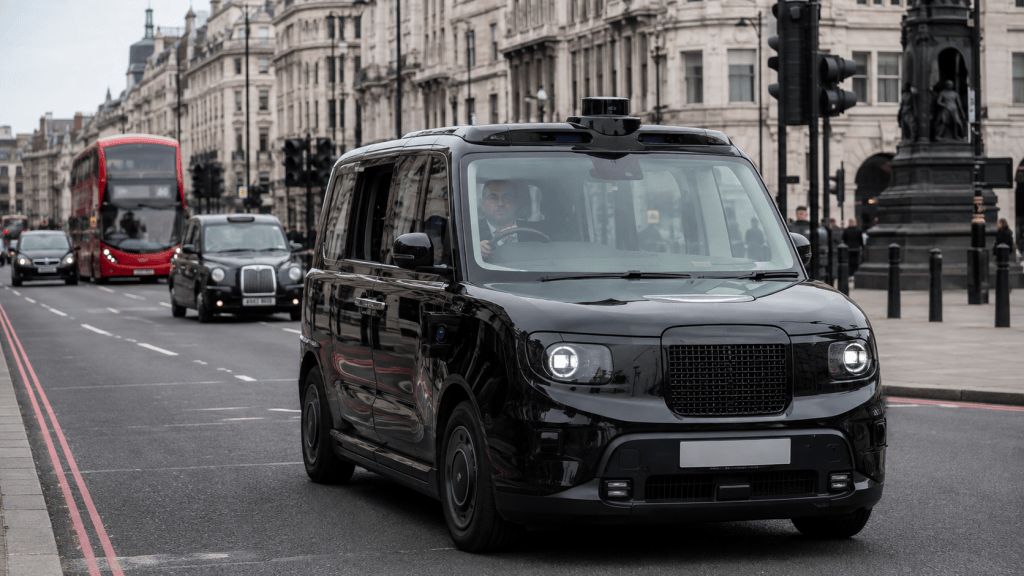
A taxi can be self-driving and still arrive with a person behind
the wheel. That is not necessarily a contradiction; it is a sign that
autonomy is being introduced in stages.
Londoners can now be matched with a small number of Wayve-equipped
cars through Uber. The vehicles can steer, brake and make driving
decisions, but a licensed safety driver remains in the front seat, ready
to take control.
The word “robotaxi” makes the arrangement sound unfinished. If there
is a driver, what exactly is robotic about it?
The answer lies in the difference between demonstrating that a
vehicle can drive and proving that it can operate safely, repeatedly and
legally without human supervision.
Autonomy is not an on-off
switch
Cars already perform many tasks that once belonged entirely to
drivers. Cruise control holds a speed. Adaptive cruise control changes
that speed to maintain distance. Lane-keeping systems make steering
corrections. Automatic emergency braking can intervene when a collision
appears likely.
These features assist a human who remains responsible. More advanced
systems can control the whole driving task under particular conditions,
but may still expect a person to take over. At the far end is a vehicle
that can complete a journey without anyone in the driving seat.
The difficult territory lies between those points. A car may be
capable of handling ordinary traffic yet still face rare, ambiguous
situations: temporary roadworks, an unusual hand signal from a police
officer, a fallen load, contradictory lane markings or a pedestrian
behaving unpredictably.
London supplies those situations in abundance. Its roads combine
buses, bicycles, delivery riders, narrow streets, complex junctions and
centuries of layout decisions. A successful drive is not enough. A
public service must cope with the long tail of things that happen only
occasionally.
What the safety driver does
The person in the London vehicles is not supposed to drive
continuously. The automated system controls the car while the safety
driver monitors it and can intervene.
That serves several purposes. It protects passengers and other road
users while the technology matures. It lets the operator collect
evidence about performance in real service. It also satisfies the
present licensing conditions for these private-hire vehicles.
The driver is therefore part of the test and safety system. Their
presence does not prove that the car contributes nothing; nor does the
car’s ability to move itself prove that the human is unnecessary.
There is an awkward human-factors problem here. Monitoring automation
can be harder than actively driving because attention drifts when
nothing goes wrong. A responsible trial needs clear takeover procedures,
training and data about how quickly a person can understand a developing
situation.
Two ways to teach a car a
city
Many autonomous-vehicle projects rely heavily on detailed maps and a
carefully defined operating area. The car compares its sensors with a
rich prior model of the road and is released only where the company has
prepared the environment.
Wayve emphasises a different approach. Its system uses end-to-end
machine learning intended to generalise across vehicles and places
rather than depending on a unique high-definition map for every street.
Cameras and onboard computing feed a learned driving model.
That could make expansion easier if it works reliably. It also makes
validation essential. A system that learns broad patterns must still be
shown to behave safely in the countless specific circumstances of real
roads.
Permission is separate
from capability
A technology company can believe its system is ready before a
regulator is prepared to let it operate without supervision. Approval
depends on evidence, standards, responsibility when something goes wrong
and confidence that the service can be managed—not just on an impressive
test ride.
London’s initial fleet is tiny: 15 licensed cars against more than
100,000 private-hire vehicles in the capital. It is better understood as
an early public deployment than a sudden replacement for conventional
taxis.
Removing the safety driver also changes the operation around the
vehicle. Who checks that a passenger is safely inside? What happens
after a minor collision? Who assists a vulnerable customer or deals with
a blocked pickup point? A driverless taxi is a transport service, not
merely a car that can steer.
The last person
may be the hardest to remove
Automation often arrives by first changing a job rather than
eliminating it. Railway signalling, aircraft autopilots and automated
factories all shifted what human operators did before they reduced the
number of people required.
London’s supervised robotaxis belong to that pattern. The person
behind the wheel is evidence that the city is crossing a boundary
cautiously. The truly important milestone will not be the first car that
drives itself for one journey. It will be the first service trusted to
handle thousands of uneventful journeys—and the exceptional one—without
that human safety net.
Quick facts
- Wayve-equipped robotaxis became bookable through Uber in London on 3
September 2026. - The initial licensed fleet numbers 15 vehicles.
- A licensed safety driver remains ready to take control.
- Fully driverless operation requires separate regulatory
approval. - Wayve’s approach emphasises learned, generalisable driving rather
than a unique high-definition map for every street.



Leave a Reply