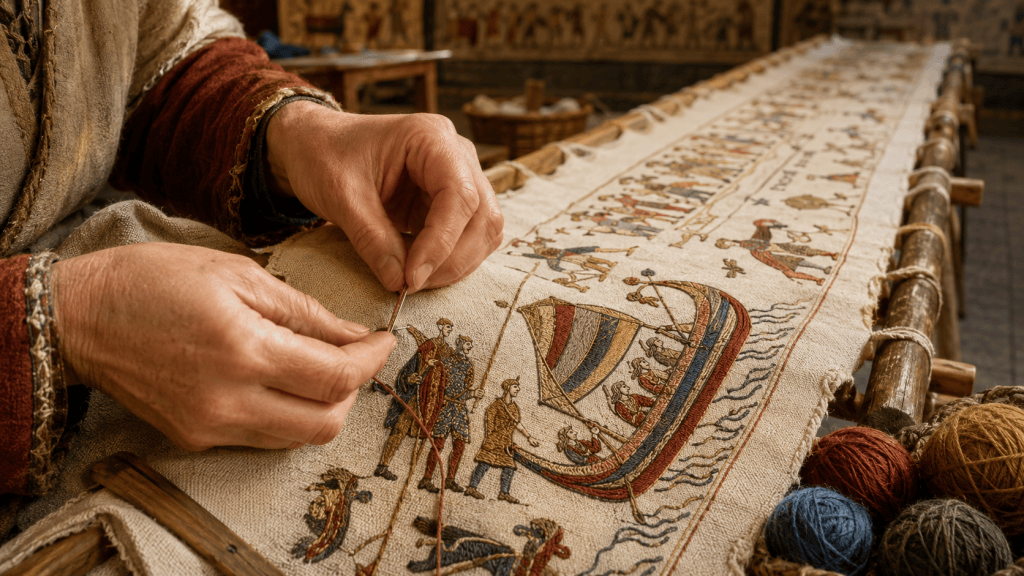
It is one of the most famous historical objects in the world: nearly 70 metres of kings, ships, horses, comets and battle. Yet the name by which everybody knows it is technically wrong.
The Bayeux Tapestry has spent almost a thousand years telling the story of 1066. It begins before the Norman invasion, follows Harold Godwinson’s journey to Normandy and William’s preparations, and ends amid the violence of the Battle of Hastings. Its pictures have become so familiar that they now stand for the Middle Ages themselves.
But it is not woven as a true tapestry. It is embroidery: coloured wool stitched onto a pre-existing linen cloth.
That distinction sounds like the sort of correction made only to win an argument in a museum café. In fact, it tells us something important about how the object was made, how it communicates and why it has survived.
Weaving a picture versus stitching one
In a true tapestry, the image is part of the fabric. Coloured weft threads are woven back and forth across structural warp threads, building the picture as the textile itself is created. There is no separate blank canvas beneath it.
The Bayeux work was made differently. Nine lengths of linen were joined together, and its people, animals, buildings, ships and Latin inscriptions were sewn onto that ground with woollen yarn. Outline or stem stitch drew lines and letters; laid-and-couched work filled larger blocks of colour.
The linen remains visible. This is one reason the scenes feel unusually clear and graphic. The makers did not cover every inch with thread. Figures stand out against a pale background, almost like a very long illustrated strip.
Medieval English did not hand us a modern technical label for the object, and “tapestry” has long had a broader everyday meaning: a decorated textile hanging. The familiar name is therefore understandable, even if “Bayeux Embroidery” would describe its construction more accurately.
A story told in scenes
The surviving work is about 70 metres long but only around half a metre high. It is conventionally divided into 58 scenes. Short Latin captions identify people or actions, while the images do most of the storytelling.
The central strip carries the main narrative. Borders above and below contain birds, beasts, fables, farming scenes and, later, the dead and stripped bodies of battle. Trees and buildings sometimes separate episodes, but the story flows continuously. An event can begin in one section and spill into the next.
This is not neutral reportage. The narrative broadly supports William’s claim to the English throne and shows Harold swearing an oath whose meaning is left unstated. Yet it is not a simple piece of triumphal propaganda either. Harold is shown acting courageously, including rescuing men from the sands near Mont-Saint-Michel. The work gives historians evidence, but it also asks them to interpret choices made by its patrons and designers.
Who made it?
The embroidery was preserved in Bayeux, Normandy, but much scholarship points to manufacture in England, probably in the 1070s. Bishop Odo of Bayeux—William the Conqueror’s half-brother and Earl of Kent—is a leading candidate for the commissioner.
The style of the needlework and lettering has often been connected with English workshops, perhaps in Canterbury. That creates a striking possibility: an English-made object telling the Norman victors’ version of England’s defeat.
We do not know the names of the people who stitched it. Medieval embroidery was highly skilled work, and the scale of the project implies planning, coordination and a practiced workshop. The anonymous makers translated horses in motion, armour, grief, comedy and terror into a limited palette of wool.
Useful evidence, with limits
The embroidery is a remarkable source for eleventh-century life. It shows shipbuilding, feasting, weapons, hairstyles, harness and armour. It contains an early picture of Halley’s Comet, seen in 1066 and treated as an omen. Its ships and equipment have informed generations of reconstructions.
But every image is designed. Scale is flexible; important figures are made prominent; several moments can be compressed into one scene. The missing end may once have shown William’s coronation. Later repairs altered portions of the needlework.
The right question is not simply “Is this accurate?” It is “Why did its makers show the event this way?”
The wrong name that became right
Calling it a tapestry may be technically loose, but the error has become part of the object’s identity. “The Bayeux Tapestry” now names one particular survivor rather than a method of manufacture.
Knowing that it is embroidery does not diminish it. It makes the achievement more vivid. This immense historical narrative was not painted, printed or mechanically reproduced. It was built one deliberate stitch at a time.
Quick facts
- The surviving embroidery is nearly 70 metres long and about half a metre high.
- It is wool embroidery on linen, not an image woven as tapestry fabric.
- Its 58 conventional scenes cover events leading to the Norman Conquest and Battle of Hastings.
- It was probably made in England in the eleventh century, despite being preserved in Bayeux.
- The final section is missing and may have included William’s coronation.



Leave a Reply