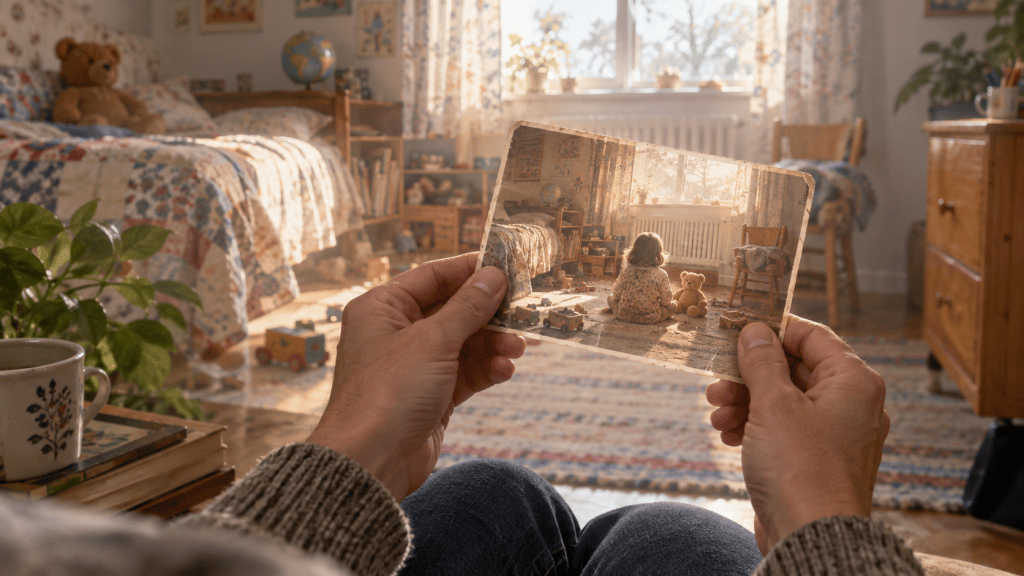
A childhood photograph seems to prove that a moment happened. There
is the cake, the beach or the first bicycle, fixed more securely than an
ordinary memory.
Look at the picture often enough, however, and a curious thing can
occur. The remembered scene begins to use the camera’s viewpoint. You
see yourself from across the room even though the original experience
was seen through your own eyes.
The photograph has not merely retrieved the memory. It has joined
it.
Memory is reconstruction
Human memory is not a film stored intact and replayed. Remembering
rebuilds an event from traces: sensory detail, knowledge, emotion and
later information. Each retrieval can strengthen some parts and leave
others vulnerable to change.
Photographs are powerful cues because they restore visual context. A
wallpaper pattern may bring back the room’s layout; a relative’s
clothing may recover a voice or habit. Such recollections can be genuine
without every detail being accurate.
The picture also narrows attention to the fraction of a second inside
its frame. Events before and after may fade, while the photographed
instant becomes the official version.
Family stories supply a
script
Albums are rarely viewed in silence. Adults identify people, explain
why everybody was laughing and repeat stories that become family
folklore. A child can later remember the story’s imagery without knowing
which parts came from direct experience, the photograph or years of
narration.
This is normal source confusion, not dishonesty. Memories usually
arrive without labels stating where each detail originated.
Digital platforms intensify repetition. A printed album might appear
occasionally; automated “memories” return the same selected images
annually, strengthening some episodes simply because they were
photographed and surfaced.
Altered images can
create false recollection
Psychological experiments have shown that doctored childhood
photographs can encourage some participants to develop partial or fuller
memories of events that did not occur. In a famous line of work, a
manipulated image appearing to show a childhood balloon ride prompted
imaginative elaboration in some viewers.
This does not mean photographs routinely manufacture complete false
lives, or that every experimental participant becomes convinced. It
shows that visual evidence combined with suggestion can influence
reconstruction.
Modern generative editing makes the lesson newly practical. A joke
image placing somebody in a fictional childhood scene may be obviously
funny today but become detached from its context later.
Photographs change
perspective
Research distinguishes field memories, experienced from the original
first-person viewpoint, from observer memories in which people see
themselves from outside. Childhood recollections are particularly likely
to take an observer form, and photographs can supply that external
angle.
An observer memory is not automatically false. Perspective is one
feature of reconstruction. It can alter emotional distance, making an
event feel more like a story about the self than a moment lived through
the self.
Keep the uncertainty with
the image
Family photographs remain valuable. They preserve faces, material
surroundings and relationships that would otherwise disappear. The
answer is not to distrust them but to avoid demanding that they function
as complete records.
Captions can record date, place and who supplied the information.
Keeping several images rather than only the posed best one preserves
more context. When children describe what they remember, open questions
are safer than supplying vivid details for them to confirm.
A photograph is both evidence and influence. It shows that light
struck a sensor or film in a particular arrangement. It cannot by itself
explain what the moment meant, and it may eventually help create the
very memory used to interpret it.
The family album does not simply store the past. Quietly, every time
it opens, it edits the way the past can be seen.
Quick facts
- Remembering reconstructs an event rather than replaying a perfect
recording. - Photographs can cue genuine details while focusing attention on one
selected instant. - Family stories may become blended with personal recollection.
- Experiments have used manipulated photos to induce false or partial
memories in some participants. - Observer-perspective memories are not necessarily false, but they
reflect reconstruction.



Leave a Reply