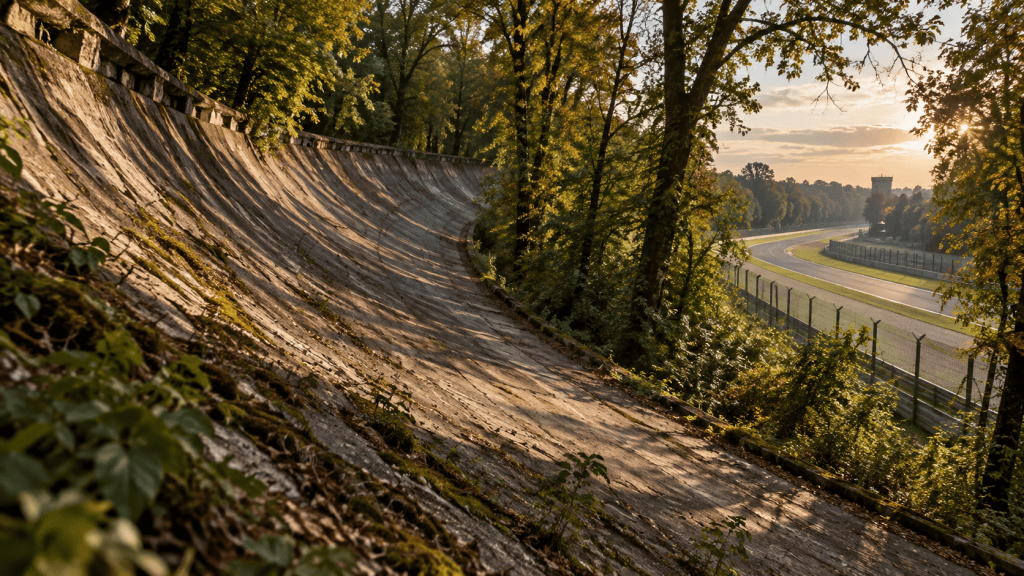
Modern Formula One cars at Monza race through woodland on a circuit
famous for speed. Between the trees stands an even faster idea from
another age: a steep concrete oval whose banking climbs like the wall of
a dam.
It is no longer part of the Grand Prix course. It has nevertheless
become one of motor racing’s most evocative ruins, because it shows how
engineers once tried to make speed manageable—and how quickly that
solution became unacceptable.
Monza was built to be fast
The Autodromo Nazionale Monza opened in 1922, commonly described as
the world’s third purpose-built motor-racing circuit after Brooklands
and Indianapolis. Its location in a royal park near Milan combined road
sections with a high-speed loop.
Banking allows a corner to support some of a vehicle’s sideways force
through the angle of the surface. On a flat bend, tyres must provide
most of the force needed to change direction. Tilt the road inward and
part of the normal force contributes.
In principle, cars can corner faster. In practice, speed, surface
quality, suspension and driver exposure determine whether the experience
is elegant or brutal.
The great oval was rebuilt
Monza’s course changed repeatedly. The dramatic surviving banking
belongs to a high-speed oval constructed in 1954. It could be combined
with the road circuit to create a roughly ten-kilometre lap, with cars
moving between ordinary bends and immense concrete curves.
Formula One used the combined layout in 1955, 1956, 1960 and 1961.
The spectacle was extraordinary, but the loads were severe. The banking
was rough, cars bottomed and suspensions suffered. Teams disputed
whether their machinery could safely endure it.
Speed had advanced beyond the assumptions embodied in the
concrete.
Safety changed
from courage to system design
Early racing culture often treated danger as a test of the driver.
Over time, deaths and serious accidents forced circuits and governing
bodies to ask different questions: not simply whether a competitor
accepted the risk, but whether organisers had designed out avoidable
hazards.
At Monza, the 1961 Italian Grand Prix brought catastrophe when
Wolfgang von Trips’s Ferrari left the track after contact, killing the
driver and 15 spectators. The accident did not occur on the banking, but
it belongs to the wider history that changed how racing treated circuit
layout, barriers and crowds.
The banked oval ceased to be a Formula One solution. Other events
used it for a time, but the road course became the circuit’s future.
Why was it not demolished?
Abandoned infrastructure often survives because removal costs money
while trees and restricted access reduce pressure for redevelopment. At
Monza, heritage gave the structure additional value. Film, photography
and circuit tours turned the banking into evidence of the venue’s long
life.
Its survival has not been uncontested. Concrete deteriorates,
vegetation intrudes and the park itself has environmental importance.
Preservation cannot mean pretending the structure is maintenance-free or
that every obsolete element should be restored for racing.
A ruin improves the modern
circuit
Monza’s active course has chicanes, barriers and run-off shaped by
later safety standards. The abandoned banking makes those changes
legible. It embodies a period when the answer to faster cars was to
build a steeper road.
That is why photographs flatten its meaning. Standing beneath the
curve, a visitor can see the optimism and the menace at once. The
structure promised that engineering could hold speed in place. Its
abandonment records the moment racing decided that possibility was not
the same as acceptability.
Monza retains the banking because a historic circuit is more than the
current lap. It is every previous answer still visible beside it.
Quick facts
- Monza opened in 1922 as an early purpose-built motor-racing
circuit. - The surviving high-speed oval was constructed in 1954.
- Formula One used the combined road-and-oval course in 1955, 1956,
1960 and 1961. - Banking helps provide the force needed for high-speed
cornering. - The concrete oval is now a historic structure rather than part of
the Grand Prix lap.



 The Knowledge Back Catalogue
Leave a comment