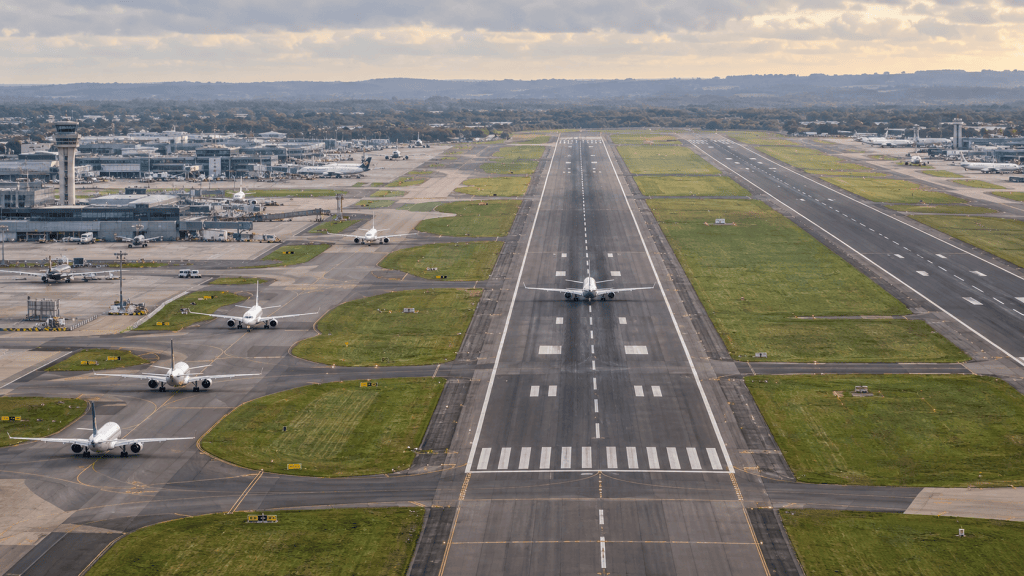
An airport runway looks enormous until an aircraft stops in the wrong
place on it.
On 4 September 2026, a departing aircraft developed a technical
problem at Gatwick. The runway closed for about 50 minutes while the
aircraft was dealt with. Arriving flights held, diverted or landed
elsewhere; departures waited; and the disturbance continued after the
tarmac reopened because aircraft and crews were no longer where the
timetable expected them to be.
The obvious question was why another runway could not simply take
over. Gatwick appears to have two.
It does—but their geometry makes the answer much less useful than it
sounds.
Two runways, one operating
system
Gatwick’s main runway is accompanied by a shorter northern runway.
The northern strip is not an independent parallel runway in the usual
sense. Its centreline is only about 198 metres from the main runway’s
centreline, far too close for the two to support normal simultaneous
take-offs and landings.
For most of its life it has therefore acted as a standby. If the main
runway closes for planned maintenance or a sufficiently long incident,
operations can transfer. That change is not instantaneous: the airport
must secure the main runway, inspect and configure the alternative,
alter lighting and procedures, and ensure that the northern runway’s
available length suits the aircraft involved.
For a closure measured in minutes rather than hours, opening the
standby may not recover more capacity than the change itself
consumes.
Gatwick made one
runway work remarkably hard
Runway capacity is not simply a count of concrete strips. It is the
number of safe movements that air-traffic controllers, ground teams and
airlines can sequence through the whole airport.
An arriving aircraft must leave the runway quickly. A departing
aircraft must enter at the right moment, line up and accelerate. Wake
turbulence behind a heavy aircraft can increase the separation required
before the next movement. Taxiways must keep the runway supplied without
creating queues across it.
Gatwick became exceptionally efficient at this choreography. Closely
spaced arrivals and departures, rapid-exit taxiways and disciplined
scheduling allow one runway to handle traffic that many cities would
associate with a two-runway airport.
Efficiency, however, is not the same as redundancy. A system designed
to keep its principal resource almost continuously occupied has little
spare capacity when that resource becomes unavailable.
A runway closure
spreads through the network
The first effect of a closure is local: no aircraft may use the
runway. The later effects are geographical.
An inbound flight has limited fuel for holding. If reopening time is
uncertain, its crew may divert to Heathrow, Stansted, Birmingham or
another nominated airport. Passengers and baggage are then in the wrong
place. The aircraft may be needed for a later Gatwick departure, while
its crew may approach legal working-time limits.
Departures left on stands can block arriving aircraft. Gates become
unavailable. Tugs, fuelling teams and caterers face a sequence different
from the plan. Even after the runway reopens, aircraft cannot all leave
at once.
This is why a 50-minute closure can produce delays for much longer.
The runway is a narrow point inside a network of tightly timed
dependencies.
Why not build a
completely new runway?
Runways consume more than their paved width. Aircraft need protected
airspace, approach paths, taxiways and separation from buildings and one
another. Noise and surface access affect communities far beyond the
airport boundary.
Gatwick’s current proposal is therefore to reposition the northern
runway’s centreline 12 metres north. Combined with other airfield
changes, this would allow routine use for departures by smaller aircraft
while the main runway continued to handle arrivals and larger
departures.
It would not turn Gatwick into a simple copy of Heathrow. The runways
would still be closely spaced and their use carefully defined. The aim
is additional capacity and resilience within the existing airfield, not
two wholly independent strips.
Resilience
always looks inefficient—until it is needed
Transport systems are frequently judged by their normal-day
performance. A spare runway, duplicate railway route or reserve vehicle
may look underused. Yet its value appears precisely when the normal
system fails.
Gatwick demonstrates both sides. Intensive use of one runway is an
engineering and operational achievement. It also creates a conspicuous
single point of failure. Moving the northern runway could reduce that
vulnerability, but only through a large project whose cost,
environmental effects and local consequences must be weighed against the
disruption it prevents.
One aircraft can stop Gatwick because the airport has spent decades
becoming brilliant at using one runway. The same concentration that
creates its efficiency creates its fragility.
Quick facts
- Gatwick has a main runway and a northern standby runway.
- Their centrelines are currently about 198 metres apart.
- The spacing prevents routine simultaneous use.
- The proposed scheme would move the northern runway’s centreline 12
metres north. - A short runway closure can create longer disruption through
diversions, displaced aircraft and crew limits.




Leave a Reply