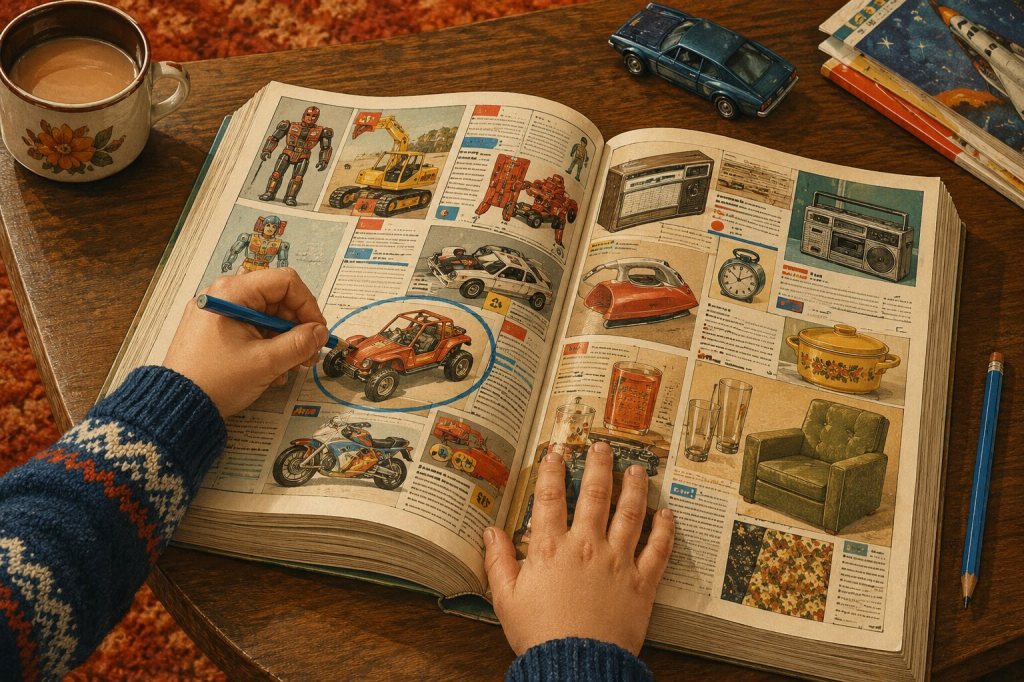
For almost fifty years, it was Britain’s toy box, wish list and shopping search engine. Then, in 2020, Argos retired its famous printed catalogue—but not the remarkably modern idea hidden inside it.
It was less a book than a piece of household equipment.
You could find it beside the telephone, under the coffee table or on the floor with half its pages folded at the corners. Children went directly to the toys. Teenagers inspected stereos, games consoles and watches. Adults compared kettles, lawnmowers, jewellery and whatever else the house had suddenly decided it needed.
Then came the shop itself: rows of catalogues, a tiny blue pencil, an order slip and a product number copied with great concentration. You checked whether the item was in stock, paid at one counter and waited for it to emerge from a mysterious warehouse behind another.
The ritual felt unmistakably old-fashioned by the time it disappeared. Look more closely, however, and the Argos catalogue was doing something remarkably modern.
It allowed people to search a database, identify a product, check its availability and ask a warehouse to retrieve it. Argos had built something very like click-and-collect decades before most Britons had anything to click.
That is why the catalogue’s disappearance is not quite the story it first appears to be. The internet did not simply destroy the Argos model. It completed it.
Before Argos, there were Green Shield Stamps
The story begins not with cash, but with stamps.
In 1958, entrepreneur Richard Tompkins introduced Green Shield Stamps to Britain after seeing a successful American trading-stamp scheme. Participating shops and petrol stations gave the stamps to customers, who stuck them into collecting books. Fill enough books and they could be exchanged for goods shown in a catalogue or displayed at a Green Shield gift centre.
It was an early loyalty scheme with an unusually physical reward. Instead of accumulating invisible points on an account, shoppers carried home sheets of stamps, licked or dampened them, filled books and converted their patience into a toaster, a set of glasses or some other domestic prize.
Tesco became one of the scheme’s most important participants. But by the 1970s, high inflation and fierce competition were changing supermarket retail. Tesco began moving away from stamps and towards lower prices. Green Shield’s catalogue shops, warehouses and distribution system needed another purpose.
Tompkins realised that the same machinery could sell goods for money. Customers were gradually allowed to use a mixture of stamps and cash, then simply cash. In July 1973, the catalogue shops were rebranded as Argos.
The stamp scheme had accidentally provided almost everything the new retailer required: catalogues, products, stockrooms, delivery vehicles, collection counters and customers who already understood how to order without walking around shelves.
Argos did not begin by inventing an entirely new shop. It removed the stamps from an existing one.
A shop with most of the shop hidden
An Argos showroom was a strange place if you judged it by the rules of ordinary retail.
Most shops attempted to put their goods in front of customers. Argos put most of its goods behind a wall. The public area could be relatively small because it did not need to display a full-sized example of every television, paddling pool, vacuum cleaner and wardrobe it sold.
The catalogue was the showroom.
Each item had a photograph, a compact description, a price and a number. That number connected the customer’s choice to a box in the stockroom. The system reduced the need for elaborate displays and allowed an extraordinary variety of goods to coexist in one book. Jewellery could sit a few pages away from power tools; toys could give way to telephones, cameras and garden furniture.
There were frustrations. The item you wanted could be out of stock. A handwritten number could be copied incorrectly. The product that looked magnificent in its photograph might seem rather less magnificent when a member of staff carried it to the collection counter.
But the method worked because it turned shopping into a simple sequence: browse, choose, check, pay and collect.
The book of dreams
Argos published its main catalogue twice a year. For children in particular, a new edition was not merely a reference work. It was an event.
The toy section could occupy hours. Desired objects were circled, ranked and reconsidered. Christmas and birthday lists acquired catalogue numbers. Prices introduced a stern element of arithmetic. Two modest toys might be possible; the enormous Scalextric set probably was not.
Comedian Bill Bailey later gave the catalogue its most affectionate unofficial name: the “laminated book of dreams”. The joke survived because it recognised what the book actually did. It placed thousands of possible lives between two covers. Here was the television for the future living room, the exercise machine for the future self and the toy that might make the coming Christmas perfect.
The scale was extraordinary. Argos said that more than one billion copies were printed after the catalogue launched in 1973. There were 93 main editions across its 47-year life, and the publication was once estimated to reach three-quarters of British homes.
Its importance now extends beyond the products it sold. Old editions have become accidental works of social history.
Turn their pages and fashions change at speed. Record players give way to cassette decks, CD systems, MP3 players and smart speakers. Telephones lose their dials, gain buttons, cut their cords and become mobile. Computer games move from simple electronic toys to machines powerful enough to dominate the living room. Brown and orange kitchens become white, then stainless steel, then something else entirely.
Prices are revealing too, although not always in obvious ways. A cheap-looking television from the 1970s could represent a formidable share of a weekly wage. A calculator that once seemed futuristic becomes a stocking filler. Products move from luxury to normality and sometimes disappear altogether.
The catalogue recorded British desire at six-month intervals. It was trying to sell the future, but it ended up preserving the past.
Why did Argos stop printing it?
By the 2010s, the catalogue’s great strengths had become digital strengths.
A printed book could contain thousands of products, but it could not search them instantly. It could provide a product number, but not live availability in the nearest shop. It could print a price, but not change it without waiting for the next edition. It could show a carefully staged photograph, but not offer dozens of customer reviews or a demonstration video.
The Argos website and app could do all of those things. In-store tablets began replacing the catalogue racks and stock-checking machines. Shoppers could order at home, reserve an item and collect it later without touching a pencil or filling in a slip.
The numbers show how decisively habits changed. When Argos announced the catalogue’s retirement in July 2020, it said its website was receiving more than one billion visits a year and that smartphones and tablets accounted for over 70 per cent of its online sales. The print run for each main edition had fallen from roughly ten million copies to about three million during the previous decade. The final edition, published in January 2020, had a run of 3.9 million.
The coronavirus pandemic made 2020 an especially brutal year for printed retail and the high street, but Argos said the decision was not caused by the pandemic. It was the conclusion of a much longer shift.
After 93 editions, the general printed catalogue was finished. Argos continued with a smaller Christmas gift guide, but the twice-yearly household institution had reached its final page.
The catalogue became the website
It is tempting to describe this as another case of the internet killing a beloved object. That is true as far as the paper is concerned, but it misses something more interesting.
The Argos system already treated goods as information before it treated them as physical objects.
Customers did not begin by handling a toaster. They began with its image, specification, price and identifying number. Only after making a choice did the warehouse produce the object itself. Online retail follows the same sequence, except that the paper page becomes a screen and the order slip becomes a button.
Argos was therefore unusually well prepared for click-and-collect because collection was what it had always done. The website did not need to recreate a conventional department store online. It only had to replace the catalogue, pencil and stock checker with a more efficient interface.
Even the old collection-counter suspense survives. A customer still chooses an item without touching it, submits an order and waits for somebody out of sight to find the correct box. The machinery is faster and the warehouse may be inside a supermarket, but the choreography would be familiar to a shopper from 1985.
The catalogue vanished because it had designed a job that software could perform better.
What the screen could not replace
Digital shopping is quicker, more accurate and much easier to update. It is not, however, the same kind of browsing.
Search boxes are excellent when you know what you want. A large catalogue was excellent when you did not. Opening it at random could place a telescope, a chemistry set or an elaborate food mixer in front of someone who had never thought to search for one.
The physical layout created its own memory. People remember where the toys began, the coloured tabs, the jewellery near the front and the dense pages of small photographs. Families shared one copy and left evidence of their interests in it: folded corners, pen marks, torn pages and circles around unaffordable ambitions.
A website can recommend products with great precision, but its recommendations are personal and temporary. The catalogue showed the same strange universe to everybody. That made it a common cultural object as well as a sales tool.
This helps explain the wave of nostalgia that followed its retirement. People were not mourning the effort of carrying an enormous book home. They were mourning a way of imagining purchases together—and a time when browsing left a physical trace.
The final item number
The Argos catalogue lasted from 1973 to 2020 because it solved a real problem brilliantly. It allowed a relatively compact shop to offer the range of a much larger one, and it gave customers an orderly route through an otherwise unmanageable warehouse of things.
The internet made that route quicker. Live stock information replaced the checker. Online baskets replaced paper slips. Search replaced the index. The collection counter remained.
So what happened to the Argos catalogue?
The book disappeared, but its logic escaped into almost every part of modern shopping. Browse remotely. Choose by description. Check the stock. Place the order. Collect the box.
And the printed copies left behind have acquired a second life. A publication designed to become obsolete every six months is now an archive of how Britain furnished its homes, entertained its children and pictured the good life.
For a book that was always trying to sell us the next thing, it has become remarkably good at showing us what came before.
Quick facts
- Argos catalogue launched: 1973
- Main editions published: 93
- Estimated lifetime circulation: More than one billion copies
- Final main edition: January 2020
- Retirement announced: July 2020
Sources and further reading
- Argos to stop printing catalogue after almost 50 years, The Guardian, 30 July 2020.
- Argos axes print catalogue after 47 years, The Independent, 30 July 2020.
- The Argos story: from Green Shield Stamps via Tesco, The Guardian, 5 January 2016.
- Argos catalogue archive, Retromash.
- First Argos catalogue, 1973–74, Internet Archive.
Additional reference: Contemporary Argos catalogues and advertising; reporting and company figures released when the general printed catalogue was retired in 2020.




Leave a comment