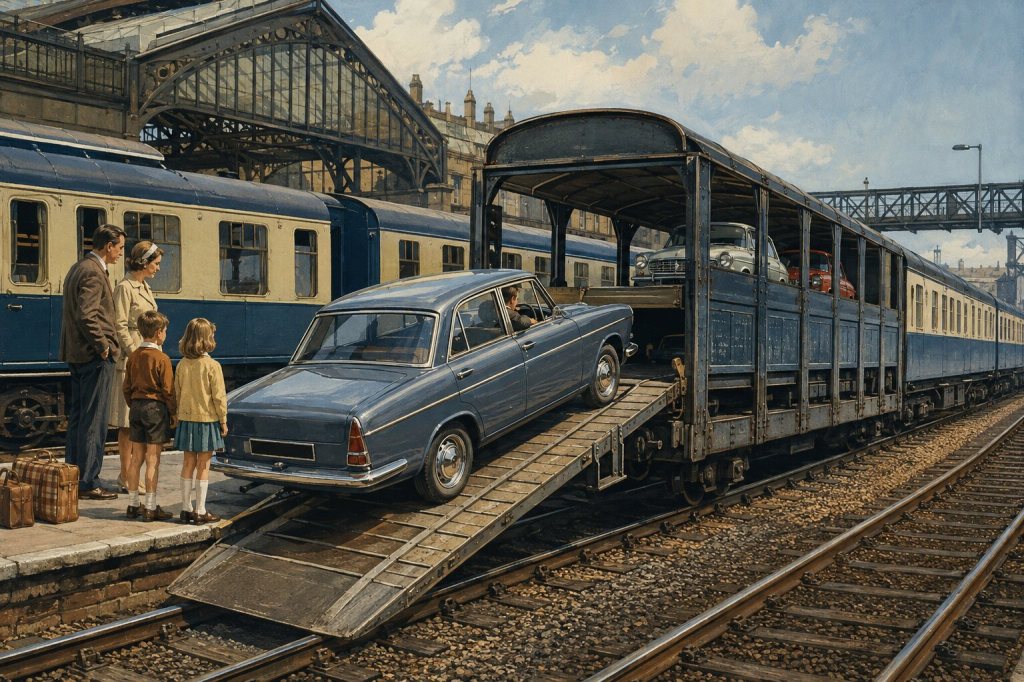
Before the motorway network transformed long-distance driving, British Rail offered an appealing alternative: put the car on the train, settle into a seat or sleeping compartment, and collect it hundreds of miles away.
Imagine beginning a motoring holiday without doing most of the motoring.
You drive to a railway terminal, where the family car is loaded and secured, then climb aboard the same train. While the railway carries you through the night, your car travels in a special wagon elsewhere in the formation. By morning, both of you have arrived in Scotland or Cornwall. You collect the car and begin the part of the journey for which you actually wanted it.
This was not an experiment, nor an occasional luxury for transporting valuable vehicles. It was a scheduled British Rail service with its own terminals, rolling stock, timetables and advertising campaigns.
It was called Motorail—and its history begins before Britain had a single mile of motorway.
The car train that arrived before the motorway
British railways had transported road vehicles in various ways since the nineteenth century, but the first recognisable long-distance car-carrying service of the modern era appeared in June 1955.
British Railways called it the Car-Sleeper Limited. It ran between London and Perth, carrying motorists north while their cars travelled with them. The seasonal service combined two things that would normally have competed with one another: railway comfort for the long journey and a private car for the holiday at the other end.
The timing is important. Britain’s first motorway, the eight-mile Preston Bypass that later became part of the M6, did not open until December 1958. The first section of the M1 followed in 1959.
In 1955, a drive from southern England to Scotland meant a long succession of ordinary roads, towns, junctions and bottlenecks. Cars were becoming more widely available, but the road system had not yet been rebuilt around them. A family could arrive at the beginning of its holiday already exhausted by the journey.
Motorail offered a neat solution: take the car where it was useful and let the railway handle the distance where it was not.
A railway service built around the motorist
More car-carrying trains followed. At various points, services connected London and other English cities with destinations including Penzance, Plymouth, Fishguard Harbour, Carlisle, Edinburgh, Perth, Inverness and Fort William. Some trains ran during the day; others included sleeping cars. There were even services designed to connect motorists with ferries for travel farther afield.
The Motorail name arrived in 1966, together with a purpose-built terminal at Kensington Olympia in west London. Cars could be loaded using ramps onto dedicated vehicles, which ranged from open car-carrying wagons to enclosed vans. The passengers travelled separately in conventional seating or sleeping accommodation coupled into the train.
British Rail understood that the service was not really selling rail travel. It was selling the absence of a drive.
Its advertising showed relaxed families, mountain scenery and cars ready for use at the destination. One later slogan invited travellers to “leave the long distance driving to us”. Another declared that it was “miles better by Motorail”.
That was the cleverness of the idea. Motorail did not demand that people abandon the freedom of their cars. It promised to make that freedom less tiring.
Why Motorail made sense
For a particular period in British history, the service occupied a useful gap between rail and road.
A conventional train could take passengers quickly between major stations, but it could not carry their luggage, children and holiday plans onwards to a remote cottage, campsite or Highland hotel. Driving offered that flexibility, but at the cost of spending an entire day behind the wheel.
Motorail combined the strongest part of each mode. The train covered the long, repetitive trunk journey. The car handled the local roads at the destination.
Car ownership was also growing at extraordinary speed. Britain had roughly four million licensed vehicles in 1950. By the early 1970s the motorway network had expanded dramatically, but so had the number of motorists wanting to travel. British Rail was reported to be carrying around 70,000 cars a year by 1972, and peak annual passenger use has been estimated at about 100,000.
Those figures never made Motorail a mass form of transport. They did make it a substantial national service rather than the eccentric curiosity it can appear today.
The contradiction at the heart of Motorail
The growing popularity of the car created Motorail. It also helped destroy it.
The service was most attractive when people owned cars but long-distance driving remained slow, tiring and uncertain. As Britain filled the missing links in its motorway network, the balance changed.
The Preston Bypass had been the country’s only motorway when it opened in 1958. By 1969, Britain had completed its first thousand motorway miles. Journeys that had once required an exhausting sequence of A-roads could increasingly be made on fast, purpose-built routes.
Cars changed too. They became faster, more reliable and more comfortable. Heating improved. Radios became normal. Better seats, tyres and road manners made a long journey less punishing, while service stations turned the motorway drive into something families could break into manageable stages.
Motorail now asked the motorist to drive to a specialist rail terminal, arrive early enough for loading, fit a holiday around a limited timetable and wait for the car to be unloaded at the other end. Driving all the way was still tiring—but it was simpler.
The more convenient motoring became, the harder it was for a service built to avoid motoring to justify itself.
An expensive train for relatively few cars
Motorail also had an awkward business model.
A normal passenger coach can carry dozens of fare-paying people. A vehicle transporter consumes a considerable length of train while carrying comparatively few cars. The railway needed special loading facilities, suitably equipped terminals, trained staff and rolling stock that had little alternative passenger use. Much of the demand was seasonal and concentrated around holiday periods.
As passenger numbers declined during the 1980s and early 1990s, those costs became harder to defend.
The final decision became entangled with the privatisation of British Rail. In January 1995, the government confirmed that the franchising director would not require future operators to provide Motorail. A private franchise could choose to run it commercially, but it would not form part of the guaranteed passenger-service specification.
The official argument was blunt: Motorail was extremely expensive, used specialised equipment and carried relatively few vehicles. Parliament was told that its total annual capacity was approximately 17,500 cars.
Supporters replied that this ignored its wider value to tourism, remote Scottish communities and motorists unable or unwilling to make a very long drive. There were also disputes over the true cost of particular sleeper and Motorail services. But once the operation was excluded from the services that future franchises had to maintain, its chances of survival were poor.
British Rail withdrew the remaining Motorail trains on commercial grounds from 28 May 1995.
Forty years after the first Car-Sleeper Limited, the national network was gone.
The comeback that lasted six years
That should have been the end of the story—but Motorail returned.
In 1999, First Great Western added a car-carrying facility to the Night Riviera sleeper between London Paddington and Penzance. Eight former general utility vans were converted to carry vehicles, giving holidaymakers the old Motorail promise once again: sleep through the long journey and wake up in Cornwall with your own car waiting.
The revival showed that the basic idea still had appeal on the right route. London to far-west Cornwall was long enough for an overnight train to save a meaningful drive, and a car remained particularly useful after arrival.
But the market was not large enough. The car-carrying portion was withdrawn after the 2005 summer season because of low use, although the Night Riviera itself survived.
That was the second—and so far final—ending of domestic British Motorail.
Did Britain really stop putting cars on trains?
Not completely.
LeShuttle still carries cars, vans, motorhomes and other vehicles between Folkestone and Calais through the Channel Tunnel. In that sense, Britain operates an enormously successful car train every day.
But LeShuttle solves a different problem. It replaces a sea crossing rather than a long domestic drive. Its trains shuttle between two dedicated terminals, the journey takes about 35 minutes, and passengers usually remain with their vehicles. Geography gives it a clear advantage: there is no road through the Channel Tunnel with which it must compete.
Traditional Motorail had to persuade people not to use roads that already existed. That is a much harder proposition.
Could Motorail return again?
The environmental argument is easier to make now than it was in 1995. Moving a group of cars and their occupants together by rail could reduce long-distance road mileage, congestion and driver fatigue. Sleeper trains have also regained some of their appeal as travellers look for alternatives to short-haul flights.
The practical obstacles, however, have not changed very much. A new service would need expensive vehicle-carrying stock, loading terminals at both ends, enough railway capacity and a route with large numbers of people making the same long journey at similar times. Its price would have to compete with driving all the way—or taking an ordinary train or flight and hiring a car after arrival.
Scotland and Cornwall still look like the obvious possibilities because distance works in Motorail’s favour. Yet the same seasonal demand that makes those routes attractive also makes specialist trains difficult to keep busy throughout the year.
Motorail was not a foolish idea overtaken by common sense. It was a clever answer to a temporary mismatch: Britain had embraced the private car before it had built the roads that made long-distance motoring easy.
Once the motorways caught up, the train carrying the car lost the problem it had been created to solve.
Quick facts
- First modern service: Car-Sleeper Limited, June 1955
- First route: London–Perth
- Motorail brand introduced: 1966
- British Rail service ended: 28 May 1995
- Cornish revival: Paddington–Penzance, 1999–2005
Sources and further reading
- James Bond 007 lets the train take the strain, National Railway Museum.
- History of roads and National Highways, National Highways.
- Motorail Service: Future, 31 January 1995, Historic Hansard.
- Motorail and Sleeper Service to West Highlands, 27 March 1995, Historic Hansard.
- Written answers on Motorail withdrawal, 23 March 1995, UK Parliament.
- “It’s miles better by Motorail”, 1973 poster, Science Museum Group Collection.
- InterCity Motorail bargain offer, 1991, Science Museum Group Collection.
- St Austell Motorail history, Great Scenic Railways.
- How LeShuttle carries cars today, LeShuttle.
Additional print references: Paul Atterbury, The Railway Experience; contemporary British Rail Motorail timetables and publicity; reports of First Great Western’s 1999 launch and 2005 withdrawal in the railway press.


Leave a Reply