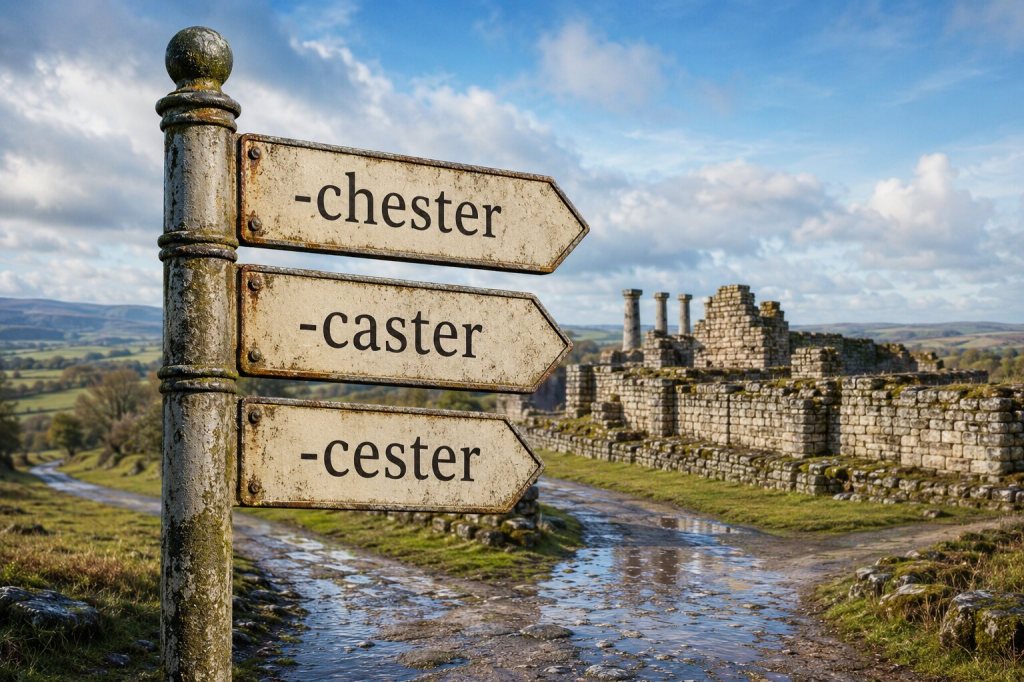
Manchester, Doncaster and Leicester appear to have three different endings. In fact, all three began as the same Latin word—and together they preserve nearly two thousand years of invasion, settlement and changing speech.
Take a map of England and start circling names.
There is Manchester and Winchester, Lancaster and Doncaster, Leicester and Worcester. Add Colchester, Gloucester, Towcester, Cirencester, Bicester, Tadcaster, Ribchester and dozens more, and a pattern begins to emerge.
The endings look similar enough to be related, but not similar enough to make the relationship simple. Some have -chester, some -caster and some -cester. The last group then causes a second problem by refusing to sound as it looks. Leicester is “Lester”, Worcester is “Wuster” and Gloucester is “Gloster”, while Cirencester usually pronounces every part of its ending.
This can seem like another collection of traps laid for visitors by the English language.
It is actually a map of history.
All three endings descend from a word associated with a fortified place. The Romans brought it to Britain. The Anglo-Saxons borrowed it. Scandinavian settlement helped shape some of its regional forms, medieval speech compressed others, and spelling preserved stages that pronunciation left behind.
Read the names carefully and an old Roman fort can still be hiding in plain sight.
Three endings, one ancient word
The story begins with the Latin castrum, meaning a fort or fortified camp. Its plural was castra, a form often used for a military encampment.
After the end of Roman rule in Britain, this became Old English ceaster—also written in slightly different forms in different dialects. It referred to a city, walled town or fortified place, particularly one associated with a former Roman station.
Over many centuries, ceaster developed into the familiar endings -chester, -caster and -cester. Other names wore it down even further, producing forms such as -xeter in Exeter and Wroxeter.
The family resemblance is therefore real. Winchester, Lancaster, Leicester and Wroxeter all contain descendants of the same borrowed word.
The surprise is who put it there.
The Romans did not call them that
It is easy to assume that names ending in -chester are surviving Roman place names. Usually, they are not.
The Roman fortress at modern Chester was known as Deva Victrix. Roman Manchester was Mamucium or Mancunium. Leicester was Ratae Corieltauvorum. Winchester was Venta Belgarum, while the large Roman town at modern Wroxeter was Viroconium Cornoviorum.
The familiar names mostly emerged later.
This matters because -chester does not generally preserve what Roman administrators called a settlement. It records what later people understood the place to be.
When Anglo-Saxon speakers encountered old walls, earthworks, roads and occupied towns in the former Roman landscape, they used ceaster to describe them. Sometimes an older British or Roman element survived beside it. Sometimes a river, local people or geographical feature supplied the first part of the new name.
The result was not a Roman label carried unchanged into modern English. It was a post-Roman name attached to a conspicuously Roman place.
In other words, the buildings outlived the bureaucracy, and the new name remembered the buildings.
What the Anglo-Saxons could still see
Roman rule in Britain ended in the early fifth century, but Roman Britain did not simply vanish.
Stone walls, defensive banks, roads, bridges and the outlines of towns remained in the landscape. Some settlements continued to be occupied. Others became ruins, quarries or useful enclosures. Even where the original Latin name had been forgotten, a fortified site could remain the most obvious landmark for miles.
The word ceaster became a practical way of identifying such places.
Winchester developed from an Old English form such as Wintanceaster. The first part retained a memory of Roman Venta; the second identified it as the old fortified town. At Chester, Anglo-Saxon forms included Legacæstir, usually interpreted as the “city of the legions”. Over time, the identifying first element became unnecessary and the generic description did the whole job: Chester was simply the chester.
This is why the ending is such a useful archaeological hint. Long before a modern excavation reveals a mosaic, bathhouse or fort ditch, the name may already be suggesting that earlier inhabitants recognised an ancient enclosed place.
But a hint is not a guarantee.
As the word broadened, it could be used for a walled town or even a prehistoric fort rather than a specifically Roman military camp. A chester name is evidence worth investigating, not a certificate proving that legionaries slept there.
Why did ‘chester’ become ‘caster’?
To understand the split, the important letter is c.
Latin castra began with a hard k sound. In parts of Old English, that sound changed before certain vowels into the sound now written ch. The old borrowed word could therefore develop from something closer to caster into ceaster and eventually chester.
Elsewhere, the hard sound remained. This is why -caster is particularly associated with northern and eastern England: Lancaster, Doncaster, Tadcaster and Brancaster are all examples.
The traditional explanation gives Scandinavian settlement an important role. Old Norse did not use the English ch sound in the same way, and large parts of northern and eastern England lay within the area of Scandinavian influence known as the Danelaw. A hard k form fitted that linguistic landscape.
Modern specialists add a useful caution. The exact distribution may reflect a mixture of Scandinavian influence and differences that already existed among Old English dialects. Language rarely changes at one clean border, and people do not replace every place name on the day a new ruler arrives.
Even so, the broad geographical pattern is striking. -Chester is the softened relative; -caster preserves the harder consonant. They are not rival words but regional outcomes of the same one.
Why is Leicester not pronounced ‘Lie-ses-ter’?
The -cester group preserves another part of the story: speech becomes more efficient while spelling can remain stubbornly historical.
Place names are used constantly. Frequent words are especially likely to be shortened, blurred and compressed in ordinary conversation. Over generations, unstressed syllables disappear.
That process helps explain why:
- Leicester became “Lester”
- Worcester became “Wuster”
- Gloucester became “Gloster”
- Bicester became “Bister”
- Towcester became “Toaster”
The spelling retains -cester, but the middle of the spoken name has collapsed. Linguists call the loss of a sound or syllable from the middle of a word syncope. Most people simply call it how the town is pronounced.
Cirencester is the celebrated awkward relative. Its common modern pronunciation—“Siren-ses-ter”—keeps the ending much more fully. Older shortened pronunciations have existed, including versions resembling “Sissiter”, but the spelling pronunciation became dominant.
So Cirencester is not proof that Leicester ought to be pronounced differently. It is evidence that place names can travel along different routes even when they share the same historical component.
Exeter and Wroxeter travelled further still. Their earlier ceaster element was reduced and reshaped until the original connection became difficult to see. The Roman clue survived, but in disguise.
The first half of the name tells another story
The ending identifies a fort or old town. The beginning often reveals who noticed it, where it stood or what the surrounding landscape was called.
Manchester probably combines ceaster with a much older British element related to a breast-shaped hill. Lancaster is the fort on the River Lune, whose name is also of British origin. The two names therefore combine elements from different languages and different eras.
That makes them small linguistic excavations. A pre-English river or landscape name sits beside a Latin word, filtered through Old English and—in Lancaster’s case—possibly reinforced by Scandinavian speech.
Doncaster is the fortified place on the River Don. Winchester preserves part of Roman Venta. Chester once referred to the legions. In each case, the name is not a single historical object. It is a stack of them.
This is common across Britain. Rivers often keep exceptionally old names because later settlers learn what local people already call the water. Town names then attach newer words to those ancient rivers. Political control changes, but the Thames, Avon, Ouse, Don and Lune continue flowing through the vocabulary.
A place name can therefore contain the history of several populations that did not arrive together and may not have spoken to one another in the same language.
What about Welsh ‘caer’?
Cross into Wales and a similar idea appears at the other end of the name.
The Welsh caer means a fort or fortified place. It appears in Caernarfon, Caerphilly, Caerleon and the Welsh name for Cardiff, Caerdydd. Caerdydd is the fort on the River Taff; Caerleon is the fort of the legion.
Unlike English ceaster, caer is a Brittonic and Welsh word rather than the same Latin borrowing. It is a parallel way of reading a landscape full of defended places.
The comparison is particularly neat at Chester. Its modern Welsh name is simply Caer: “the fort”. Both the English and Welsh names reduce the city to the feature that mattered most—its fortifications—but they reach that meaning through different linguistic histories.
The map of Britain is full of these overlaps. English, Welsh, Latin, Norse and older British elements sit beside one another because languages did not erase the landscape completely when they arrived. They inherited it, misunderstood parts of it, translated some of it and added their own descriptions.
A Roman map written after Rome
The most interesting thing about -chester, -caster and -cester is not simply that they mean “fort”. It is that one ancient word survived several different Britains.
Rome supplied castra. Old English turned it into ceaster. Regional speech divided the hard k of -caster from the softened ch of -chester. Scandinavian influence probably helped shape the northern pattern. Medieval pronunciation compressed -cester into -ster, while conservative spelling kept letters that daily speech no longer needed.
The towns themselves continued changing around the names.
That is why an ordinary road sign can function like a small historical document. It may point to a Roman site, but it also records the people who lived among Roman remains centuries later—and the many generations who altered the word every time they said it.
The Romans did not leave England a neat map labelled Manchester, Doncaster and Leicester.
They left forts, walls and towns. Everyone who came afterwards supplied the pronunciation.
Quick facts
- Latin root: castrum; plural castra
- Old English form: ceaster
- Basic meaning: Fort, walled town or fortified place
- Hard-sound form: -caster
- Common contracted form: -cester pronounced -ster
- Welsh parallel: caer, meaning fort
Sources and further reading
- The Origins of English Place Names, English Heritage.
- Linguistics in place names, Keith Johnson, The History of Early English student resources, Routledge.
- A Key to English Place-Names, Institute for Name-Studies, University of Nottingham.
- Palatalization and assibilation of /k/ in English and Scottish place-names, Stephen Laker, NOWELE, 2021.
- Roman Chester, A History of the County of Chester, British History Online.
- Welsh language history: place names, Dr Dylan Foster Evans, Cardiff University and Wales.com.
- English Place-Name Elements, Part I, A. H. Smith, English Place-Name Society, 1956.
Additional print reference: Victor Watts, ed., The Cambridge Dictionary of English Place-Names, Cambridge University Press, 2004.




Leave a Reply