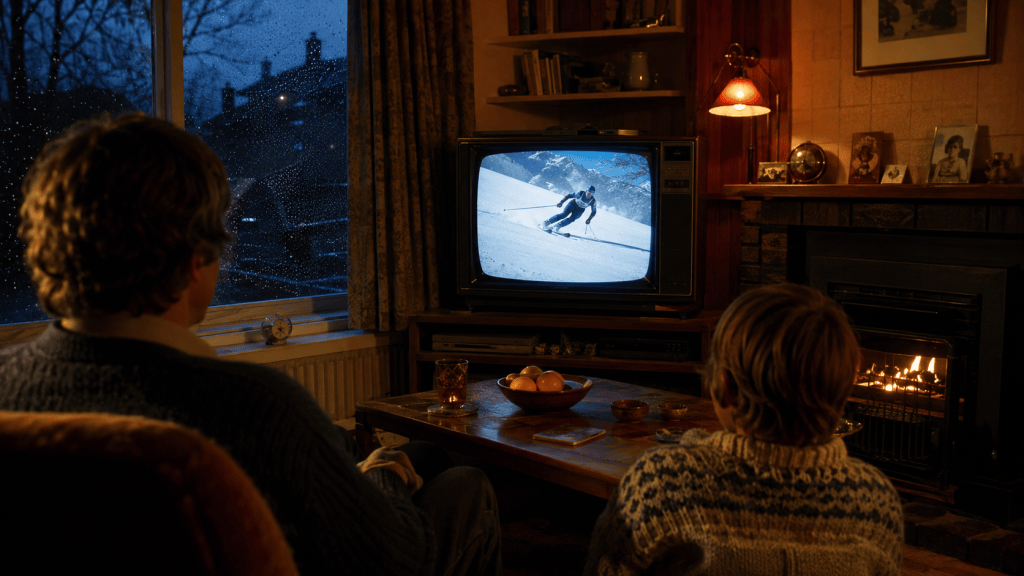
For nearly half a century, a familiar violin theme turned distant
mountains into part of the British weekend.
The music did half the work. A restless string figure climbed, the
title appeared, and a British sitting room was suddenly somewhere above
the snow line.
Ski Sunday began on BBC Two in January 1978 and ended in
2026 after 48 years. Britain has mountains, winter weather and a long
enthusiasm for snow holidays, but it is not an Alpine nation. The
programme’s achievement was to make downhill racing feel less like an
imported curiosity and more like a recurring part of the domestic
calendar.
It did so during a particular age of television, when a small number
of channels could teach millions of people how to watch an unfamiliar
sport at the same time.
A programme built for Sunday
The original Ski Sunday concentrated on Alpine World Cup
racing: downhill, slalom and giant slalom from European resorts. David
Vine presented for roughly two decades, bringing clarity and calm to
events that many viewers had never seen in person.
The scheduling mattered. Early Sunday evening was a shared pause
before the working week. Winter sports arrived as a seasonal
appointment, often within the broader world of Sunday
Grandstand.
Television did not need every viewer to understand gate combinations
or ski preparation before tuning in. Speed supplied the first
explanation. A racer descended an icy course at extraordinary pace; the
clock decided whether the run had been brilliant.
Commentary gradually supplied the rest: why a line was fast, where
time had been lost, how snow and visibility changed the contest.
The daredevil at Kitzbühel
The programme inherited compelling characters from the sport itself.
Austrian downhill racer Franz Klammer, winner of the 1976 Olympic
downhill, became a defining figure for British viewers. Later
generations encountered Pirmin Zurbriggen, Alberto Tomba, Hermann Maier,
Lindsey Vonn and many more.
Alpine racing works well on television because individual athletes
confront the same course one after another. The drama can be understood
through comparison. A tiny mistake at the top may become several tenths
of a second at the finish.
The camera also revealed something spectators beside the piste could
not see: the whole mountain assembled into one continuous descent
through multiple viewpoints and replays.
A theme tune that
was not written for skiing
“Pop Looks Bach”, composed by Sam Fonteyn, was recorded for the
Boosey & Hawkes music library in 1970. It was not commissioned for
Ski Sunday.
Library music is written and recorded so that producers can license
it for programmes, adverts and films. A piece may wait on a shelf until
an editor discovers that it fits. In this case, the urgent strings,
brass and organ became almost inseparable from downhill skiing in the
British imagination.
This is one of television’s alchemical effects. Music composed
without a mountain acquires snow; viewers who hear it decades later can
picture a skier leaving the gate.
The theme also created continuity while presenters, graphics and
formats changed. Its return could reassure viewers that the programme
still belonged to the same tradition.
Teaching by repetition
Minority sports often face a broadcasting problem. To attract viewers
they need coverage; to obtain coverage they are expected to have
viewers.
A regular terrestrial programme breaks that circle. Repetition
produces knowledge. A person who initially understands only “fastest
wins” begins to recognise the difference between downhill and slalom,
the importance of start order or the significance of changing snow.
The same effect helped snooker, darts, athletics and other sports
build broad audiences in the era of limited channels. Viewers did not
always choose them from an infinite menu. They encountered them because
they were on.
That lack of choice could be frustrating, but it also created
accidental expertise and shared reference points.
From race coverage to
winter magazine
As broadcasting rights, audience habits and the internet changed,
Ski Sunday evolved. It became more of a magazine programme,
covering snowboarding, freestyle events, adventure and the experiences
surrounding winter sport. Graham Bell, Ed Leigh and Olympic skier Chemmy
Alcott were among the later presenting figures.
The broader format reflected a changed audience. Race results and
clips could be found instantly online. A television programme had to add
access, explanation and storytelling.
At the same time, Britain became more successful across a wider range
of winter disciplines. Dry slopes, indoor snow centres and lottery
funding created routes into sports that once appeared geographically
implausible.
What ended was larger
than one programme
The BBC attributed the 2026 decision to financial pressure and
changing audience behaviour. Those forces are real. Sports rights are
costly, viewers watch at different times and specialist fans can find
direct coverage from international services.
But an on-demand world changes discovery. Algorithms are good at
supplying more of what a person already watches. A fixed schedule could
place something unfamiliar in front of everyone.
The loss is therefore not only a weekly highlights programme. It is
part of the disappearance of common gateways through which a niche
subject could become national knowledge.
The mountain in the living
room
Most Ski Sunday viewers never raced a World Cup course. Many
never stood on skis. That was not a failure of the programme; it was the
point of broadcasting.
Television compressed distance. A race in Wengen or Kitzbühel became
part of a wet British weekend. The camera taught the eye, the
commentator supplied a vocabulary and the theme tune announced that
winter had arrived.
For 48 years, Britain did not need Alpine geography to possess an
Alpine season. It only needed the first few bars.
Quick facts
- Ski Sunday first aired on BBC Two in January 1978.
- David Vine presented the programme for around twenty years.
- Its theme, “Pop Looks Bach”, was composed by Sam Fonteyn and
recorded as library music in 1970. - The programme expanded from Alpine racing into a wider winter-sports
magazine. - The BBC announced its cancellation in September 2026 after 48
years.



Leave a Reply