It did not invent two people fighting on a screen. It invented
the grammar that let players understand, practise and argue about the
fight.
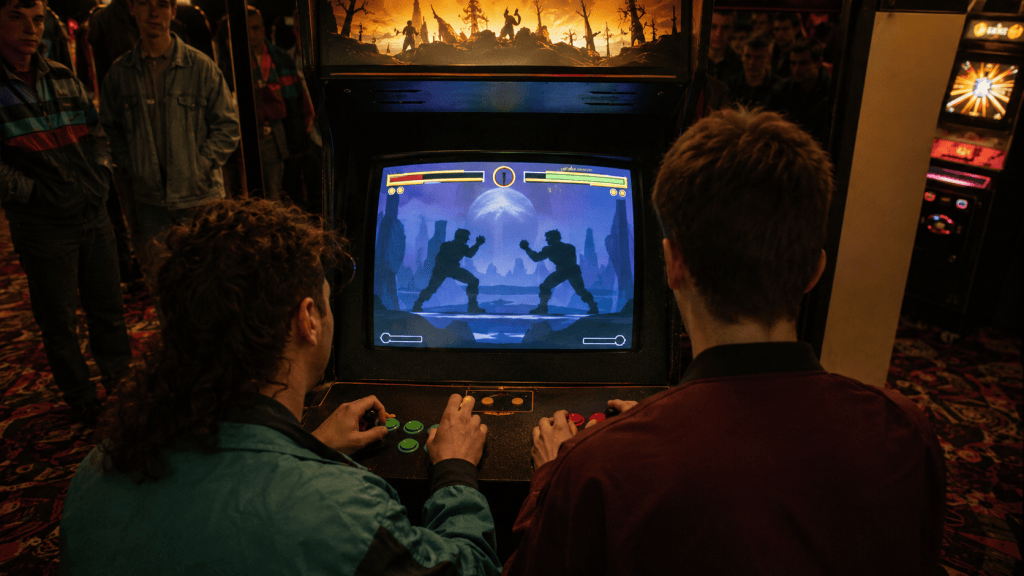
Two characters face one another. Health bars stretch across the top
of the screen. A clock counts down. One player crouches at the edge of
striking range, waiting for the other to make a mistake.
Anyone who has played a modern fighting game can read this scene.
Much of its language became familiar through Street Fighter II,
released by Capcom in arcades in 1991.
The first Street Fighter had appeared in 1987, and
one-on-one combat games existed before it. The sequel’s achievement was
to bring controls, characters, competition and spectacle together so
convincingly that an entire genre organised itself around the
result.
Eight ways to enter the same
fight
At the beginning, players could choose from eight world warriors.
Each had a recognisable silhouette, homeland, stage, moves and
rhythm.
Ryu and Ken offered a relatively direct introduction. Zangief was
slow but terrifying at close range. Dhalsim controlled distance with
stretching limbs. Guile encouraged patience. Chun-Li was fast and became
one of gaming’s most significant female protagonists.
The selection did more than add variety. It created match-ups. A good
tactic against one character might fail against another. Players could
develop an identity around a favourite while learning how the rest of
the cast worked.
Character selection became a promise: the same rules would support
meaningfully different styles.
Six buttons and a joystick
The control panel used three punch buttons and three kick buttons,
each arranged from light to heavy. Together with eight joystick
directions, they gave the player a broad vocabulary without requiring a
separate button for every action.
Light attacks were generally quick and safer; heavy attacks were
slower and more damaging. Holding away from an opponent blocked many
attacks. Special moves required directional sequences and a button: the
quarter-circle motion of Ryu’s fireball became something arcade players
taught one another by demonstration.
This physical design mattered. The game rewarded timing and
dexterity, but its basic intentions remained legible. A newcomer could
press a button and see a punch. An expert could control distance, bait a
reaction and execute a precise sequence.
Good competitive design leaves room between those two
experiences.
The accidental combination
One of the genre’s defining ideas emerged from behaviour the
developers had not originally intended as a main feature.
Under certain conditions, one attack could connect before the
opponent had recovered from the previous hit. Players discovered that
moves could be linked into combinations from which the defender could
not escape. Instead of removing the behaviour, later versions and games
embraced it.
The combo changed the meaning of a successful opening. A single
mistake could become a practised sequence. Training was no longer only
about knowing individual moves; it was about timing, routes and the
pressure of performing them when another person was watching.
An accident became a language, then an expectation.
The arcade cabinet as a
social machine
Home games usually belonged to the person holding the controller. An
arcade machine belonged temporarily to whoever could keep winning.
Street Fighter II turned a cabinet into a small theatre. A
challenger could insert a coin and interrupt the single-player game.
Spectators gathered. Local reputations formed. The winner stayed; the
loser made way.
This shifted arcade competition away from the private accumulation of
a high score towards direct human confrontation. The opponent was not an
abstract name on a leaderboard but the person standing beside you.
Arcades produced unwritten etiquette, rumours about secret moves and
regional styles. Skills travelled when players visited another venue.
Long before online matchmaking, a competitive network existed through
physical machines.
Why there were so many
versions
The original game was followed by Champion Edition,
Hyper Fighting, Super Street Fighter II and other
revisions. To outsiders, the names could look like an elaborate way to
sell the same game repeatedly.
They also show an early form of live competitive balancing. New
versions made bosses playable, adjusted speed, changed move properties
and added characters. Players had to adapt while the fundamental system
remained recognisable.
Modern fighting games deliver similar changes through downloads and
seasonal updates. In the cartridge and arcade-board era, the update
often had to become a product of its own.
The games that answered it
Success produced rivals. Mortal Kombat emphasised digitised
actors, violence and secrets. Virtua Fighter moved the duel
into polygonal 3D. Tekken, The King of Fighters and
many others developed different movement, team and combo systems.
They were not copies in any simple sense. They were responses to a
newly proven form. The shared round structure, health bars, distinct
characters, command moves and head-to-head mastery made experimentation
understandable to players.
The genre also generated organised tournaments. Local contests grew
into international competition, with spectators able to appreciate
decisions that last fractions of a second because the underlying grammar
had become familiar.
Easy to recognise,
difficult to master
The current interest created by a new Street Fighter film
trailer shows how far the characters travelled beyond the arcade. Yet
the series’ deeper legacy is structural.
Street Fighter II made a fight readable. Distance became
strategy. A joystick motion became intention. A row of portraits became
a set of identities. A second player transformed the machine from an
obstacle course into an argument.
Many games are remembered for what appeared on the screen. This one
is remembered for what happened in front of it: two people, shoulder to
shoulder, learning a shared language one coin at a time.
Quick facts
- Capcom released the original Street Fighter in 1987 and
Street Fighter II in 1991. - The first version offered eight selectable fighters.
- Its cabinet used six attack buttons: three punches and three
kicks. - Combo behaviour was discovered during development and became a
defining genre feature. - The Strong inducted Street Fighter II into the World Video
Game Hall of Fame in 2017.




Leave a Reply