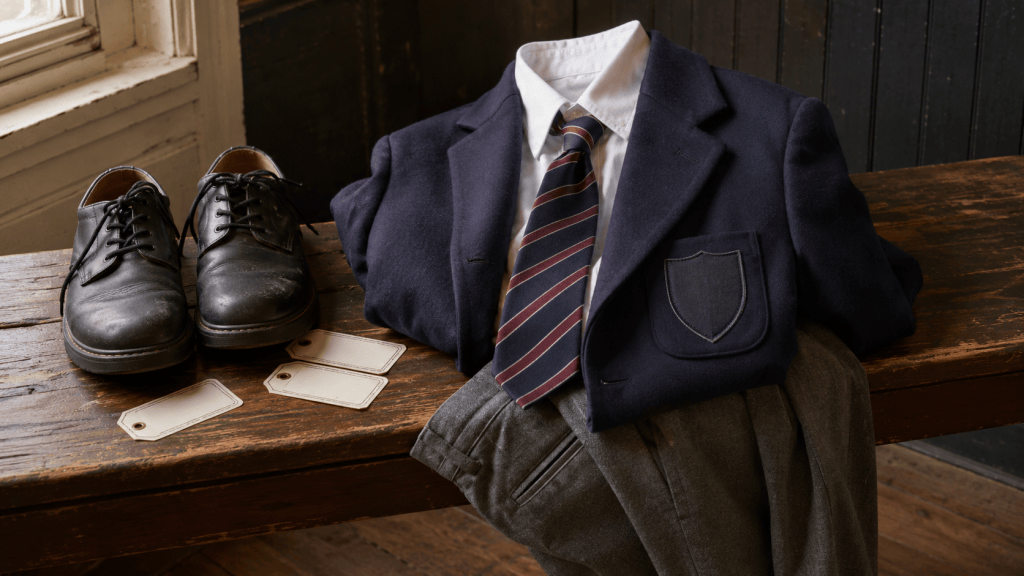
The blazer, tie and embroidered jumper seem timeless, but British
school uniform is the product of charity, class, mass education and a
surprisingly modern retail system.
At the beginning of September, the uniform appears everywhere:
trousers still creased from the packet, shoes fractionally too large,
name labels waiting to be ironed into collars.
The annual ritual can make school uniform feel like an ancient and
universal British tradition. It is neither. There has never been one
national uniform, and many of the rules families now navigate are
comparatively recent. Yet Britain adopted school dress more extensively
than many similar countries.
To understand why, it helps to begin not with a modern blazer but
with a long blue coat.
The bluecoat children
Christ’s Hospital was founded in London in 1552 to educate poor
children. Its pupils became known for a uniform that included a long
blue coat. The school’s distinctive dress has survived, with changes,
for more than 470 years.
Other charity schools also clothed their pupils. Uniform served
several purposes at once. It made children recognisable, supplied
garments that families might struggle to afford and displayed the
benevolence and discipline of the institution. Blue was commonly
associated with charity and service.
This origin complicates the idea that uniform began as an elite
badge. Some of the earliest conspicuous school clothing marked pupils as
recipients of charitable education.
From charity dress
to institutional identity
Over time, schools serving wealthier boys developed their own
distinctive clothes and customs. What later came to be called Britain’s
public schools — privately funded institutions such as Eton, Harrow and
Rugby — turned dress into part of a school identity.
The familiar elements did not all arrive together. Caps, ties, house
colours, sports jerseys and blazers developed through nineteenth-century
school life. A blazer was originally a brightly coloured sporting
jacket, not necessarily the sober navy garment sold today. Team and
house clothing allowed pupils to signal belonging within the institution
as well as beyond it.
Uniform also supported hierarchy. Different ties, badges, buttons or
gowns could identify prefects, teams and senior pupils. Clothing made
the school’s social order visible.
Mass schooling needed
routines
Compulsory elementary education expanded in the late nineteenth
century, but ordinary state schools did not instantly put every child in
a standard outfit. Families often supplied practical everyday clothes,
while some schools prescribed only particular items.
Uniform became much more widespread in state secondary education
during the twentieth century, especially as more children attended
schools organised around a shared institutional culture. The grammar
school blazer, cap, badge and tie offered an accessible version of
traditions once associated with older fee-paying schools.
Supporters saw a common outfit as a way to reduce visible differences
in wealth, encourage discipline and make pupils feel part of something
larger. Critics noticed the contradiction: a supposedly equal uniform
could be expensive, uncomfortable or used to enforce narrow ideas about
gender and respectability.
Both readings can be true. Clothing can conceal one kind of
difference while creating another burden.
Why the badge costs
more than the jumper
Modern school uniform is not merely a dress code. It is a supply
system.
A school can specify generic grey trousers or a white shirt that
families buy from many shops. It can also require a garment carrying a
particular badge, trim or design, available only from an approved
supplier. The second approach strengthens visual consistency but weakens
price competition and makes second-hand exchange more important.
That distinction sits behind the legal change taking effect in
England in September 2026. Schools must generally limit compulsory
branded uniform and PE items to three. Middle and secondary schools may
require a fourth when one of the items is a tie.
The law does not abolish uniform. It tries to separate the school’s
need for a recognisable identity from the family’s need to shop
affordably.
Does uniform create equality?
There is no simple answer.
Uniform can prevent daily competition over fashion and make mornings
easier. It can help staff identify pupils on trips and create a shared
visual identity. Some children like the clarity: school clothes are
school clothes, and home clothes remain their own.
But equality depends on design and enforcement. A low-cost code built
around widely available garments is different from a long list of
school-specific items. Rules about hair, skirts, trousers, religious
dress and sensory needs can affect groups differently. A child in a
visibly worn blazer may still be judged, even when everyone is nominally
dressed alike.
Evidence that uniform alone improves academic attainment is limited
and difficult to separate from a school’s wider culture. A blazer cannot
manufacture good teaching, safety or belonging. At best, clothing
supports an environment built by people.
The annual handover
Uniform has survived partly because it adapts. Caps largely
disappeared. Trousers became available to more pupils. Trainers entered
some policies. Supermarkets began selling basic ranges. Parents
organised resale rails and online exchanges. Schools adjusted rules as
costs and expectations changed.
The most durable piece may be the second-hand garment. A blazer
passes from one child to another, its previous name crossed out and a
new label added. That modest exchange captures the promise and the
problem of uniform: an object intended to make everyone look the same,
carrying unmistakable traces of individual lives.
British children wear school uniform because several histories became
tangled together — charity clothing, elite tradition, mass education,
discipline, identity and retail. The result feels ancient because it is
repeated every morning. In reality, it has always been changing.
Quick facts
- Christ’s Hospital traces its bluecoat uniform to the sixteenth
century. - Blazers developed from brightly coloured sporting jackets.
- Uniform became increasingly common in state secondary schools during
the twentieth century. - From September 2026, English schools must generally limit compulsory
branded items to three. - Middle and secondary schools can require four branded items when one
is a tie.





Leave a Reply