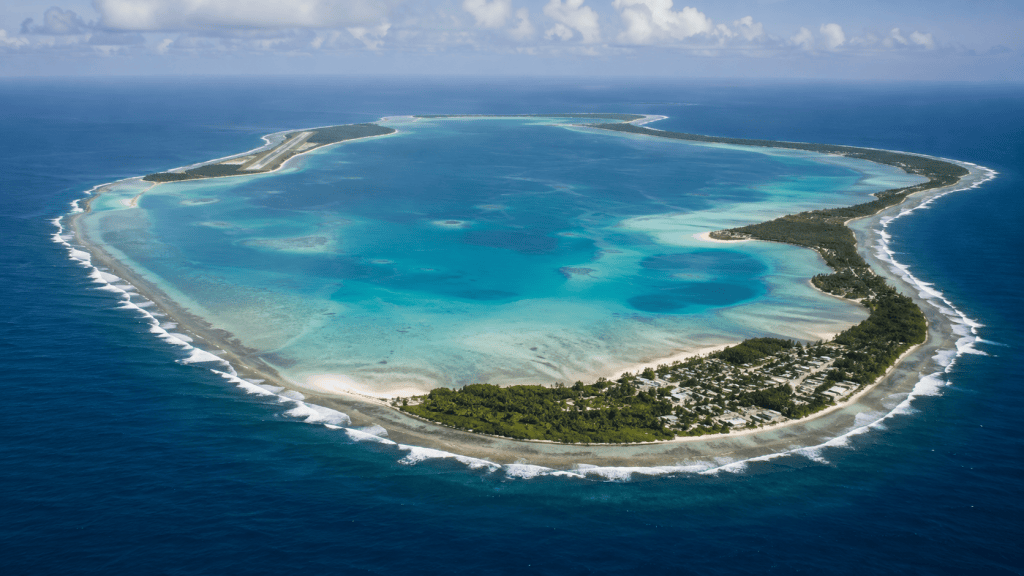
The Chagos Archipelago sits far from any continental shore. Its
history joins empire, forced displacement, international law,
conservation and a military base of global importance.
On a map of the Indian Ocean, the Chagos Archipelago is easy to miss.
The islands are small, low and scattered across a vast area of water
south of the Maldives. Their total land area is modest. Their position
is not.
One atoll, Diego Garcia, contains a major joint UK–US military
facility. The people once living across the archipelago were removed
during the creation of that base. Mauritius has long claimed
sovereignty. International courts and the United Nations have challenged
Britain’s continuing administration.
Every argument about the islands therefore contains several maps at
once: the map of empire, the map of strategy and the map remembered by
displaced families.
A chain of coral atolls
Chagos consists of more than sixty islands grouped into several
atolls. They rise only slightly above sea level, while reefs and lagoons
cover a much larger area than the visible land.
The archipelago lies near important sea and air routes between
Africa, the Middle East, South Asia and Southeast Asia. Distance from
large populations made it attractive for a military facility; centrality
within the ocean made that facility useful.
This combination — remote locally, connected globally — is the first
answer to why the islands matter.
From Mauritius to a
separate territory
Britain took control of Mauritius and its dependencies from France in
the early nineteenth century. In 1965, while Mauritius was moving
towards independence, Britain detached the Chagos Archipelago and
created the British Indian Ocean Territory.
Mauritius became independent in 1968. It has argued that the
separation was imposed during decolonisation and was not a free
agreement between equal sovereign states.
In 2019, the International Court of Justice issued an advisory
opinion concluding that the decolonisation of Mauritius had not been
lawfully completed and that Britain should end its administration of the
archipelago as rapidly as possible. The opinion was advisory rather than
a judgment between two states, but it carried substantial legal and
diplomatic weight. The UN General Assembly subsequently demanded an end
to British administration.
The removal of the
Chagossians
The central human fact is that the islands were inhabited.
Chagossian communities had developed over generations around coconut
plantations and island settlements. Between the late 1960s and early
1970s, Britain removed the population as Diego Garcia was prepared for
the military base. People were prevented from returning and displaced
mainly to Mauritius and the Seychelles, where many faced poverty and
exclusion.
The British government has acknowledged and expressed deep regret for
the manner of the removal. Court cases, compensation schemes,
citizenship changes and campaigns for a right of return have followed
for decades.
Chagossians do not hold one single view of the islands’ future. Some
prioritise return, some sovereignty, some compensation and recognition;
opinions on agreements between Britain and Mauritius differ. Treating
the community as one voice repeats the habit of deciding its future from
elsewhere.
Why Diego Garcia is
different
Diego Garcia’s large lagoon and isolated position supported the
construction of an air and naval facility under UK–US arrangements
beginning in the 1960s.
The base has served operations in the Middle East and Asia. Long
runways can handle heavy aircraft; the lagoon can support ships; its
location provides reach without reliance on a densely populated host
area.
Supporters describe the facility as crucial to Western security.
Critics connect it inseparably to the expulsion that enabled it and have
also questioned military activities conducted from the island.
Any sovereignty settlement must confront a difficult design problem:
change the legal status of the archipelago while preserving, altering or
ending the arrangements that keep the base operating.
Conservation without
inhabitants
The waters around Chagos contain significant coral reefs and marine
ecosystems. Britain declared a large marine protected area in 2010.
Conservation added another layer of dispute. Protection from
industrial fishing can benefit ecosystems, but Chagossian campaigners
argued that restrictions were being used to obstruct resettlement and
traditional livelihoods. A protected landscape is not politically empty
simply because its residents were removed.
Climate change intensifies the question. Low islands and coral reefs
are vulnerable to warming seas, bleaching, erosion and sea-level rise.
The environment is both globally valuable and part of a contested
homeland.
The attempted settlement
Britain and Mauritius signed an agreement in May 2025 under which
Mauritius would gain sovereignty while the UK would lease Diego Garcia
for at least 99 years to preserve the base.
The plan required implementation and generated opposition from
several directions. Some British politicians argued that it endangered
security or surrendered territory. Some Chagossians objected that they
had not been adequately consulted. Supporters said the agreement
responded to international law while giving the base a secure
future.
In April 2026, the UK government halted the implementing legislation
after US support changed, leaving the treaty’s future uncertain.
Parliamentary and legal arguments continued into September.
This sequence explains why a headline saying Britain has simply
“given away” or “kept” the islands is inadequate. A signed international
agreement, domestic legislation, military arrangements and effective
transfer are related but distinct steps.
The problem with an
empty dot on the map
Small islands are often described through the interests of larger
powers. Chagos becomes a strategic asset, a legal precedent, a
conservation zone or a cost in a government budget.
Each description identifies something real. None is sufficient.
The archipelago matters because geography magnifies small places. A
few square miles can anchor control over airspace and ocean, test the
meaning of decolonisation and carry the memory of a community spread
across several countries.
The most accurate map must therefore include people who are no longer
physically present. Without them, the apparent emptiness of Chagos is
not geography. It is the result of policy.
Quick facts
- Chagos contains more than sixty low-lying islands arranged in
several atolls. - Britain detached the archipelago from Mauritius in 1965.
- Chagossian inhabitants were removed in the late 1960s and early
1970s. - Diego Garcia hosts a major joint UK–US military facility.
- The International Court of Justice said in 2019 that Mauritius’s
decolonisation had not been lawfully completed. - A 2025 UK–Mauritius agreement was not implemented before the
relevant UK bill was halted in 2026.
Sources and further reading
- International Court of
Justice — Chagos advisory opinion, 2019 - UK
Parliament Hansard — Diego Garcia and the British Indian Ocean
Territory, 25 February 2026 - UK
Parliament — Diego Garcia Military Base and British Indian Ocean
Territory Bill - Associated
Press — UK–Mauritius agreement signed, 22 May 2025 - Associated
Press — UK puts the agreement on hold, April 2026 - UK
Parliament — Current written question on Chagos spending, 2 September
2026



 The Knowledge Back Catalogue
Leave a comment