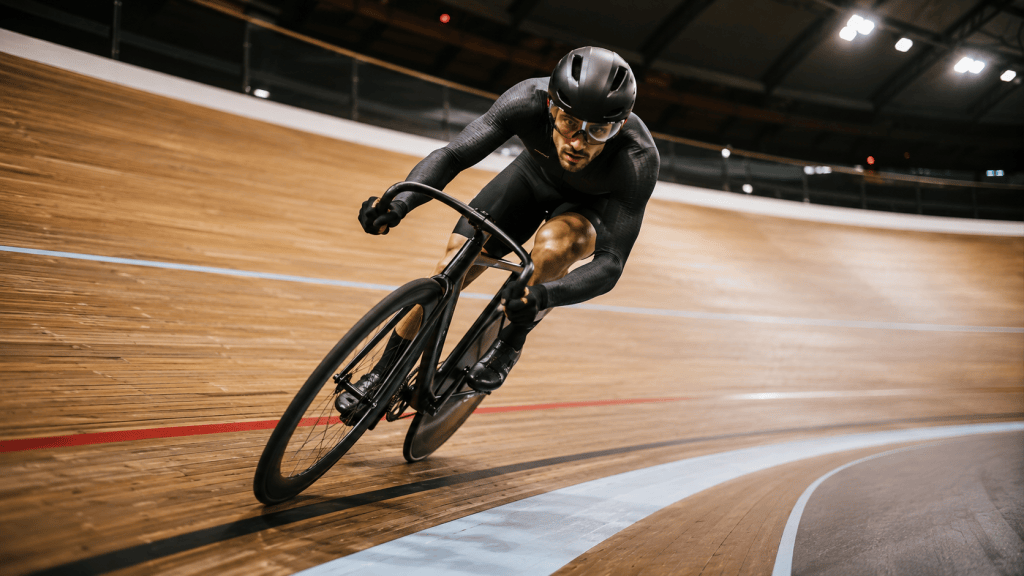
A track bicycle looks dangerously incomplete: one gear, no
freewheel and no brake levers. On the smooth, banked geometry of a
velodrome, those absences are part of the safety system.
The first surprise comes when the rider stops pedalling and the
pedals refuse to stop.
On an ordinary bicycle, a freewheel lets the back wheel continue
turning while the cranks remain still. A track bike has a fixed gear. If
the rear wheel turns, the chain turns and the pedals turn with it. There
is no coasting.
The second surprise is more visible. There are no brake levers on the
handlebars and no callipers at the wheels.
On a road, that would be a serious defect. On a velodrome, where
every rider travels in the same direction on a controlled surface, it
makes a different kind of sense.
The bicycle with one
continuous motion
A fixed drivetrain creates a direct connection between rider and rear
wheel. Push harder and the bike accelerates. Resist the turning pedals
and it slows. The rider can make tiny speed adjustments without abruptly
grabbing a brake.
That smoothness is valuable when cyclists ride only centimetres
apart. A sudden stop in the middle of a group would be far more
dangerous than the absence of a conventional brake. Track riders slow
progressively, move away from the racing line or circle the track until
speed falls.
The design is also mechanically simple. One chainring, one sprocket
and a straight chain line reduce weight and remove gear changes. On a
perfectly smooth circuit with no hills, traffic lights or potholes,
extra ratios are unnecessary for many events.
The cost is that cadence — how fast the legs turn — is tied directly
to speed. A rider cannot select an easier gear when accelerating or a
harder one at full pace. Choosing the chainring and sprocket before an
event is therefore a strategic decision.
Why brakes could cause the
crash
Imagine a line of road cyclists approaching a junction. Each needs
independent control because cars, pedestrians and corners may force an
immediate stop.
Now imagine a line of track cyclists moving at racing speed,
following the same curve with no outside traffic. If the first rider
squeezed a powerful brake, everyone behind would have almost no warning
or space.
Velodrome safety depends on predictability. Riders hold their line,
look ahead and alter speed gradually. The fixed wheel gives fine control
through the pedals. Rules and training replace the road bike’s emergency
response.
This is why a brakeless fixed-gear bike that is appropriate on a
closed track is not automatically appropriate in traffic. The machine is
designed for an environment, not for bicycle travel in general.
What the banking does
A bicycle turning on flat ground needs friction between tyre and
surface to provide the inward, or centripetal, force that curves its
path. The rider leans inward so that the combined forces pass through
the contact patches.
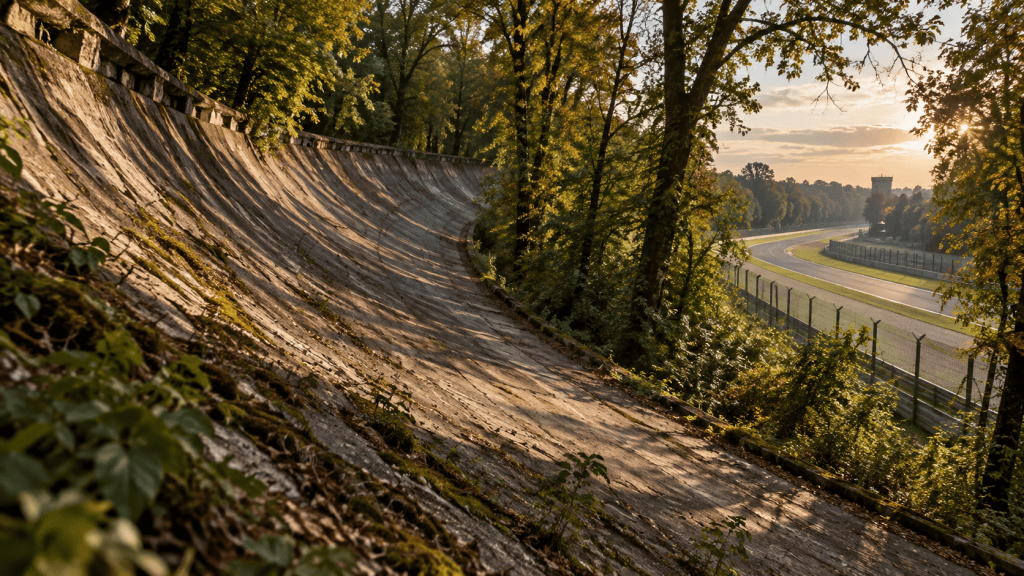
A banked track tilts the surface towards the centre of the turn. Part
of the force from the track now points inward, helping the bicycle
follow the curve. At the design speed, rider and bike can feel
remarkably settled even though the banking looks like a wall from the
infield.
There is no single magical speed that makes every line safe. A rider
travelling too slowly on a steep section risks losing grip and sliding
down. Beginners are taught to build enough speed before moving higher
and to keep pedalling through the bends.
The banking also gives riders tactical options. Climbing the slope
trades some speed for height. Descending converts that height back into
speed. In sprint events, riders use the whole track as a field of
position and energy, not merely as a lane.
The blue
line, the red line and the shortest way round
Velodromes are marked with lines that organise different kinds of
racing.
Near the bottom is the black measurement line from which the official
track length is calculated. A blue band below the racing surface, called
the Côte d’Azur, is not a shortcut to be used casually. A red sprinter’s
line and a blue stayer’s line define important zones in particular
events.
The shortest route is low on the track, but the fastest tactical
position is not always the shortest. A rider may climb to watch an
opponent, create room or prepare a downhill acceleration.
The track is therefore both road and diagram. Its paint tells riders
which rules apply to the space beneath their wheels.
Why every event does
not use the same bike
All track bikes share the fixed-wheel principle, but their shapes
vary.
Mass-start machines use drop handlebars that give control in close
racing. Pursuit and time-trial bikes use aerodynamic extensions because
the rider competes against the clock with fewer changes of direction.
Sprinters need exceptional stiffness for explosive forces; endurance
riders balance aerodynamics and efficiency over longer efforts.
Wheels may be deep-section or solid discs where rules and conditions
allow. Tyres are narrow and run at high pressure on the smooth timber
surface. Components are scrutinised because tiny aerodynamic differences
matter at elite speed.
The apparently primitive one-speed bicycle is in fact highly
specialised.
Learning not to stop
Track beginners usually start on a hire bike and spend their first
laps low on the circuit. They learn to start and stop at the rail, look
over a shoulder without swerving and control speed through the
pedals.
The habit that takes longest to acquire is simple: keep pedalling.
Trying to coast can lift the rider from the saddle as the moving cranks
drive the legs upward.
Once that lesson settles, the fixed gear becomes communicative.
Changes in the track, the rear wheel and the riders nearby can be felt
through the pedals. The machine has fewer controls because the rider is
in more continuous contact with it.
A safer bike in a narrower
world
The track bike is a useful warning against judging an object without
its setting. “No brakes” sounds reckless because we imagine a bus
pulling out, a wet descent or a child crossing the road.
Remove those hazards, put every rider in the same direction and build
a smooth circuit around predictable behaviour, and conventional brakes
create a new danger. The safest design changes with the system around
it.
A velodrome bike is not unfinished. It is complete for a very
particular world: no junctions, no coasting and no sudden stops — only
the continuous exchange of legs, chain, wheel and curve.
Quick facts
- A track bike has a fixed gear, so the pedals turn whenever the rear
wheel turns. - Riders slow by resisting the pedals and reducing speed
gradually. - Sudden braking would be hazardous in a closely packed group.
- Banking directs part of the track’s supporting force towards the
centre of the turn. - Track gearing is selected by changing the sizes of the front
chainring and rear sprocket.



Leave a Reply