A model railway can begin with a very practical question: how much
track will fit on the board?
That question is necessary. It is also dangerous.
Begin with the track alone and it is easy to assemble a greatest-hits
collection of railway features: a large station, a locomotive depot, a
mine, a goods yard, an airfield, a museum and perhaps a canal squeezed
into whatever spaces remain. Each feature may be attractive. Together,
they can feel like unrelated exhibits sharing a baseboard.
Worldbuilding changes the question. Instead of asking only what will
fit, it asks: what happened here?
Why is there a railway in this valley? What did it originally carry?
Which community did it serve? Why does one branch survive while another
has become a heritage line? What was built first, what came later and
what has been adapted because demolishing it would have cost too
much?
Those questions sound like fiction. In practice, they are design
tools.
A place rather than a plan
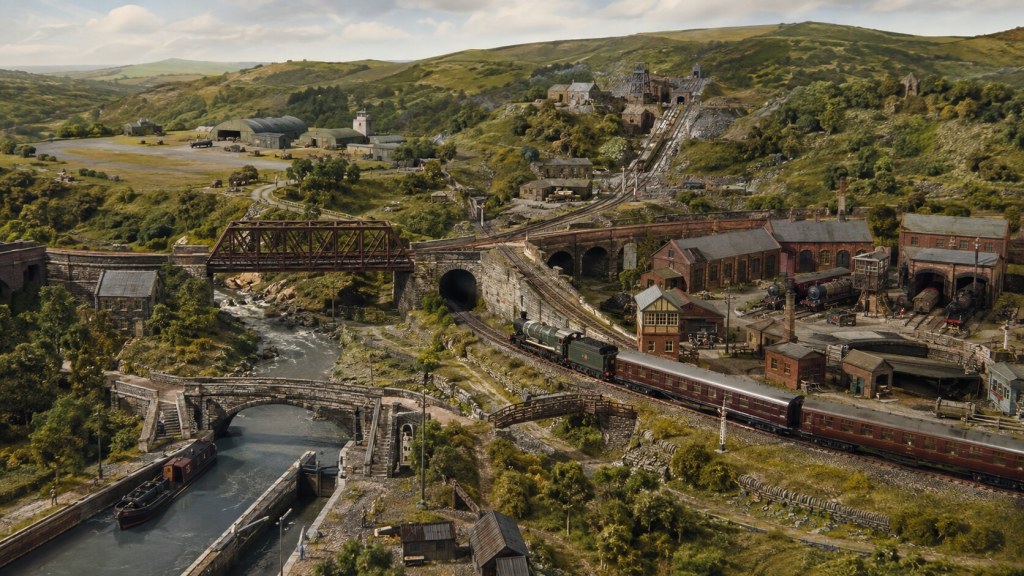
Consider Bro Cwmlili, a fictional region in South Wales created as
the setting for an interconnected model railway world. It contains
places including Pen-y-Tawe, along with a main line, branches climbing
into more difficult country, mineral workings, waterways, a former
military airfield, a scrapyard and a railway museum. None of those
ingredients is unusual on a model railway.
The difference appears when they are treated as parts of the same
place.
The mine is not simply an excuse to own narrow-gauge wagons. It
explains why a small industrial railway was built and why exchange
sidings are needed. The river and canal are not empty scenic space. They
represent an older transport geography which the railway had to cross,
compete with and eventually outlive. The airfield does not exist only to
display aircraft. Its supplies and later redevelopment give a branch
line traffic and a reason to change over time.
The fictional Wales Railway Museum and its supporting heritage trust
provide another layer. Preserved locomotives no longer have to appear
magically on an ordinary main line. They belong to an institution with
workshops, access arrangements, visitors and limits. Even the
neighbouring scrapyard gains a relationship with the museum: one
business dismantles and recovers material while the other decides what
is worth saving.
Track, scenery and rolling stock begin answering one another.
That is worldbuilding at modelling scale. It does not require a
thousand-page history. It requires enough cause and effect to make the
visible scene feel like the latest chapter of something older.
Geography is the first
author
Real places are shaped by resistance. Hills get in the way. Rivers
flood. Roads need gradients people and vehicles can manage. Railways
prefer gentle curves and slopes but rarely receive an empty landscape on
which to draw them.
A fictional model becomes more convincing when its geography also
refuses to cooperate.
Across Bro Cwmlili, rising ground helps explain tunnels, retaining
walls and the separation between the main line and the upland branches.
Waterways justify bridges and awkward alignments. A branch looping
around the landscape no longer exists because curves happened to fit
there; it is finding a route through terrain.
This principle works far beyond railways. A tank model placed beside
a muddy lane tells us little. Add a sunken road, a damaged bridge and a
village on higher ground, and the terrain begins to explain where the
vehicle is going and why. A harbour determines the position of
warehouses, cranes and rail connections. An airfield’s prevailing wind
and perimeter shape affect where runways, dispersal areas and buildings
belong.
Geography is useful because it creates constraints—and constraints
can improve creative decisions. Research on creativity does not suggest
that every limitation is helpful, but well-chosen constraints can narrow
an unmanageably large field of possibilities and direct attention
towards more original solutions. “The river has to remain here” is more
productive than “anything can go anywhere”.
History explains the untidy
bits
Perfectly planned model worlds often look less believable than
imperfect ones.
Real landscapes are palimpsests: new uses written over old ones
without completely erasing them. A railway closes but its embankment
survives. A goods shed becomes a builders’ merchant. A military siding
serves an industrial estate. A canal basin is filled in, but its
retaining wall still determines the shape of a car park.
An imagined chronology allows a modeller to create that kind of
untidiness deliberately.
Bro Cwmlili can be understood in layers. Mineral industries and
waterways came first. The standard-gauge railway expanded to serve
communities and industry. Wartime needs altered the landscape again.
Contraction removed some facilities but not every trace. Preservation
and redevelopment then found new purposes for what remained.
Once those layers exist, details stop being decoration and become
evidence. A blocked tunnel portal suggests a lost connection. New
fencing cuts across an older track alignment. Brickwork changes colour
where a building was extended. A heritage platform looks newer than the
retaining wall behind it because it is newer.
This is one reason weathering works best when it answers a question.
Rust should collect where water and use would put it. Repairs should
appear where damage occurred. A vehicle’s finish can show the job it
performs, not merely demonstrate that its owner owns weathering
powders.
Industry turns scenery
into operation
Model railways are often divided into scenery and operation, as
though one is the attractive background and the other is the serious
business. Worldbuilding joins them.
The National Model Railroad Association’s guidance makes the
practical relationship clear: factories and businesses are railway
customers; mines, farms and quarries generate the raw materials that
trains move. Its operations guide similarly treats towns, stations and
yards as locations connected by routes along which passenger and freight
business occurs.
In other words, an industry is not only a building. It is a reason
for a train.
If a mine produces stone or coal, what arrives empty and what departs
loaded? Where is material transferred between gauges? Which locomotive
can manage the gradient? Does the traffic justify a daily train, a busy
shift or only an occasional trip? Each answer affects sidings, storage
space, wagon choices and the timetable.
This can prevent a common design problem: adding track because track
looks interesting. A siding with no customer becomes difficult to
operate meaningfully. Give it a timber merchant, fuel depot or
engineering workshop and it acquires a pattern of arrivals, departures
and pauses.
Purpose also tells you what not to build. If the railway’s imagined
traffic would never require a large marshalling yard, omitting one is
not a compromise. It is coherence.
People make infrastructure
matter
The smallest useful piece of worldbuilding may be a human question:
who uses this place?
A station serving a market town needs different facilities from a
platform built for shift workers. A rural halt might be busy twice a day
and almost silent in between. A preserved railway has visitors,
volunteers, storage problems and projects awaiting money. An airfield
branch carries personnel and supplies before it carries tourists or
industrial traffic.
Very few of these people need to be modelled literally. Their needs
appear through the built environment: a bus stop outside the station, a
staff gate in a fence, a footpath worn towards a platform, bicycles
beside a workshop, a locked door separating public and operational
areas.
These are modest details, but they give viewers something to infer.
The scene stops saying, “Here is a station kit.” It begins saying,
“People arrive here in the morning.”
That distinction helps explain the emotional force of a well-made
miniature world. Psychological research on narrative transportation
describes the absorption created when attention, imagery and feeling
become focused on a story. A static model is not a written narrative,
but the comparison is useful: coherent visual clues invite the viewer to
imagine events beyond the frozen moment.
The train has come from somewhere. The half-demolished wall remembers
something. The figure on the platform is waiting for someone.
Worldbuilding is
a filter, not another backlog
There is an obvious danger here. A hobby intended for relaxation can
acquire a fictional government, three hundred years of municipal records
and a committee arguing about the coat of arms before a single piece of
track is laid.
Useful worldbuilding should reduce decisions, not create another
unfinished project.
Begin with five sentences:
- Where is it? Define the broad geography and visual
character. - When is it? Choose a date, a period or several
operating eras. - Why was it built? Identify the traffic, conflict or
need that created it. - What changed? Add one closure, expansion, war, new
industry or social shift. - Who uses it now? Decide whose needs shape the scene
at the moment being modelled.
That is usually enough to test a design choice. Does this building
belong here? Would this vehicle have a job? Why is the line still open?
What lies beyond the scenic boundary?
Answers may change. Bro Cwmlili became stronger through revision:
junctions moved, branches acquired clearer purposes and institutions
gained names only after their relationships were understood. The world
did not dictate a perfect plan at the beginning. It provided a
consistent way to improve one.
The story behind the surface
Accuracy and imagination are sometimes treated as opposites in
modelling. They are not.
Prototype research supplies the grammar: how railways work, how
industries connect, how buildings age and how geography limits
infrastructure. Worldbuilding uses that grammar to compose a place which
may never have existed but feels as though it could have done.
The result is not necessarily more track or more detail. Often it is
the opposite. A coherent world makes restraint easier. One meaningful
siding can replace three arbitrary ones. A carefully placed ruin can
suggest an entire vanished industry. A short train can feel exactly
right because the imagined community would never fill a longer one.
That is why worldbuilding helps people make better models. It turns
choices into consequences, scenery into evidence and operation into
purpose.
A model stops being a board on which objects have been arranged.
It becomes a place.
Quick facts
- Worldbuilding can begin with only five decisions: place, period,
original purpose, later change and present users. - Geography provides productive constraints by explaining gradients,
curves, bridges, tunnels and settlement patterns. - An industry becomes operationally useful when the modeller defines
what it receives, what it sends and how often. - Historical layers make an imagined setting feel lived-in: reused
buildings, abandoned alignments and later repairs are visual evidence of
change. - The same method works for railway layouts, military dioramas,
aircraft scenes, harbours, architecture and tabletop worlds.
Sources and further reading
- National
Model Railroad Association — Beginners Guide Part 2: Layout
Planning - National
Model Railroad Association — Beginners Guide Part 7: Structures - National
Model Railroad Association — Beginners Guide Part 9: Operations - National Model
Railroad Association — Layout Design SIG - Melanie C. Green
and Timothy C. Brock — “The Role of Transportation in the Persuasiveness
of Public Narratives”, Journal of Personality and Social Psychology
(PubMed) - Patricia
D. Stokes — Creativity from Constraints: The Psychology of
Breakthrough



Leave a Reply