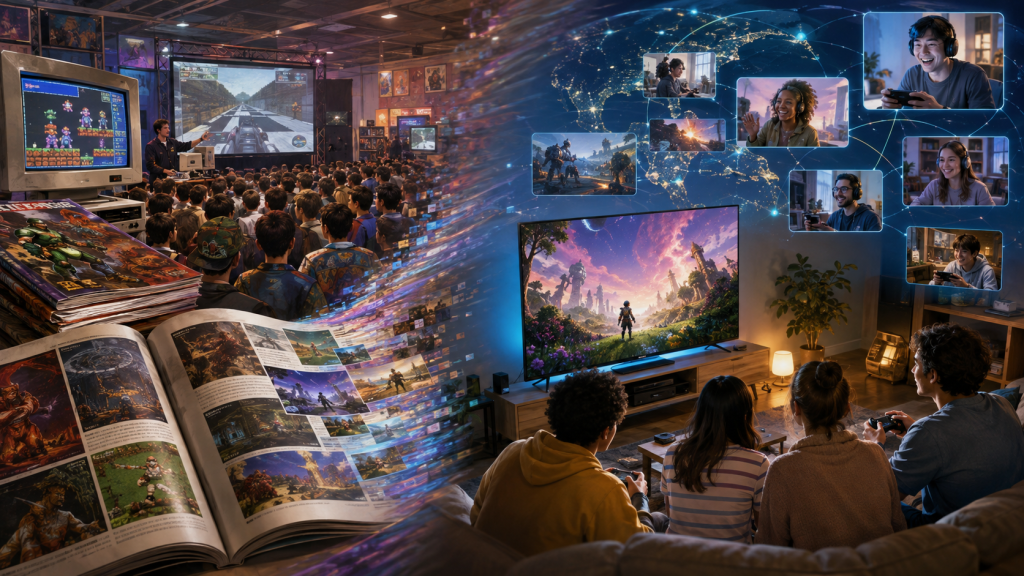
A new game was once discovered in a magazine screenshot or behind
the closed doors of a trade show. Now millions watch the announcement
together, live, on the manufacturer’s own stage.
Sony’s State of Play, Nintendo Direct, Xbox showcases and the events
surrounding Gamescom and Summer Game Fest treat coming games as
scheduled global television. Countdowns begin days before. Fans predict
surprise appearances. Reaction streams put one broadcast inside
another.
The format feels natural now, but it represents a major transfer of
power. Games companies no longer need a magazine, television programme
or physical trade fair to present their next products. They can speak
directly to the audience—and control the camera.
When screenshots travelled
slowly
For much of video-game history, print magazines were the main window
into the future. Publishers supplied screenshots, artwork and preview
code. Journalists visited studios or trade events and returned with
pages that might appear weeks later.
The delay created mystery. A single still image could be examined
repeatedly because moving footage was scarce. Regional release schedules
meant readers in one country might know a game existed long before they
could play it.
Television covered games intermittently, but airtime was expensive
and broadcasters served general audiences. Specialist programmes helped,
yet magazines remained better suited to long lists of releases,
technical detail and screenshots.
The trade-show era
The Electronic Entertainment Expo, or E3, began in Los Angeles in
1995 and became the industry’s great annual theatre. Companies built
enormous stands, held press conferences and competed to dominate a few
days of attention.
E3 announcements were initially aimed at retailers and journalists.
As internet video improved, the public began watching the press
conferences directly. The room still mattered—the applause, giant
screens and live demonstrations—but the real audience was increasingly
elsewhere.
The limitations became obvious. A live stage demo could fail. Every
company fought for attention during the same crowded week. The event
cost money and forced announcements into someone else’s calendar.
Nintendo removes the room
Nintendo Direct, introduced in 2011, helped normalise the
pre-recorded digital showcase. The company could choose the length, pace
and release date; move rapidly between games; add subtitles for
different regions; and avoid the unpredictability of a conventional
press conference.
Pre-recording did not make the event feel less live. Viewers still
arrived at the same moment, watched together and reacted in real time.
The scarcity moved from physical seats to shared timing.
Other companies developed related formats. Sony launched State of
Play in 2019. Microsoft created its own Xbox presentations. Independent
developers gained showcase events organised around genres, communities
or creators.
The announcement as
entertainment
A showcase is not merely a catalogue. Its order is designed like a
programme. Smaller updates establish rhythm. A recognisable character
produces a lift. The final “one more thing” rewards viewers who
stay.
Trailers are edited not just to explain a game but to generate clips,
memes and frame-by-frame analysis. A logo can be withheld until the
final seconds. Familiar music may identify a series before the title
appears.
Reaction videos extend the event. Watching somebody else recognise a
character has become a second form of entertainment, and publishers know
that cameras are waiting. Ambiguity supplies material for days of
discussion.
What direct broadcasting
changes
The manufacturer decides exactly what is shown and what is not. A
polished trailer can conceal performance problems, unclear business
models or a distant release date. Journalists no longer control first
access to the announcement, although they remain important for
verification, interviews and independent testing.
At the same time, players receive the primary material instantly and
globally. Smaller games can appear alongside blockbusters. Accessibility
features, developer commentary and demonstrations can be presented
without fitting a broadcaster’s schedule.
The boundary between news and advertising becomes thin. A showcase is
exciting precisely because it is a marketing event designed as communal
entertainment.
A new kind of appointment
viewing
Traditional television was defined by scarcity: a programme aired at
a particular time because there was only one channel slot. Internet
video removed that technical restriction, yet game showcases recreate
appointment viewing voluntarily.
The recording remains available afterwards, but being present for the
reveal matters. Spoilers spread instantly; the live chat and collective
surprise cannot be replayed perfectly.
Video-game announcements became global television events not because
they needed television, but because the industry rediscovered what
television did best: gather an audience at one moment and make the next
few minutes feel unknown.
Quick facts
- Video-game magazines once carried previews weeks after screenshots
were supplied. - E3 began in 1995 as a major industry trade show.
- Nintendo Direct helped popularise pre-recorded direct-to-player
showcases from 2011. - Sony’s State of Play series began in 2019.
- Modern showcases are designed for live viewing, clips, reaction
streams and later replay.



Leave a Reply