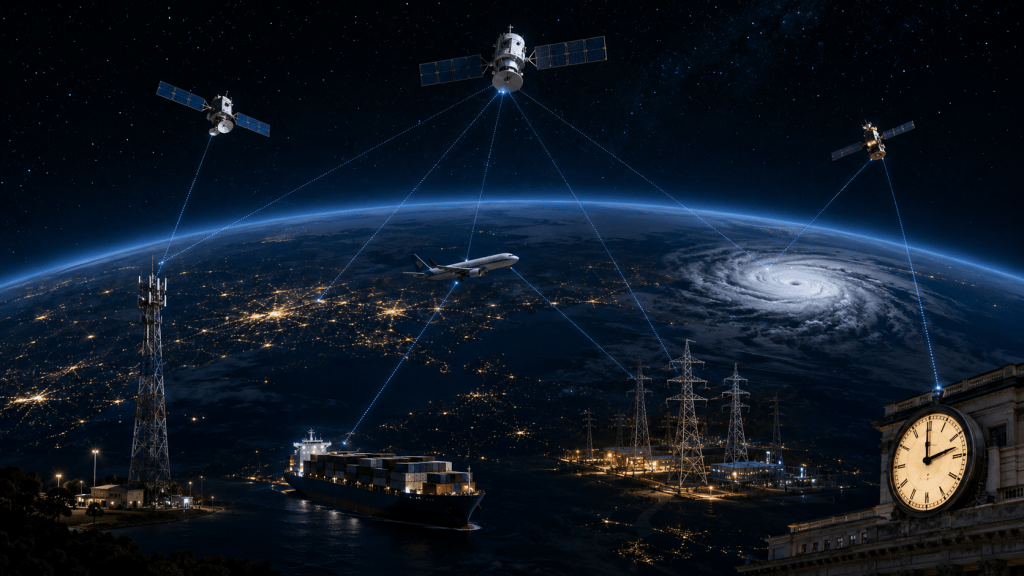
A world without satellites would not simply lose television
pictures and map directions. Time itself would become harder to
distribute—and systems on the ground would begin drifting
apart.
Satellites seem remote because they are remote. They orbit hundreds
or thousands of kilometres above everyday life, largely invisible unless
a bright point crosses the night sky.
Yet navigation, weather forecasts, communications, banking, aviation,
farming and emergency response all depend on services delivered from
orbit. Some failures would be obvious within minutes. Others would
emerge quietly as clocks and measurements lost agreement.
Navigation is the visible
dependency
Global navigation satellite systems—including GPS, Europe’s Galileo,
China’s BeiDou and Russia’s GLONASS—broadcast precisely timed signals. A
receiver compares arrival times from several satellites to calculate
position.
Phone maps would become less reliable without those signals, but the
consequences extend beyond drivers. Aircraft and ships use satellite
navigation alongside other systems. Surveyors, construction equipment
and precision agriculture depend on centimetre-level corrections.
Emergency calls use location data to help find people.
Older techniques would still exist: inertial navigation, radio
beacons, paper charts and landmarks. They are valuable backups, but
often less accurate, less convenient or more expensive at global
scale.
The hidden service is time
Every GPS satellite carries atomic clocks. Receivers on Earth use
their signals to synchronise with extremely precise time.
Mobile networks need agreement so calls and data use radio spectrum
without interfering. Electricity grids compare phase and events across
wide areas. Financial systems timestamp transactions. Broadcast
networks, data centres and scientific instruments coordinate
operations.
GPS.gov notes that receivers can obtain time to within around 100
billionths of a second. Organisations do not need an atomic clock at
every site because the satellite system distributes one.
If that signal vanished, equipment would continue using internal
oscillators. But clocks drift. Holdover systems can bridge an outage for
a while; eventually different parts of a network disagree enough to
reduce performance or fail.
Weather would become
blurrier
Geostationary weather satellites continuously watch large regions,
tracking clouds and rapidly developing storms. Polar-orbiting satellites
measure temperature, humidity, sea ice, ocean conditions and atmospheric
composition around the globe.
Forecast models need those observations, especially over oceans and
sparsely monitored land. Ground stations, aircraft, balloons and radar
would continue, but the global picture would contain larger gaps.
Forecast skill would decline, and warnings for tropical storms and other
fast-changing hazards could arrive later or with less confidence.
Communications would fail
unevenly
Many internet connections travel through undersea fibre rather than
satellites, so the whole internet would not disappear. Dense cities
would retain substantial terrestrial networks.
Remote islands, ships, aircraft, research stations and rural
communities would be affected more severely. Satellite television and
some broadcasting links would vanish. New low-Earth-orbit constellations
provide broadband and backhaul where cables are unavailable.
The unevenness matters. Losing satellites would widen the distance
between well-connected places and those for which orbit is the only
practical route.
Earth observation would
stop updating
Satellites monitor crops, forests, floods, fires, glaciers,
coastlines and illegal activity at sea. Governments and scientists would
keep the archive, but the moving picture would freeze.
Farmers could lose vegetation measurements. Rescue teams would have
fewer current images after disasters. Climate research would lose
continuous records that are most valuable precisely because instruments
make comparable observations year after year.
Would everything fail at
once?
No. “Satellites went dark” could mean one constellation, one region,
a solar storm or the destruction of many spacecraft. Systems differ in
redundancy.
Critical users may receive several navigation constellations, atomic
clocks on the ground, inertial backups and resilient terrestrial links.
A phone relying on whichever signal is easiest may fail sooner. Some
services degrade gracefully; others encounter thresholds.
The most dangerous failures could be indirect. A navigation outage
creates congestion. A timing fault disrupts communications during an
emergency. Poorer forecasts arrive while responders also lack current
imagery.
Orbit has become
ordinary infrastructure
Roads and power lines are visible, so societies recognise them as
infrastructure. Satellites are harder to notice. Their signals arrive
without weight, noise or an obvious local building.
That invisibility is a measure of success. Space systems have been
absorbed into ordinary objects until a farmer’s tractor, a cash machine
and a mobile mast quietly share the same clocks in the sky.
If satellites went dark, the world would not instantly stop. It would
become less precise, less connected and less able to see itself—and the
longer the darkness lasted, the more those small losses would
combine.
Quick facts
- Satellite navigation systems calculate position from precisely timed
radio signals. - GPS time synchronises communications, power grids and financial
networks. - Weather satellites provide vital observations over oceans and remote
regions. - Most urban internet traffic uses terrestrial fibre, but many remote
connections rely on satellites. - Resilience depends on backups such as ground clocks, inertial
systems and multiple constellations.




Leave a Reply