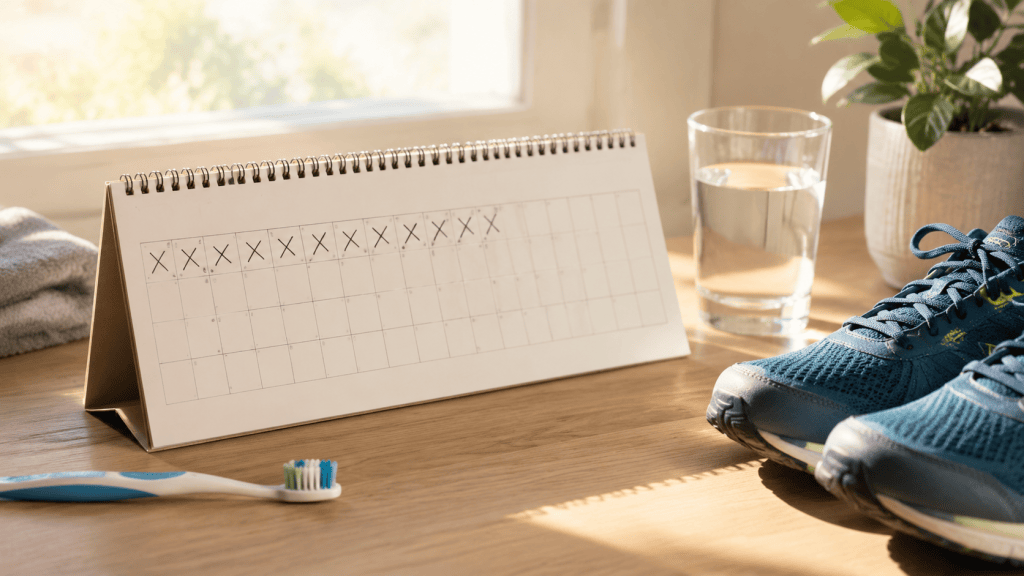
The promise is irresistible: repeat something for three weeks and
it will become automatic. The science is less tidy—and considerably more
encouraging.
The “21-day rule” appears in fitness challenges, productivity videos
and habit-tracking apps. It offers a finish line close enough to
imagine. Twenty-one days without sugar; twenty-one mornings of exercise;
twenty-one nights without scrolling.
But research does not support a universal three-week transformation.
Habits form at very different speeds depending on the person, behaviour
and setting. A 2024 systematic review found reported medians around 59
to 66 days and means from 106 to 154 days, with individual results
ranging far beyond either figure.
That does not mean change is hopeless. It means the stopwatch was the
wrong model.
Where 21 days came from
The number is commonly traced to plastic surgeon Maxwell Maltz. In
his 1960 book Psycho-Cybernetics, Maltz observed that patients
often needed at least about 21 days to adjust psychologically to a
changed appearance or an amputation.
This was an observation about adaptation, not a controlled finding
that any repeated behaviour becomes habitual after exactly three weeks.
Retellings gradually removed the cautious “minimum” and the specific
clinical context. A memorable estimate hardened into a rule.
The path is familiar. Precise numbers sound scientific, travel well
and fit neatly into a challenge. “It varies considerably” is more
truthful but less marketable.
What a habit actually is
A habit is not simply something performed many times. It is a
behaviour increasingly triggered by a context with less conscious
decision-making.
If putting the kettle on prompts someone to take a daily tablet, the
kettle becomes a cue. If arriving home prompts shoes to come off and
running shoes to go on, the transition becomes part of the routine.
Researchers often measure “automaticity”: how much the action happens
without deliberate thought. Repetition in a stable context strengthens
the cue-behaviour connection. The process usually rises quickly at first
and then gradually approaches a plateau rather than clicking into place
on one decisive day.
Why the timing varies
Drinking a glass of water after breakfast is simpler than completing
a lengthy workout. Daily behaviours offer more repetitions than weekly
ones. A routine that fits an existing schedule has stronger cues than a
vague intention to act “when there is time.”
Enjoyment, reward, effort and individual circumstances matter too. So
do interruptions. Illness, childcare, shifts and travel change the
environments in which habits are supposed to operate.
The 2024 review, covering more than 2,600 people across 20 studies,
found wide variation. Some behaviours began feeling habitual in a few
days; the longest reported formation periods extended to 335 days.
Exercise generally took longer than simpler eating or drinking
behaviours.
Missing once is not starting
again
The 21-day story encourages an all-or-nothing streak. Miss day 17 and
the imagined clock returns to zero.
Evidence from habit research is kinder. One missed opportunity does
not erase the associations built by earlier repetitions. A pattern of
inconsistency matters, but a single disruption is a wobble rather than
destruction.
This changes the useful response to a missed day. There is no need
for punishment or a dramatic Monday restart. Resume at the next normal
cue.
Build the cue, not just the
ambition
“Exercise more” describes an outcome. “After breakfast, I will walk
for ten minutes” identifies a cue and an action. The second plan gives
the behaviour somewhere to live.
Good habit design reduces friction. Put the needed object where the
cue occurs. Make the first version small enough to repeat on difficult
days. Choose a time that already has structure. Reward can be immediate
and simple: satisfaction, a check mark, music enjoyed only during the
walk.
Complex goals may need several habits rather than one heroic routine.
“Get fit” could become laying out clothes, walking after lunch and
preparing one regular meal.
The better promise
Three weeks can still be useful. It is long enough to learn about
obstacles and prove that a change is possible. It just should not be
sold as a biological deadline.
The better promise is that automaticity grows through repetition, and
the speed is personal. If a behaviour still feels effortful after day
21, nothing has gone wrong. The habit may be forming exactly as real
habits do: unevenly, gradually and without a cinematic moment when
willpower becomes unnecessary.
Quick facts
- The 21-day idea is linked to Maxwell Maltz’s observations about
adjustment after surgery. - Habit researchers measure automaticity, not merely consecutive
repetition. - A 2024 review found median formation times around 59–66 days in
reporting studies. - Individual times varied from a few days to as long as 335 days.
- Missing one occasion does not usually erase the progress already
made.





Leave a Reply