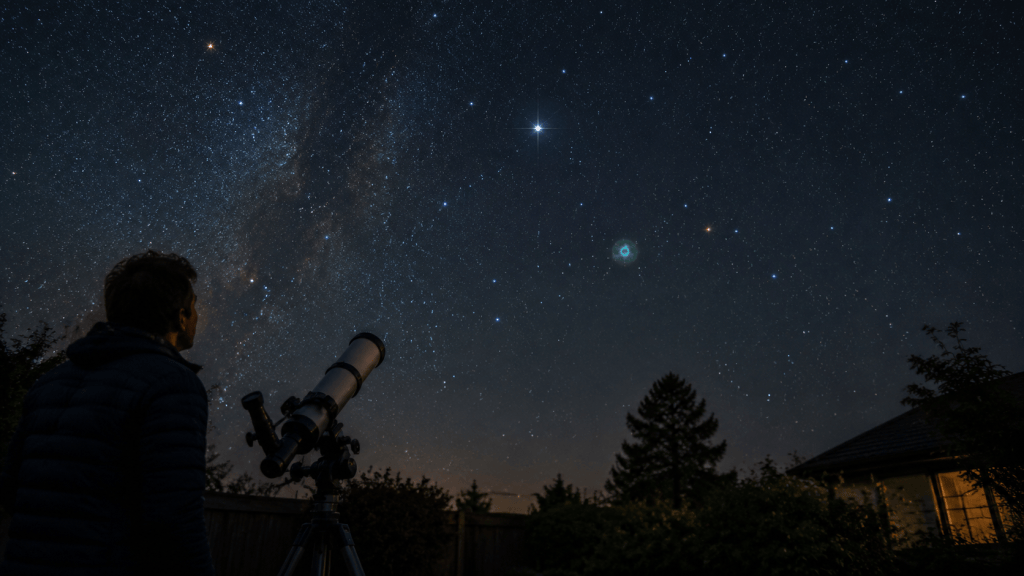
Look directly at NGC 6826 and its faint shell can disappear. Look
slightly away and it returns. The nebula is not flickering; your retina
is changing the view.
High in the northern constellation Cygnus lies a small blue-green
planetary nebula surrounding a bright central star. Through a modest
telescope, observers can make it appear to blink simply by shifting
their gaze.
The effect is wonderfully interactive. It is also a demonstration of
how seeing is not the same as a camera recording light. Different parts
of the human retina are built for different jobs.
A planetary nebula with no
planet
NGC 6826 is called a planetary nebula, but it has nothing to do with
planets. The name comes from early telescopic observers who saw small
round discs that resembled the planets visible through their
instruments.
The object is a late stage in the life of a star broadly similar to
the Sun. After exhausting fuel in its core and expanding into a red
giant, the star shed outer layers into space. Ultraviolet radiation from
the exposed hot core now makes that expanding gas glow.
The central star remains bright and concentrated. The surrounding
shell is extended and much fainter. That combination creates the
“blink.”
Cones at the centre
The retina contains two main kinds of light-sensitive cells. Cones
support detailed, colour-rich vision in brighter conditions. They are
densely concentrated in the fovea, the tiny central area used when we
look directly at something.
Rods are more sensitive in low light but provide less detail and no
true colour vision. They are more numerous away from the fovea.
When an observer stares directly at NGC 6826, the central star falls
on the cone-rich fovea. The star is easy to see, but the dim, spread-out
gas may fall below the threshold of direct vision.
Shift the gaze slightly to one side and the nebula’s light reaches a
rod-rich part of the retina. The shell reappears. Look back at the star
and it seems to vanish again.
Averted vision
Astronomers call this technique averted vision. Rather than looking
straight at a faint galaxy, cluster or nebula, the observer looks a
little to one side while keeping attention on the target.
The ideal direction differs between people and eyes because of the
blind spot and retinal structure. A small shift is enough; looking too
far away loses the object altogether.
Averted vision works best after dark adaptation. Bright phone screens
bleach the eye’s light-sensitive chemistry and make faint objects harder
to recover. Red light preserves night vision better, though even red
light should be kept dim.
Why photographs do not blink
A camera sensor does not have a fovea surrounded by rod-rich
peripheral vision. It can also collect photons during a long exposure,
building a bright image from light too faint for the eye to register
instantly.
Astrophotographs therefore show the shell continuously. The blinking
is not a property of the nebula switching on and off; it emerges from
the conversation between object, telescope and observer.
Atmospheric turbulence can make stars twinkle, but that is a
different effect. Turbulence bends starlight through moving pockets of
air. NGC 6826’s famous change is produced mainly by where its image
falls on the retina.
How to see it
NGC 6826 lies in Cygnus and is accessible to small telescopes under
reasonably dark skies. At low magnification it can resemble an ordinary
star. Increasing magnification helps reveal the tiny disc.
First locate the central star. Let the eye adapt, then move the gaze
a fraction to one side. Alternate gently between direct and averted
vision. The surrounding haze should appear stronger when not examined
head-on.
The technique can feel paradoxical: to see an object, stop looking
directly at it. Once learned, it opens much of the faint night sky.
Seeing the act of seeing
Most astronomical objects appear indifferent to the observer. The
Blinking Planetary Nebula seems to respond. A tiny movement of the eye
changes what exists in the view.
Nothing is actually blinking thousands of light-years away. What
flickers is the boundary of human perception. That makes NGC 6826 more
than a beautiful stellar remnant: it is a telescope pointed inward as
well as outward.
Quick facts
- NGC 6826 is a planetary nebula in Cygnus.
- Planetary nebulae are glowing shells shed by ageing stars, not
planetary systems. - Direct vision favours the bright central star.
- Averted vision places the faint shell on more light-sensitive rod
cells. - Cameras show the nebula continuously because the blink is a
visual-perception effect.





Leave a Reply