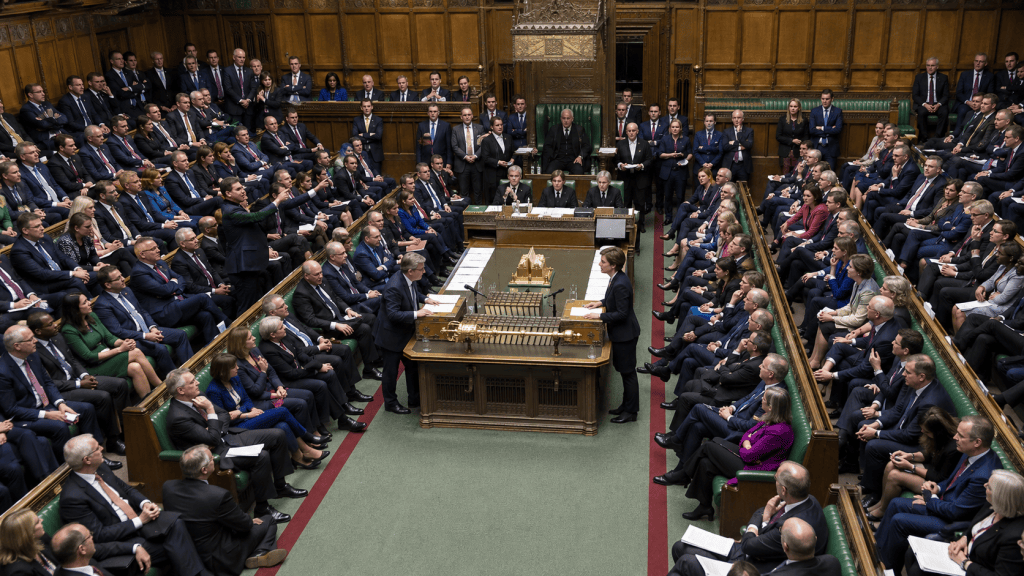
For half an hour each sitting Wednesday, the House of Commons
turns one constitutional principle into live theatre: the head of
government must stand up and answer.
Prime Minister’s Questions—PMQs—is one of the most recognisable
scenes in British politics. MPs roar, laugh, wave papers and attempt to
land a phrase that will survive the afternoon news. The prime minister
and leader of the opposition face one another across the dispatch
boxes.
It can look ancient. The current timetable is comparatively young.
Set periods for questions to the prime minister began in 1961, and the
single Wednesday session dates only from 1997.
Questions before Question
Time
Parliamentary questions are much older than PMQs. MPs have long used
them to seek information, challenge ministers and draw public attention
to grievances.
For much of the twentieth century, questions addressed to the prime
minister were mixed into the ordinary order of business. Prime ministers
often transferred detailed questions to the responsible department.
There was no guaranteed weekly confrontation resembling the modern
programme.
The pressure for a regular slot grew as the prime minister’s role
became more prominent and broadcasting made political personalities more
visible.
The 1961 settlement
In July 1961, Harold Macmillan’s government introduced fixed times
for prime-ministerial questions. The prime minister answered twice a
week, on Tuesday and Thursday afternoons, for 15 minutes each.
The arrangement made access predictable. MPs knew when they could put
questions to the head of government; journalists knew when to watch.
Repetition created a ritual.
The format remained twice weekly until Tony Blair became prime
minister in 1997. The two shorter sessions were combined into one
30-minute period on Wednesday at noon.
That change reduced the number of weekly appearances but created a
larger single event. Modern PMQs runs from 12.00 until around 12.30 on
sitting Wednesdays.
Why the first
question often says nothing
The formal order is not as spontaneous as it appears. MPs enter a
ballot to ask a question. The first listed question often asks the prime
minister to list official engagements for the day.
This open wording allows a supplementary question on almost any
aspect of government responsibility. If the detailed subject were
printed in advance, the prime minister could prepare a narrow
departmental answer. The engagements formula preserves surprise.
The Speaker calls MPs, manages time and tries to maintain order. The
leader of the opposition normally receives six questions, often divided
into exchanges. The leader of the third-largest party usually receives
two.
Accountability or theatre?
PMQs has two jobs that do not always sit comfortably together.
It is an accountability mechanism. The prime minister must appear in
the Commons, respond without knowing every supplementary question and
face cases raised by backbenchers. A local hospital, pension error or
threatened employer can enter the national record.
It is also partisan performance. Questions from government MPs may
invite rehearsed praise. Opposition leaders build a sequence toward a
conclusion. Noise rewards confidence more readily than detailed
explanation. Both sides extract short clips before the session has
ended.
Critics argue that the atmosphere discourages thoughtful answers and
makes Parliament look childish. Defenders note that few heads of
government submit to such frequent direct questioning in public.
Broadcasting changes the
room
Radio began carrying Commons proceedings in 1978, and regular
television coverage followed in 1989. PMQs became accessible beyond the
press gallery.
Television favours confrontation. A hesitant qualification can look
weak; a memorable retort travels well. Leaders rehearse examples and
lines while still needing enough flexibility to respond.
The audience is therefore several audiences: MPs in the chamber,
party supporters, journalists, television viewers and people who will
encounter only a short social-media clip.
What happens when
the prime minister is away?
Prime ministers sometimes miss PMQs for official engagements or other
reasons. A deputy or senior minister answers instead. The opposition’s
main leaders commonly stand aside too, allowing senior colleagues to
conduct the exchange.
Attendance has varied between governments, which is why the House of
Commons Library maintains records. The expectation of presence matters
politically even though it is governed by convention and scheduling
rather than a constitutional law requiring every appearance.
A weekly stress test
PMQs rarely forces an immediate change of policy. Its value is
cumulative. It exposes what the government is prepared to defend, what
opponents choose to prioritise and how confidently leaders command their
parties.
The noise can obscure the questions, but the ritual embodies a
significant idea: executive power should remain physically answerable to
elected representatives.
Every Wednesday, that principle is compressed into half an hour—part
scrutiny, part contest and part national theatre.
Quick facts
- Fixed periods for questions to the prime minister began in
1961. - Until 1997, PMQs usually consisted of two 15-minute sessions on
Tuesdays and Thursdays. - Since 1997, it has normally run for 30 minutes at noon on sitting
Wednesdays. - The leader of the opposition usually asks six questions.
- An “engagements” question allows a wide-ranging unannounced
supplementary.



Leave a Reply