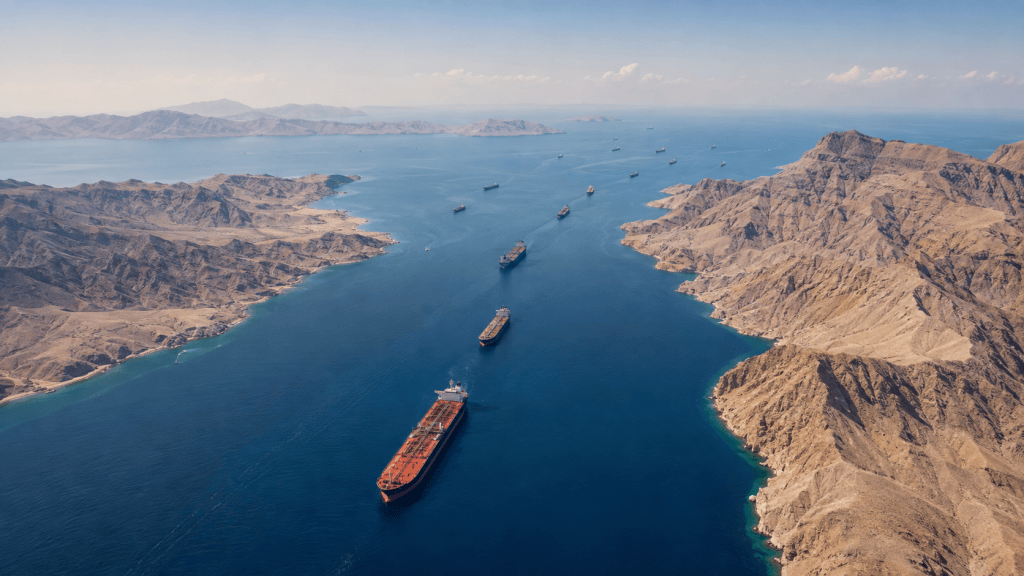
At its narrowest, one of the world’s most important energy routes
is only a few dozen kilometres across. Trouble there can affect fuel
bills and economies thousands of miles away.
The Strait of Hormuz connects the Persian Gulf to the Gulf of Oman
and the Arabian Sea. Iran lies to the north; Oman and the United Arab
Emirates are to the south. Tankers carrying oil and liquefied natural
gas pass through shipping lanes inside this confined waterway before
reaching global markets.
Its importance comes from a simple geographical fact: several major
producing countries share a gulf with one principal sea exit.
What makes a chokepoint?
A maritime chokepoint is a narrow part of a heavily used route where
traffic is concentrated. The Strait of Malacca, Suez Canal, Panama Canal
and Bab al-Mandeb all perform similar geographical work.
Concentration creates efficiency. Ships take the shortest practical
route and ports develop around it. It also creates vulnerability. An
accident, conflict or threat can delay many journeys at once.
Hormuz is wide enough and deep enough for the largest crude carriers,
but commercial traffic uses designated inbound and outbound lanes. The
useful corridor is much narrower than the water visible on a map.
How much energy passes
through?
According to the US Energy Information Administration, about 20
million barrels of oil per day moved through Hormuz in 2024—roughly
one-fifth of global petroleum-liquids consumption and more than a
quarter of seaborne oil trade.
Around one-fifth of global liquefied-natural-gas trade also transited
the strait, much of it exported by Qatar.
Those proportions matter more than the nationality of any one tanker.
Oil is globally traded. If a major flow is delayed, buyers compete for
supplies elsewhere and prices can change even in countries that import
little directly from the Persian Gulf.
Why not go around?
There is no simple maritime detour. A ship inside the Persian Gulf
must use Hormuz to reach the open ocean.
Some oil can bypass the strait by pipeline. Saudi Arabia’s East-West
pipeline reaches the Red Sea, and the UAE operates a line to Fujairah on
the Gulf of Oman. Iran has developed the Goreh-Jask route.
But pipelines have limited capacity, do not connect every field and
terminal, and may already be carrying oil. The EIA estimated in 2025
that roughly 2.6 million barrels per day of unused Saudi and UAE
pipeline capacity might be available during a disruption—a useful
cushion, but far below normal maritime flow.
LNG is harder to reroute because it requires specialised liquefaction
plants, ships and receiving terminals.
The effects begin before
closure
The strait does not have to be physically blocked to influence
markets. Threats can raise insurance costs. Shipowners may delay
departures, alter speeds or demand higher payments. Naval escorts and
inspections can slow traffic. Traders respond to the probability of
interruption, not only to interruption itself.
That makes headlines volatile. A day’s vessel count can be affected
by scheduling, weather or ships waiting nearby. A short fall does not
prove a blockade; a normal count does not remove risk.
Careful reporting separates observed traffic from claims about
intention.
Why Asia is especially
exposed
In 2024, the EIA estimated that 84 per cent of the crude oil and
condensate and 83 per cent of the LNG passing through Hormuz went to
Asian markets. China, India, Japan and South Korea were the largest
crude destinations.
Yet exposure spreads through prices and supply chains. Energy costs
affect freight, aviation, chemicals, fertiliser and manufacturing.
Governments may release strategic stocks or change policy. A narrow sea
lane enters the price of ordinary goods.
Geography as infrastructure
Pipelines, reserves and alternative energy can reduce dependence, but
the strait’s significance cannot be engineered away quickly. Oilfields,
export terminals and consuming economies were built over decades around
the route.
Hormuz matters because geography has gathered an enormous flow into a
small space. The waterway is not important by itself. It is important
because so much of the modern world has been organised to pass through
it.
Quick facts
- Hormuz links the Persian Gulf with the Gulf of Oman and Arabian
Sea. - About 20 million barrels of oil per day passed through in 2024.
- That represented roughly one-fifth of global petroleum-liquids
consumption. - Around one-fifth of global LNG trade also used the strait.
- Saudi and UAE pipelines provide partial, not complete,
alternatives.




Leave a Reply