Most digital games try to keep you playing. Wordle became a
worldwide habit by telling you to stop after a few minutes and come back
tomorrow.
A Wordle puzzle offers six attempts to identify a five-letter word.
Finish it—or fail—and the game is over for the day. There is no next
level, energy refill or endless sequence generated to hold your
attention.
That limitation looks like missing functionality. It is actually the
centre of the design.
By giving everyone the same single puzzle, Wordle turned a private
word game into a shared daily event. Scarcity created anticipation; the
stopping point protected the pleasure from exhaustion.
Built for one person
Josh Wardle originally made the game for his partner, Palak Shah, who
enjoyed word puzzles. It was not designed around advertising,
subscriptions or the measurements used to maximise time inside an
app.
That origin matters. Wordle did not need to manufacture reasons to
continue playing. Its job was simply to provide one satisfying
encounter.
When it spread publicly in 2021, the audience grew with extraordinary
speed—from dozens of daily players to hundreds of thousands and then
millions. Its plain page loaded quickly. There were no accounts, pop-ups
or instructions demanding attention.
The restraint made it feel unusually generous. The game took a few
minutes and then returned the day to the player.
Everyone faces the same word
If Wordle supplied unlimited random puzzles, one player’s experience
would have little connection to another’s. The daily answer creates
simultaneity. Friends, families and strangers wrestle with the same
pattern of letters.
That permits conversation without requiring multiplayer software.
“How did you do today?” becomes meaningful because the challenge was
shared.
Daily newspapers have long used the same principle. A crossword is
not merely a grid of clues; it is today’s crossword. Publication gives
it a date, a community and a small place in routine.
Wordle translated that rhythm to the web.
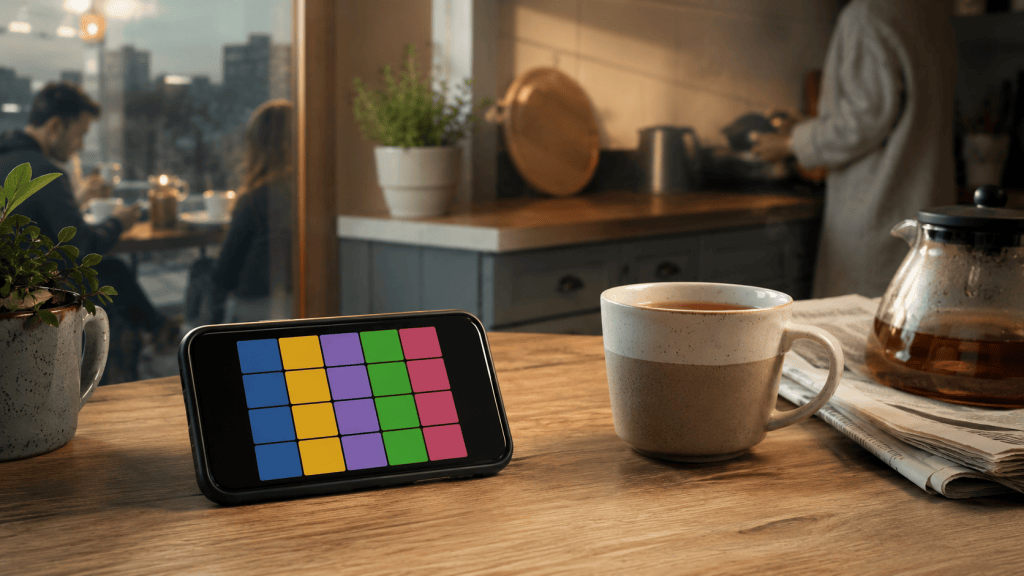
The spoiler-free grid
Early players devised ways to share results, but a grid of coloured
square emoji became the perfect social object. It shows the shape of a
solution—how many guesses, where letters were found—without revealing
the word.
The grid is compact, recognisable and slightly mysterious to
non-players. It travels easily through group chats and social feeds. It
also advertises the shared ritual without looking like a conventional
advert.
Crucially, the result has status because attempts are limited. A
two-line grid means something when the player could not simply restart
until lucky.
Scarcity prevents the
game eating itself
Unlimited access can reduce the value of an experience. When the next
puzzle is always available, it becomes easy to play until concentration
drops and the game feels repetitive.
Wordle imposes a clean ending. A good result leaves a little
satisfaction; a failure leaves unfinished business for tomorrow. Both
states can support return without requiring push notifications.
This is sometimes described as artificial scarcity, but the word
“artificial” need not mean dishonest. Rules create every game. A
football match ends after a set time; a crossword has a finite grid.
Wordle’s daily limit is simply one of its rules.
A ritual rather than a binge
Daily play attaches itself to existing moments: breakfast, a commute,
a tea break or the exchange of family messages. Because the task is
short and predictable, it is easy to make room for.
The game also produces a gentle form of collective timekeeping.
Puzzle numbers accumulate. People remember a streak, a difficult word or
the day everybody seemed to choose the same bad opening guess.
The New York Times acquired Wordle in 2022, but its essential shape
remained recognisable: one puzzle, one day, one shareable result.
The design lesson
Digital products often assume that success means removing every
stopping point. Wordle demonstrates another possibility. A boundary can
make participation feel safer and more valuable.
The limit protects the communal aspect, gives each puzzle an identity
and preserves appetite for the next one. Wordle did not succeed despite
allowing only one game a day. In a crowded internet, it succeeded partly
because one was enough.
Quick facts
- Josh Wardle originally created Wordle for his partner, Palak
Shah. - Players receive six attempts to guess a five-letter word.
- Everyone receives the same daily puzzle.
- Coloured result grids share progress without revealing the
answer. - The New York Times acquired the game in 2022.



Leave a Reply