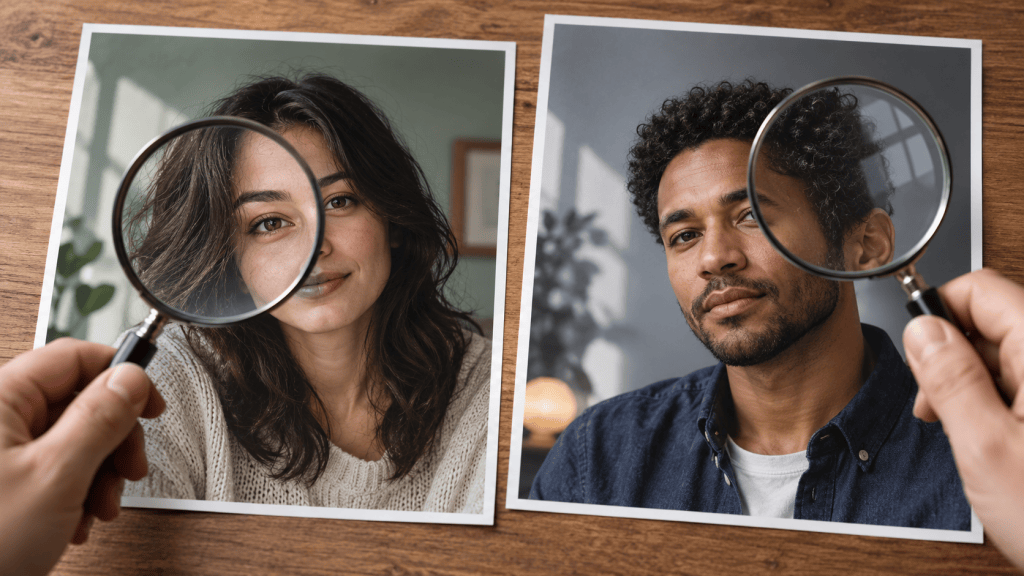
Early synthetic faces often advertised themselves. Earrings
disagreed, hair dissolved into backgrounds and spectacles bent at
impossible angles. Advice was simple: count the fingers, inspect the
teeth, look for a melted ear.
Image generators improved. The more useful fake is not a spectacular
fantasy portrait but an entirely plausible face attached to a false
identity, review or social-media account.
Researchers at the University of Southampton reported that a short
online training session—about 15 to 20 minutes—improved participants’
ability to distinguish AI-generated faces from real photographs. An
improvement remained when they were tested 20 days later.
Training helps, but it does not create infallibility.
Detection is a
classification problem
The viewer is being asked to divide images into two categories
despite having incomplete information. Some genuine photographs are
heavily processed, poorly lit or unusually smooth. Some synthetic faces
contain realistic texture and asymmetry.
People also bring expectations. Earlier research found that certain
highly realistic synthetic faces could be judged more real than actual
faces, particularly within image sets dominated by white faces.
Familiarity with the represented demographic, the generator’s training
data and the experiment’s design can all affect results.
The problem is therefore not simply sharp eyesight. It is
calibration: knowing which cues deserve weight and how confident to
be.
What training can teach
Useful instruction directs attention to relationships rather than one
isolated giveaway. Light should fall consistently across face, eyes and
background. Reflections in the pupils should broadly agree. Hairlines,
jewellery and glasses must connect coherently. Skin texture should vary
naturally rather than alternate between plastic smoothness and abrupt
detail.
Backgrounds can matter as much as faces. Repeated shapes, meaningless
symbols, distorted architecture or an object merging with a shoulder may
reveal generation.
Yet each clue is temporary. Models improve, while image compression
and ordinary editing can create similar artefacts in genuine
photographs. A checklist must evolve.
The
source is often stronger evidence than the pixels
Visual inspection asks, “Does this look wrong?” Verification asks,
“Where did it come from?”
Reverse-image searching can reveal earlier appearances. A supposed
employee may have no consistent professional history. An account created
recently may post at unnatural volume. News photographs can be checked
against agencies or original publishers. Metadata and content
credentials may help when preserved, although screenshots often strip
them.
This contextual approach is more resilient because deception needs a
story as well as an image. Even a flawless face may be attached to a
biography that does not cohere.
Training has limits
A study result describes performance under particular test
conditions. Real life introduces distractions, smaller images, mixtures
of editing techniques and incentives to believe what confirms an
existing view. Skills can fade or become obsolete as generators
change.
There is also a danger of false accusation. A genuine person may have
unusual features, use beauty filters or belong to a demographic
underrepresented in training examples. Confidently declaring a face “AI”
can harm somebody whose image is real.
The responsible conclusion is probabilistic. Suspicion should trigger
checking, not public certainty.
The aim is
better judgement, not perfect vision
Media literacy once taught that photographs could be cropped, staged
and retouched. Generative AI increases the speed and accessibility of
fabrication but does not abolish the older lesson: images are claims
made in a context.
Training can improve attention and reduce misplaced confidence. The
strongest skill, however, is knowing when the face alone cannot settle
the question.
Quick facts
- Southampton researchers tested a short online training
intervention. - Participants improved at classifying AI-generated and real
faces. - Some improvement remained at a follow-up 20 days later.
- Visual artefacts can also appear in genuine compressed or edited
photographs. - Context, source history and corroboration are essential when
consequences are serious.





Leave a Reply