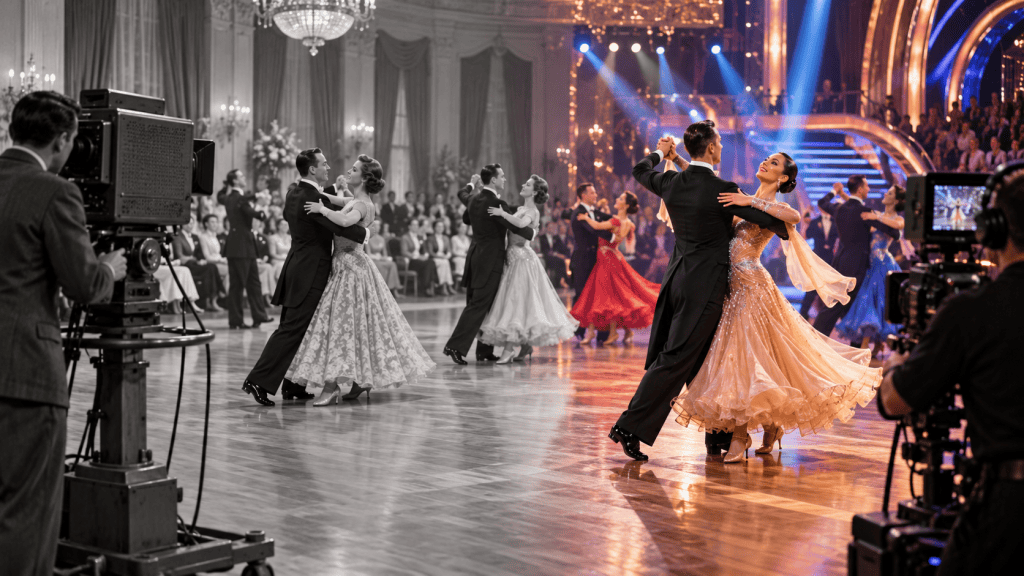
Ballroom dancing looks purpose-built for television. It offers
colour, music, recognisable competition and the possibility of visible
improvement. Yet cameras initially encountered it not as celebrity
entertainment but as an established social world of dance schools, local
teams and grand municipal ballrooms.
The BBC’s Come Dancing began in 1949. More than half a
century later, Strictly Come Dancing borrowed its name and
transformed the formula. The distance between them maps a change in both
television and British leisure.
The ballroom was already
a mass medium
Public dance halls allowed large numbers of people to learn the same
steps, hear popular music and meet under structured social rules.
Blackpool Tower Ballroom, opened in 1894 and rebuilt to Frank Matcham’s
celebrated design in 1899, embodied the grandeur of that culture with
balconies, decoration and a sprung floor.
Dance schools and competitions standardised techniques. That made
ballroom legible beyond the couple performing it. Judges could compare
footwork, posture, timing and floorcraft, while spectators learned what
to watch.
Television inherited a ready-made network of local expertise and
rivalry.
Come Dancing put
regions on the floor
The original programme presented teams and competitions from dance
halls around Britain. Early outside broadcasting was technically
cumbersome: cameras, lighting and sound had to make a large moving event
readable on small monochrome screens.
The appeal was not only the dancing. Local and regional identity gave
viewers somebody to support. Formal dresses, orchestras and disciplined
movement offered post-war glamour rooted in an activity ordinary people
could practise themselves.
Over decades the programme changed, but its title became shorthand
for televised ballroom. When it ended in 1998, the form seemed to belong
to an older broadcasting age.
Strictly changed
the emotional engine
The 2004 revival added “Strictly” from the film Strictly
Ballroom and paired professional dancers with celebrities. The
competition was no longer chiefly between accomplished amateur teams. It
became a story of learning.
A celebrity begins as the viewer’s representative: awkward,
frightened or overconfident. Training footage turns practice into
narrative. Judges provide technical language; public voting converts
affection into consequence. Each dance is both a performance and an
episode in a longer transformation.
That format also widened the audience. Viewers did not need prior
ballroom knowledge because the programme taught them through criticism,
rehearsal and comparison.
Why Blackpool still matters
Modern television can build a spectacular studio anywhere, yet
visiting the Blackpool Tower Ballroom remains a ceremonial milestone.
The venue supplies authenticity: a physical link between the current
entertainment format and the social-dance tradition it reinvented.
Its sprung floor, scale and ornament change the performance, but its
greatest value is historical. The programme steps into its own back
catalogue.
A British hybrid travelled
worldwide
The format was exported as Dancing with the Stars and other
local versions. Its ingredients travel well: local celebrities,
professional skill, familiar music and a transparent weekly
elimination.
But the underlying idea is older than reality television. Ballroom
has always combined private partnership with public display. Two people
must communicate physically while obeying shared rules and being
watched.
Television magnified that structure. First it broadcast a living
dance culture; later it used dance to tell stories about effort,
confidence and change.
The sequins are not a disguise placed over history. They are one of
the ways history stayed on air.
Quick facts
- The BBC’s Come Dancing began in 1949 and ended in
1998. - Strictly Come Dancing began in 2004.
- The modern title combines Come Dancing with the film
Strictly Ballroom. - Blackpool Tower Ballroom first opened in 1894; its present
Matcham-designed interior dates from 1899. - The format is known internationally through versions including
Dancing with the Stars.




Leave a Reply