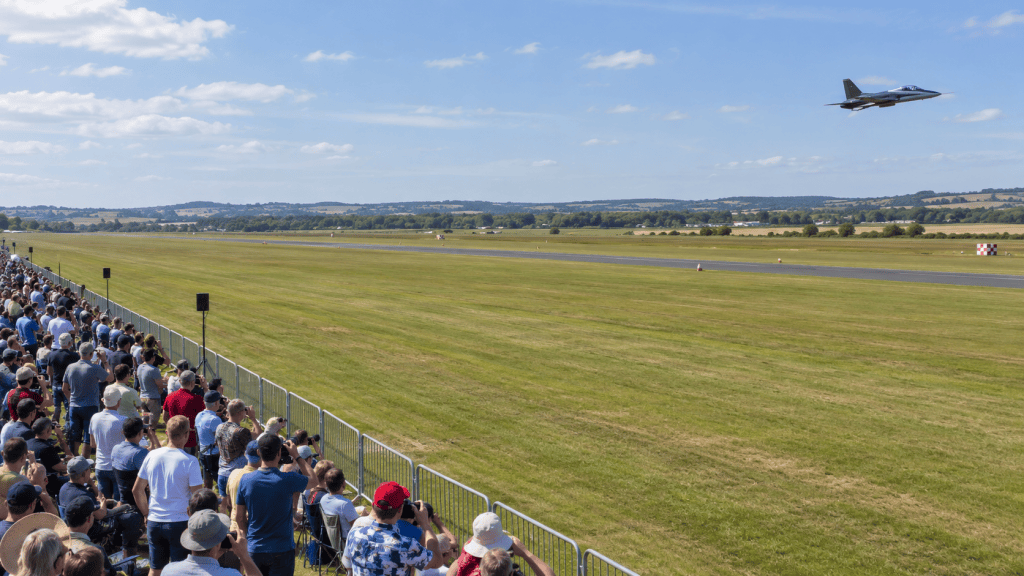
At an airshow, the audience watches the aircraft. Safety planners
also watch the lines on the ground.
On 5 September 2026, a Greek F-4 Phantom crashed during Athens Flying
Week at Tanagra. Both pilots were killed. No spectators were reported
injured, and investigators must determine the cause; public video cannot
substitute for their work.
The tragedy reopened an enduring question. When aircraft are
deliberately flown close enough to be spectacular, how are people on the
ground kept outside the risk?
The display has an axis
An air display is not a free performance over a crowd. The organiser
establishes a display line or axis, generally running parallel to the
spectator area. Aircraft perform on the far side of it, at distances
determined by the type of aircraft, speed and manoeuvre.
This geometry matters because an aircraft contains energy. Its speed
and direction affect where it could travel if control is lost or a
component fails. A manoeuvre that directs energy along the display line
is very different from one aimed towards spectators.
Crowd separation is therefore not merely an empty strip. It is a
designed buffer combined with rules about the orientation of flight.
Height and competence
are controlled too
Display pilots require suitable qualifications, currency and
authorisation. A pilot competent to fly an aircraft in ordinary
operations is not automatically approved to perform low-level aerobatics
before a crowd.
Minimum heights and distances vary with the display and conditions.
Weather can restrict the permitted routine. A cloud base that removes
vertical room, a crosswind that pushes the display towards the crowd or
reduced visibility can lead to modification or cancellation.
Briefing connects individual performances to the whole event. Pilots
need the local geography, display boundaries, emergency procedures and
sequence. Controllers and the flying display director must know when the
airspace is clear.
Spectators exist
beyond the ticketed enclosure
One difficult lesson from airshow accidents is that risk does not
stop at the event fence. Roads, houses and informal viewing areas may
lie beneath approaches or beyond display boundaries.
After the 2015 Shoreham Airshow disaster, in which an aircraft
crashed onto the A27 and killed 11 people, the UK Civil Aviation
Authority reviewed display governance, oversight, risk assessment and
the protection of people outside organised spectator areas.
Modern planning must therefore consider the surrounding population,
not just the official crowd. Some manoeuvres or aircraft may be
unsuitable at a site even if the showground itself has ample space.
Emergency
planning accepts that prevention is not certainty
Fire crews, medical teams and rescue services are positioned because
no safety rule can make mechanical and human failure impossible. Access
routes must stay open. Organisers plan for an aircraft incident, mass
casualties, fire and the needs of a crowd that may have to remain in
place or leave safely.
That is not evidence that displays are expected to fail. It is the
principle of defence in depth: qualification, geometry and operating
limits reduce the probability, while emergency preparation reduces
consequences if prevention fails.
Investigation should
precede explanation
Air accidents attract immediate theories. A visible manoeuvre is
replayed, a sound is interpreted and an aircraft type’s history is
recruited into a confident story. Proper investigation instead considers
wreckage, maintenance, recordings, weather, human factors and the
planned routine.
Until that work is complete, the responsible description is simple:
what happened is known; why it happened is not.
Airshow safety is a continual negotiation between spectacle and
distance. The best protections may be almost invisible to the audience.
The aircraft seems to own the whole sky, while in fact it is flying
inside a carefully drawn corridor.
Quick facts
- Display aircraft normally fly beyond a defined line separated from
spectators. - Manoeuvres are assessed by direction and energy, not only
distance. - Pilots need display-specific authorisation and recent
competence. - Weather can require a routine to be altered or cancelled.
- UK rules and oversight were extensively reviewed after the 2015
Shoreham disaster.



Leave a Reply