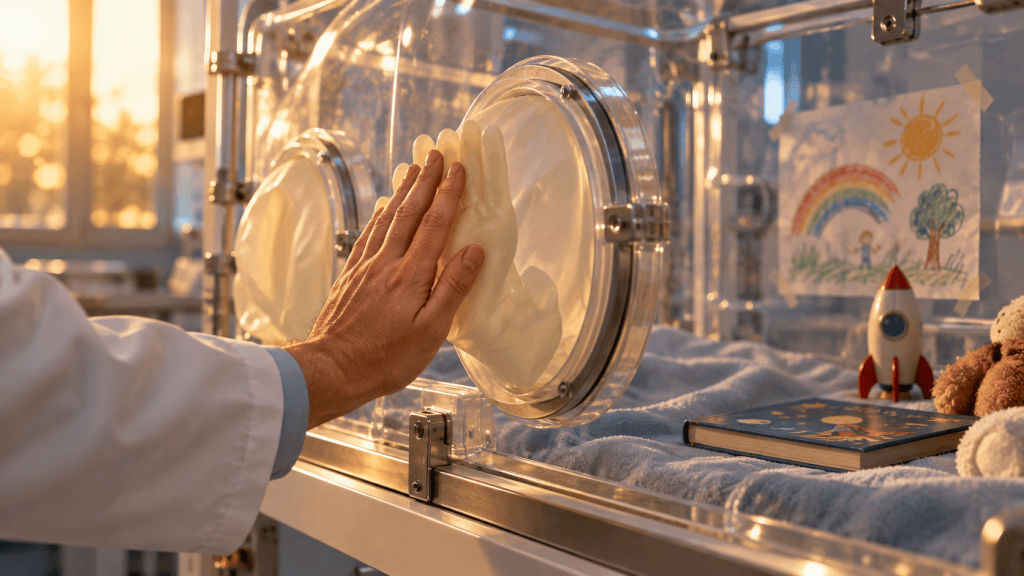
The phrase “bubble boy” risks turning a child into a medical exhibit.
David Vetter was a person who played, learned, formed relationships and
understood far more about his circumstances than the nickname
suggests.
He was born in Texas in 1971 with severe combined immunodeficiency,
or SCID. His immune system could not defend him normally against
infections. A specially constructed sterile enclosure protected him from
microorganisms that most people encounter without consequence.
The enclosure made David famous. Medically, its most important lesson
was that protection from the world could preserve life but could not
replace an immune system.
What SCID does
SCID is a group of rare inherited disorders affecting crucial immune
cells. Different genetic faults can produce it, but the result is
profound vulnerability to bacterial, viral and fungal infection. An
organism harmless to most people may become life-threatening.
Without effective treatment, infancy itself is dangerous. Today,
early identification can allow protective measures and treatment before
repeated infection causes severe damage.
David’s older brother had died from the condition. Doctors expected
that a compatible bone-marrow donor might eventually provide functioning
immune cells, while the sterile environment would keep David safe until
treatment was possible.
Isolation
solved one problem by creating others
The enclosure filtered air and sterilised objects before they reached
David. Gloves built into its walls enabled physical care without direct
exposure. Later, a protective suit allowed limited movement outside.
This was a remarkable infection-control achievement, but life cannot
be reduced to the absence of microbes. Touch, privacy, choice,
development and ordinary contact all mattered. Every object and
interaction became a technical procedure.
The case forced clinicians and the public to consider quality of life
alongside survival. It also raised questions about consent and publicity
around a child whose unusual environment attracted worldwide
attention.
Transplantation aimed at the
cause
A bone-marrow transplant can supply blood-forming stem cells capable
of producing working immune cells. Success depends on factors including
donor match, infection status and the particular form of SCID.
David received a marrow transplant from his sister in 1983. It was
later discovered that the donated cells carried Epstein–Barr virus,
which led to lymphoma. He died in 1984, aged 12.
That outcome should not be read as proof that transplantation cannot
work. Techniques for donor matching, infection detection and transplant
care have advanced substantially. Stem-cell transplantation is now an
established treatment for many children with SCID.
Screening changes the
timetable
One of the most important improvements is finding SCID before a baby
appears ill. Newborn screening can detect signs that essential immune
cells are missing. Earlier diagnosis makes it possible to prevent
exposure and begin treatment before severe infections accumulate.
The history also led towards gene therapy. For some types of SCID, a
patient’s own blood-forming stem cells can be removed, given a working
copy of the faulty gene and returned. This avoids the need for a matched
donor, although treatment carries risks and remains specialised.
Modern gene therapies are the result of decades of refinement,
including learning from serious complications in early trials. Progress
is a history of correction as well as breakthrough.
The bubble changed the
question
David’s enclosure demonstrated that engineering could create an
extraordinary barrier between patient and pathogen. But the goal of
medicine became not a better bubble; it became an immune system able to
let a child live outside one.
His life contributed to knowledge, but it should not be valued only
for what others learned. Respectful medical history keeps the person
visible inside the technology.
The lasting achievement is measured in children now diagnosed
earlier, treated more effectively and able to meet the microbial world
with protection of their own.
Quick facts
- SCID is a group of inherited disorders causing profound immune
deficiency. - David Vetter was born in 1971 and lived in a sterile protective
environment. - The enclosure prevented exposure; it did not repair his immune
system. - Stem-cell transplantation can provide functioning immune cells.
- Some forms of SCID can now be treated with specialised gene
therapy.





Leave a Reply