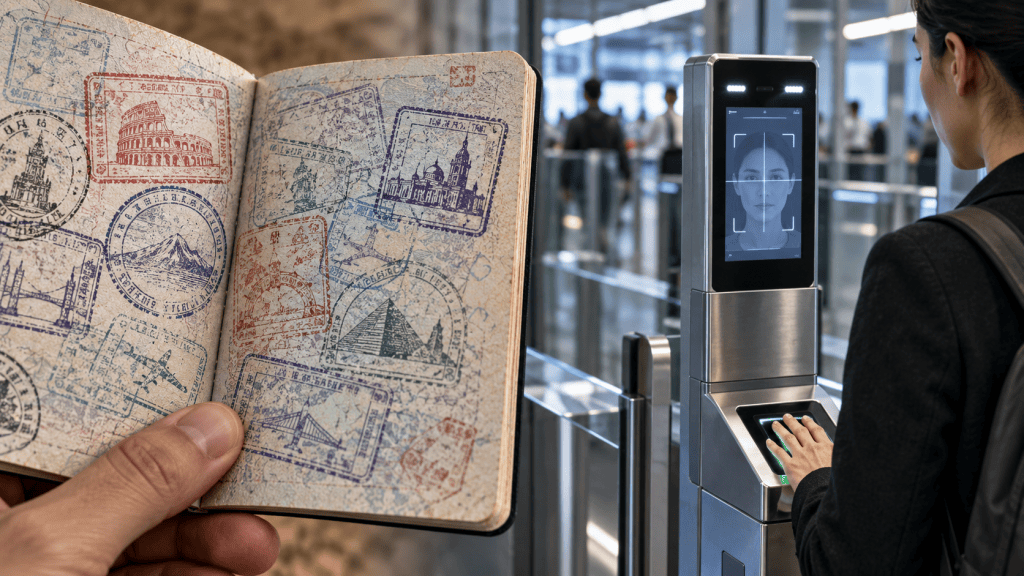
A passport stamp performs two very different jobs. To a border
officer it is an administrative mark: evidence that a person entered or
left under particular conditions. To its owner it can become a miniature
souvenir, recalling an airport, a ferry or the nervous excitement of
arrival.
The first job is increasingly being given to databases. The second
may disappear with it.
The European Union’s Entry/Exit System, known as EES, records the
movements of many non-EU travellers electronically. It is part of a
wider shift from the visible mark in a document to a biometric identity
stored across a border network.
Why stamp a passport at all?
Passports identify travellers, but the booklet alone does not record
how it has been used. Stamps supplied a cheap, portable ledger. A date,
place and entry or exit symbol allowed an officer to reconstruct a
journey and see whether somebody might have overstayed.
The system was brilliantly simple and imperfect. Ink could be faint,
pages could fill, designs varied, and an officer had to calculate
permitted stays by examining marks made at different borders. Lost or
replaced passports separated the traveller from the record.
Stamps were designed for officials, not collectors. Their accidental
beauty came from repetition: overlapping shapes and languages gradually
turned a standard document into a personal atlas.
What EES records
EES creates an electronic record for short-stay non-EU nationals
crossing the external borders of participating European countries. It
stores travel-document data, the date and place of entry and exit, and
biometric information such as a facial image and fingerprints. Refusals
of entry can also be recorded.
On an initial journey, registration may therefore take longer than
receiving a stamp. Later crossings should be able to compare the
traveller with the existing record. The system can calculate how much of
the permitted short stay has been used and flag a missing exit more
consistently than manual inspection.
The change does not abolish passports or border checks. It changes
where the evidence lives.
EES and ETIAS are not the
same thing
Two similar abbreviations often become confused. EES is a border
recording system: it notes crossings. ETIAS is a separate
travel-authorisation scheme for visa-exempt visitors, comparable in
broad purpose to electronic permissions used by other countries.
An authorisation is obtained before travel; an entry record is
created at the border. Neither guarantees admission, because the final
decision remains part of border control.
Keeping the systems distinct matters when headlines describe a new
“EU visa”. Most affected British visitors will not be applying for a
conventional visa for an ordinary short holiday, but they may need
authorisation and will have their crossing recorded digitally.
Digital records bring
different questions
A database can be searched, shared and checked more efficiently than
ink. Those advantages also make governance important. Biometric data
cannot be replaced like a password. Travellers need clear rules about
retention, access, correction and what happens when a machine fails to
match a face or fingerprint.
Automated calculation may reduce ambiguity, but it can also make an
error less visible. A missing stamp can be pointed to on a page; a
disputed database record may require a formal correction process.
Good border technology therefore depends on more than fast gates. It
needs accurate enrolment, human assistance, secure systems and workable
arrangements for exceptional cases.
The souvenir was never the
purpose
Travellers sometimes ask for a commemorative stamp, but authorities
increasingly discourage unofficial marks because they can cause
confusion. The era of collecting routine border ink was already uneven:
free-movement areas reduced stamping, while electronic gates left pages
untouched.
Future travellers may keep boarding passes, photographs or digital
timelines instead. Those records can be richer than a stamp, yet they
lack its peculiar authority. The mark was made by the journey itself,
not selected afterwards.
Border control gains a more capable ledger when stamps disappear. The
passport loses a little of its biography.
Quick facts
- Passport stamps historically recorded a traveller’s entry or exit in
the document itself. - EES stores dates, locations, travel-document details and biometric
data electronically. - The system covers many short-stay non-EU travellers at participating
European external borders. - ETIAS is a separate pre-travel authorisation, not the EES crossing
record. - Passports remain necessary even when the physical stamp is
replaced.




 The Knowledge Back Catalogue
Leave a comment