Most pieces of national infrastructure are encountered as systems.
Roads join other roads; cables disappear into networks; water arrives
from somewhere unseen. A postbox is different. The entire public
interface stands on the pavement, solid enough to lean against and small
enough to examine.
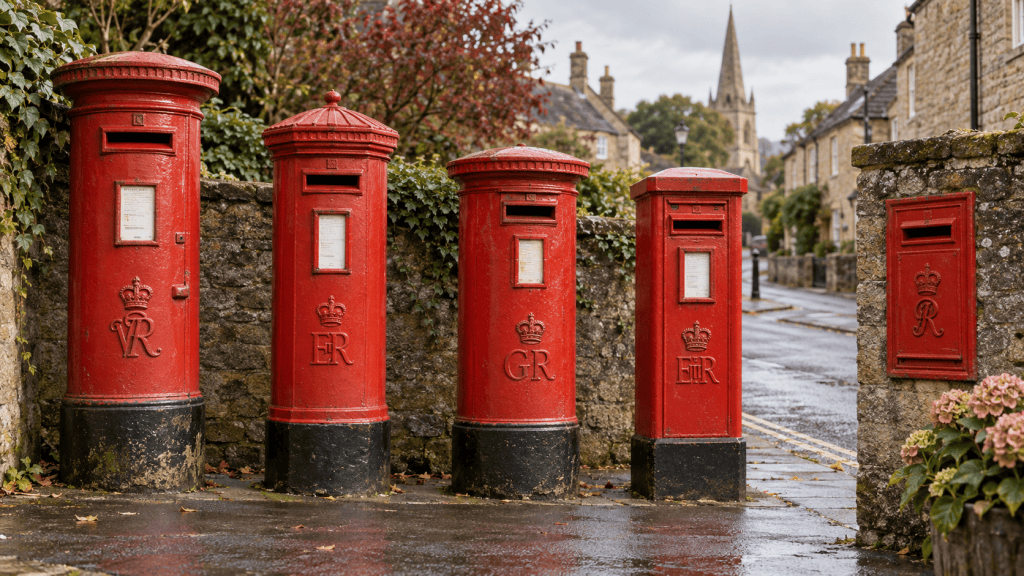
Its colour says “post” before any words are read. Its crown and
letters identify a reign. A maker’s name, collection plate and pattern
of hinges reveal further layers.
Britain’s postboxes are useful objects first, but they have also
become a street-corner archive assembled over more than 170 years.
The first experiment was
on an island
Before roadside boxes, posting a letter usually meant taking it to a
receiving house or post office. The spread of cheap postage after the
Penny Black increased the volume of mail and made convenient collection
more important.
Anthony Trollope, later famous as a novelist, worked for the Post
Office. After observing continental examples, he recommended roadside
letter boxes for the Channel Islands. The first British trials began in
Jersey in 1852, followed by Guernsey.
The early boxes were not yet part of a settled national design
language. Shapes, openings and colours varied. Some were olive or bronze
green; others differed by district and manufacturer. A recognisable
system had to be invented through use.
Red solved a visibility
problem
Green boxes could merge into rural and urban surroundings. The Post
Office began standardising red during the 1870s, producing a
transformation that took years rather than occurring everywhere at
once.
Red made the box conspicuous without requiring a large sign. It also
created a repeatable visual promise: wherever the same colour appeared,
the public understood what service was available.
That association became so strong that exceptions now feel
deliberate. Historic boxes painted in earlier colours attract attention
precisely because red became normal. In Ireland after independence,
existing boxes were painted green but often retained British royal
cyphers beneath the new colour, making political change visible in
layers of paint.
The letters
identify a reign, not a collection date
The royal cypher normally records the monarch reigning when the box
was made. “VR” indicates Victoria; “ER VII” Edward VII; “GR” George V;
“GVIR” George VI. Elizabeth II boxes bear “EIIR”, while new boxes for
Charles III use a cypher incorporating “CIIIR”. Scottish boxes may use a
crown without “EIIR”, reflecting the historical dispute over whether
Elizabeth was the first or second of that name in Scotland.
The cypher does not mean the box stopped working when the reign
ended. Postal infrastructure is replaced when condition or local need
requires it, not on accession day. A Victorian box may therefore accept
a letter carried by a modern electric van and sorted by automated
machinery.
This is why one street can contain furniture from several reigns
without being treated as a museum.
Shape follows location
The freestanding pillar box is the most famous form, but it is only
one member of the family. Wall boxes fit into buildings or boundary
walls. Smaller lamp boxes were designed to attach to lamp posts or
separate pedestals. Double-aperture boxes allowed mail to be separated
at the point of posting.
Different designs answered practical questions: how much mail would
be deposited, how frequently it could be collected, how much pavement
space existed and whether a post office was nearby.
Even the familiar pillar evolved. Early designs lacked a universal
specification. The Penfold box of the 1860s used an ornate hexagonal
form; later cylindrical patterns prioritised strength, capacity and
easier manufacture.
Survival depends upon
continued use
Historic postboxes are protected in an unusual way. Many remain part
of the working postal network. Royal Mail and heritage bodies recognise
their importance, and some particularly significant examples are listed,
but daily use supplies a reason to maintain thousands that would
otherwise be difficult to preserve as standalone monuments.
Modern change still reaches them. Collection plates alter, apertures
are adapted and security is improved. A box may be moved a short
distance when a road changes. The historical shell and the current
service coexist.
That combination explains their emotional power. A postbox is not
simply a relic of letter-writing. It links a handwritten card, an online
postage label and a Victorian civic ideal: the state placing a
dependable point of communication within walking distance.
The next time a red box appears at a junction, the most interesting
question may not be when it was last emptied. Look at the letters first.
They reveal when that particular piece of the national network
arrived.
Quick facts
- Britain’s first roadside postbox trials began in Jersey in
1852. - Anthony Trollope recommended the Channel Islands experiment while
working for the Post Office. - Early boxes appeared in several colours; red became the standard
from the 1870s. - A royal cypher generally identifies the reign in which a box was
manufactured. - Pillar, wall and lamp boxes were developed for different locations
and mail volumes.



Leave a Reply