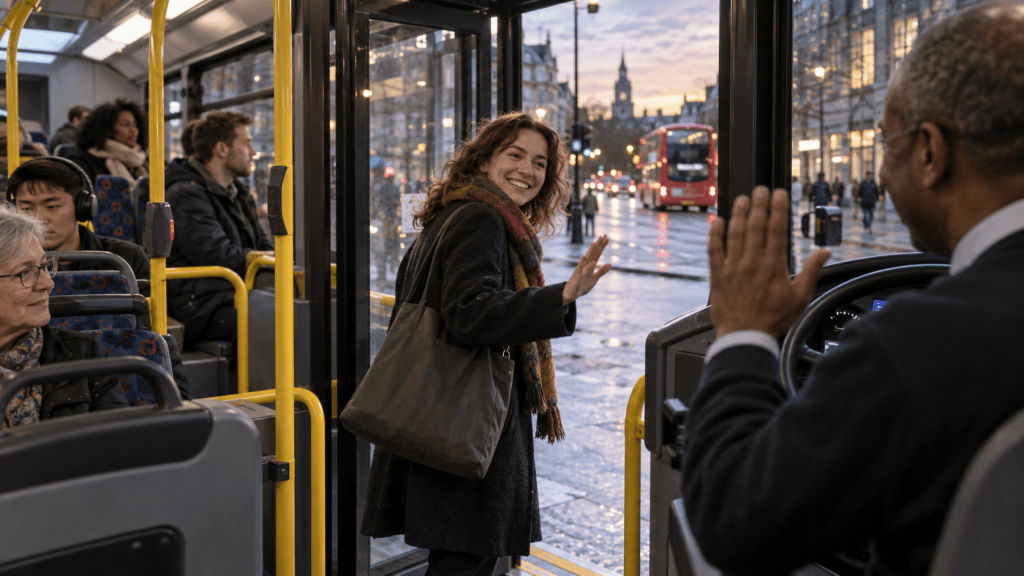
A bus journey can end with an unusual chorus. One passenger says
“thank you”, the next offers “cheers”, and in parts of Wales and western
England somebody calls “cheers, drive” towards the front.
Passengers rarely applaud a train driver or thank the pilot as they
leave an aircraft. Why does the bus driver so often receive a personal
farewell?
Part of the answer lies in the vehicle itself. A bus is public
infrastructure arranged like a social room.
The driver is both
visible and involved
Most passengers encounter the driver at the beginning of the journey.
They ask for a ticket, present a pass, check a destination or wait while
a wheelchair space is prepared. On many buses they pass the cab again
when leaving.
The driver’s work is also easy to observe. Passengers feel the
braking, watch the vehicle negotiate parked cars and notice when it
waits for somebody running towards the stop. A timetable may be
impersonal, but the person trying to keep it is plainly present.
That creates an opportunity for what sociologists call a small ritual
of recognition. The words do not convey new information. They confirm
that both people have noticed the other’s role in a shared event.
Courtesy has a geography
There is no single British bus farewell. “Thank you” may be delivered
quietly beside the cab. “Cheers” is informal and widespread. “Cheers,
drive” is strongly associated with South Wales and Bristol, although its
boundaries are porous and its exact origin difficult to pin down.
The important word is not “drive” as an instruction. It is an
abbreviated form of address: driver reduced to a friendly occupational
nickname, much as somebody might once have addressed “guard” or
“postie”.
Bus design influences the custom too. If passengers leave through a
rear or centre door, the driver may be too far away for a natural
exchange. Where boarding and alighting use the front door, thanks become
easier and are heard by everybody waiting behind.
This helps explain why people can perceive the practice as both
national and intensely local. The general courtesy is common; its
wording and frequency belong to routes, towns and vehicle layouts.
A tiny act in a difficult
workplace
Driving a bus combines safety-critical work with constant public
contact. Congestion, diversions, fares, accessibility needs and delays
all reach the driver’s cab. The driver is often blamed for a late
service whose causes began miles away.
A survey commissioned by the Confederation of Passenger Transport
found that four-fifths of surveyed passengers said they thanked their
driver. Drivers reported that thanks had a positive effect on their
wellbeing, with an average of 37 expressions of gratitude during a
working day.
Those figures describe respondents to one industry-backed survey, not
every passenger or route in Britain. They nonetheless capture something
plausible: repeated small interactions can shape the emotional texture
of work.
It is not a test of moral
character
Etiquette becomes less generous when it is used to judge strangers. A
passenger may be concentrating on a child, using headphones, anxious,
unable to speak or leaving through another door. Nobody needs to perform
gratitude to deserve transport.
Nor should cheerful passengers be expected to compensate for poor
pay, unsafe conditions or an unreliable network. Courtesy can improve an
encounter; it cannot solve structural problems.
Its value is more modest. Public transport requires strangers to
coordinate in shared space. We queue, make room, ring the bell and allow
others to leave. Thanking the driver closes that sequence with an
acknowledgment that a human being carried it out.
The most ordinary
journeys are still human
The habit survives because buses occupy a useful middle ground. They
are mass transport, but not anonymous. They run to a system, yet each
trip is affected by judgement: when to pull out, whether to wait, how
gently to brake and how to help somebody uncertain of the stop.
“Cheers, drive” lasts less than a second. It says that the passenger
saw not only the bus, but the work being done at its front.
That is a surprisingly large meaning for two very small words.
Quick facts
- British passengers use several farewells, including “thank you”,
“cheers” and “cheers, drive”. - “Cheers, drive” is particularly associated with South Wales and
Bristol. - Front-door exit layouts make thanking the driver easier than
centre-door layouts. - A transport-industry survey found four-fifths of responding
passengers said they thanked drivers. - Courtesy can support a pleasant interaction but does not replace
good working conditions or reliable services.



Leave a Reply