The Nancy Grace Roman Space Telescope left Earth on 30 August 2026,
but its destination is not a planet, moon or conventional orbit. It is
heading roughly 1.5 million kilometres away, to a place with nothing
visibly there.
This is L2, the second Lagrange point in the Sun–Earth system. The
James Webb Space Telescope already works in the same broad region. Other
astronomical missions have used it, and more will follow.
Calling L2 a place is useful, but slightly misleading. It is better
understood as a solution to a moving gravitational puzzle.
Gravity and motion can
balance
The Earth orbits the Sun because the Sun’s gravity continually bends
its path. A more distant object would normally take longer to complete
an orbit. Yet a spacecraft just beyond Earth receives a small extra
gravitational pull from our planet.
At L2, that contribution helps the spacecraft travel around the Sun
in step with Earth. From our point of view, it remains in roughly the
same direction, beyond the night side of the planet.
Joseph-Louis Lagrange showed in the 18th century that a system with
two large orbiting bodies contains five locations where a much smaller
third body can maintain a useful geometric relationship with them. The
Sun and Earth therefore have five Lagrange points; so do the Earth and
Moon.
L2 is not a gravity-free parking bay. The Sun, Earth and Moon
continue to pull, while radiation pressure and navigation errors disturb
the spacecraft. Small corrections are still required.
Telescopes orbit the point
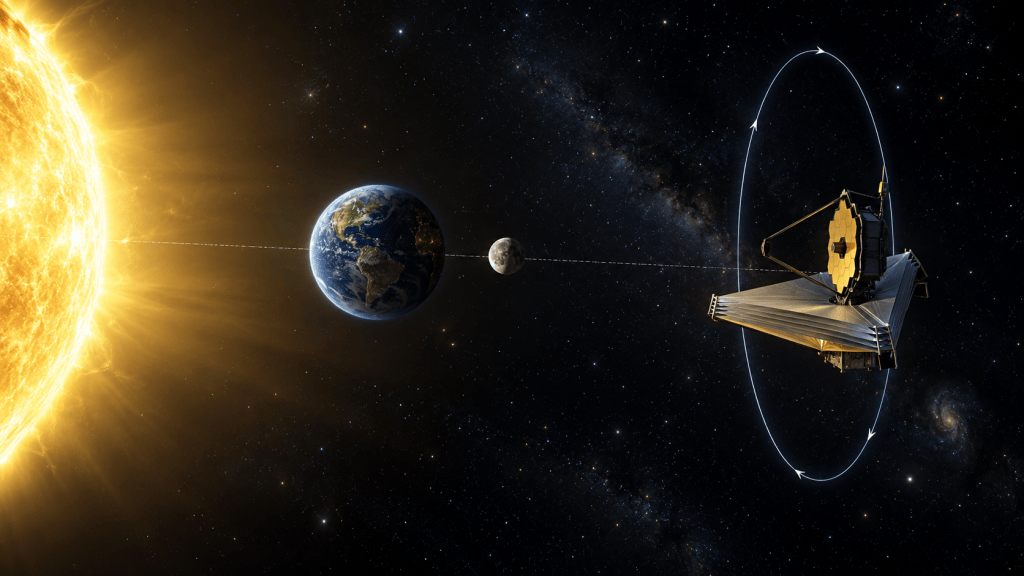
Roman and Webb do not intend to sit exactly at L2. They follow large
halo or Lissajous orbits around the region.
That sounds inefficient, but remaining near the exact point would
create communication and thermal complications. A looping orbit keeps
the spacecraft away from Earth’s full shadow, allows its solar arrays to
receive light and avoids some awkward line-of-sight geometry.
The orbit can be hundreds of thousands of kilometres across. Nothing
marks its centre. Mission controllers reconstruct the telescope’s
position using radio tracking and mathematical models, then schedule
small thruster burns to keep it within the desired path.
One shield can face
three bright objects
An infrared telescope works best when cold. Warm hardware glows in
infrared and can obscure the faint signals the instrument is trying to
measure.
Near L2, the Sun, Earth and Moon remain in approximately the same
part of the sky. A spacecraft can place a sunshield between its
instruments and all three. One side receives sunlight and supports power
generation; the shaded side remains far colder.
The telescope also avoids repeatedly moving into and out of Earth’s
shadow, reducing temperature changes that can distort precise optical
structures. Its view of deep space is broad because Earth occupies only
a small region behind the shield.
The arrangement is especially valuable for Webb, but Roman benefits
too. Roman’s wide-field instruments will survey enormous numbers of
galaxies, study dark energy, investigate exoplanets and map the
structure of the universe. Stable conditions make repeated, comparable
observations possible.
Why not stay close to Earth?
Low Earth orbit is easier to reach and has supported extraordinary
observatories, including Hubble. It also brings interruptions. A
spacecraft circles Earth roughly every 90 minutes, repeatedly passing
between daylight and darkness. Earth blocks part of the sky, and the
upper atmosphere produces a small but persistent drag.
L2 offers long, uninterrupted observing periods. Communications
remain manageable because the spacecraft stays in a predictable
direction from Earth, although radio signals still take about five
seconds for the round trip.
The disadvantage is distance. Servicing is vastly harder than it was
for Hubble. A telescope must deploy, cool and commission itself with
limited physical help. Fuel used for station-keeping ultimately limits
the mission unless refuelling becomes available.
L2 is becoming a
neighbourhood
It is tempting to imagine telescopes clustered together at one
celestial address. In reality, their halo orbits can be designed at
different sizes and phases, leaving enormous separations. Space is not
scarce there in the earthly sense.
What makes L2 resemble a neighbourhood is shared logic. Missions with
very different instruments choose it for the same combination of thermal
stability, sky access, solar power and communications.
Roman’s journey therefore matters even before its first scientific
image. It demonstrates that useful geography exists where there is no
ground. L2 is a location made from relationships: Sun, Earth,
spacecraft, speed and gravity arranged so that an observatory can keep
falling through space in almost the right way.
Quick facts
- L2 lies about 1.5 million kilometres from Earth in the direction
away from the Sun. - It is one of five Lagrange points in the Sun–Earth system.
- Spacecraft orbit around the L2 region rather than remaining
perfectly stationary. - Keeping the Sun, Earth and Moon on one side simplifies shielding and
cooling. - The James Webb and Nancy Grace Roman space telescopes use the L2
region.





 The Knowledge Back Catalogue
Leave a comment