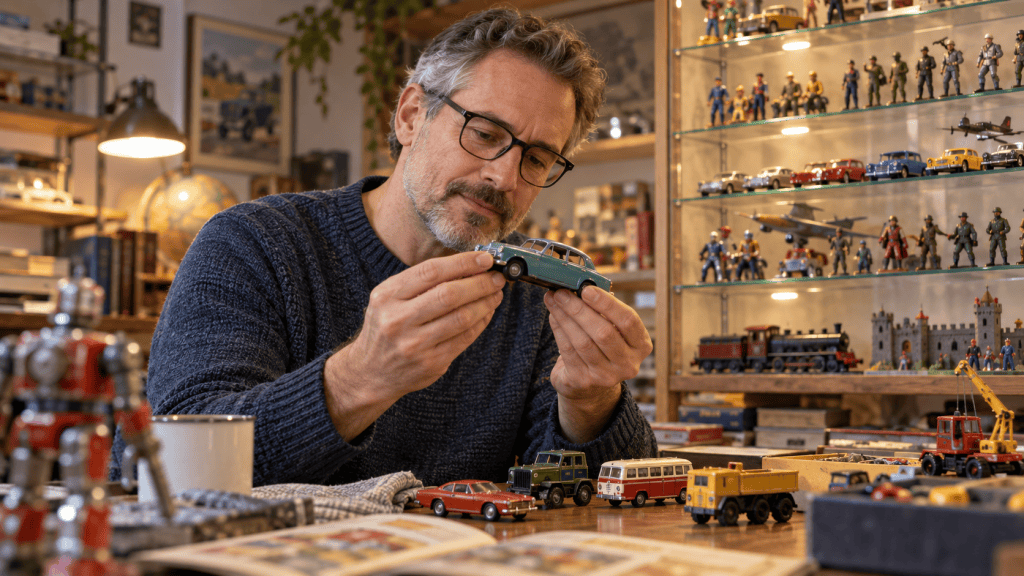
The most powerful toy in a collector’s cabinet is not always the
rarest. It may be the ordinary model that appeared in a childhood
catalogue, was admired for months and never arrived.
Years later, the adult can buy it. That transaction is easily
caricatured as delayed childishness: the grown-up with disposable income
filling a room with things meant for children. But the object has
changed, even if its paint and packaging have not. It now connects two
versions of the same person.
Adults collect toys because toys are unusually efficient containers
for memory, design and imagined possibility.
The object and the
remembered object
Childhood possessions are remembered through use. A die-cast car was
pushed along skirting boards; a doll acquired relationships and a voice;
a construction set became a city. Scratches and missing parts could
record the intensity of play.
The collector may seek the exact edition once owned, a
better-preserved example or the toy that sat beyond reach. In each case,
the purchase is partly about recovering a context. The box typography,
plastic smell or instruction sheet can summon a shop, a birthday or a
vanished bedroom more quickly than a written description.
Nostalgia is not simply a desire to live in the past. It can help
people connect personal memory to a continuing identity: this mattered
to me then, and some part of it still matters now.
Buying what childhood could
not
Children’s collecting is constrained by adults, price and chance. A
range may be discontinued before it is completed. One expensive set may
never have been realistic. The adult collector gains agency over that
unfinished system.
This explains the particular pull of the missing item. Completing a
series imposes order on a market that once felt arbitrary. The object
can represent financial independence as much as childhood longing.
There is a complication. Memory tends to polish the desired toy,
while the real object may be smaller, flimsier or less magical than
expected. Collecting sometimes preserves the dream; sometimes it
corrects it.
Toys are also designed
artefacts
A toy is a piece of industrial and cultural history. Its materials
record manufacturing technology. Its packaging reflects graphic fashion.
The characters and occupations offered to children reveal what a period
thought childhood ought to contain.
Museums collect toys for precisely these reasons. Mass-produced
objects can document ordinary lives that official records overlook. A
plastic figure may reveal changing ideas about gender; a tinplate train
can connect domestic play to contemporary enthusiasm for engineering; a
licensed toy shows how film and television entered the home.
Adult collectors often develop formidable expertise in such
distinctions. They identify mould changes, factory markings, regional
boxes and restoration. What begins as affection becomes research.
Display changes the kind
of pleasure
The child’s toy is normally valuable because it can be transformed
through play. The adult collection may instead emphasise completeness,
condition and arrangement. Neither approach is inherently more
authentic, but they create tension around unopened boxes and “mint”
examples.
Some collectors preserve; others customise, photograph or continue to
play. Model makers may buy an old kit in order to build it, even though
construction destroys the sealed condition another collector prizes. The
same artefact supports different relationships.
Community adds another layer. Fairs, clubs, forums and videos allow
specialist knowledge to circulate. Finding an obscure variation matters
more when somebody else understands why it was difficult.
A collection is not
childhood repeated
An adult cannot literally purchase a lost afternoon. The context has
changed, and pretending otherwise places an impossible burden on an
object.
What the collector can do is make a deliberate relationship with the
past. The shelf says that play, design and early enthusiasm were not
trivial merely because they happened to a child. It can preserve history
while allowing the adult to choose which parts of that history remain
visible.
The toy once promised a possible world. The collection records both
that world and the life travelled since it was imagined.
Quick facts
- Toy collections can be organised by maker, character, period,
material or personal memory. - Packaging and factory variations often matter to specialist
collectors. - Museums use toys to study design, manufacturing and changing ideas
about childhood. - Some collectors prioritise unopened condition; others build,
customise or play. - Nostalgia is one motive among several, alongside expertise,
community and preservation.




 The Knowledge Back Catalogue
Leave a comment