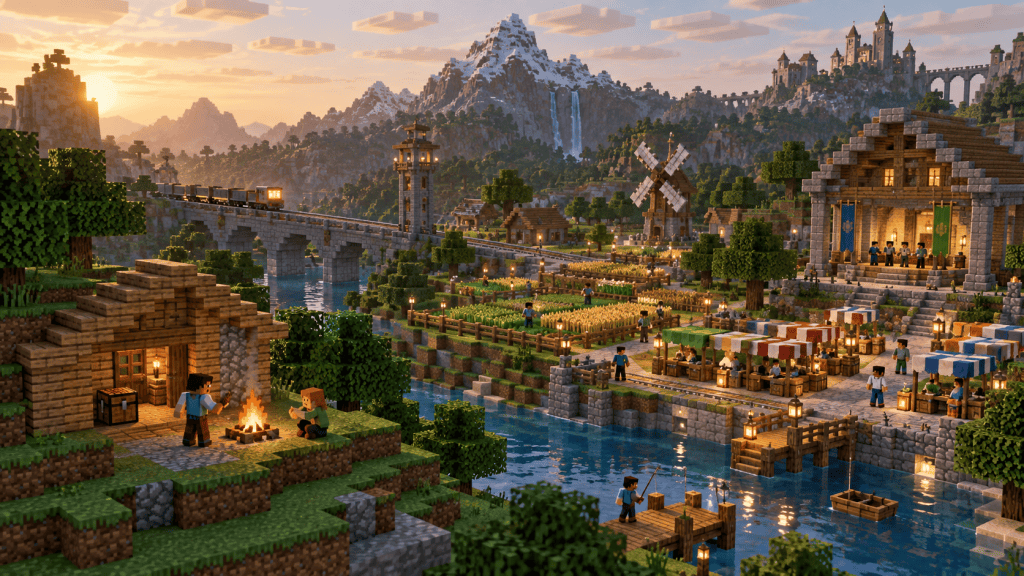
Minecraft begins with almost nothing: a landscape, a pair of hands
and materials that can be removed and placed. The game supplies gravity
selectively, creatures predictably and a day that lasts minutes. It does
not normally tell players what their civilisation should become.
That absence is productive. One player builds a shelter. Several
players create paths, stores, public works and rules about who may alter
what. Given enough time, a server acquires neighbourhoods, inequalities,
monuments, grudges and folklore.
Minecraft became a laboratory for imaginary societies because
construction is only the visible layer. Beneath it, players must decide
how to live together.
Simple rules produce
complicated behaviour
The game’s resources have different locations and costs. Survival
encourages players to gather food, find shelter and manage danger.
Specialisation can therefore emerge without being required: one person
mines, another farms, another designs.
Exchange follows. Some servers use valuable objects as informal
currency; others install systems that create money, shops or land
ownership. The economic rules may be coded, agreed or merely
customary.
This resembles a simulation, but with an important qualification.
Minecraft is not a scientifically accurate model of an economy or
ecology. Its value lies in observing how real people respond to a shared
set of artificial constraints.
Building creates politics
Place is never neutral once somebody has invested work in it. Who
owns a house? May a road cross another player’s land? Who repairs
damage? What happens when a newcomer takes resources from a chest
labelled “community”?
Servers answer through trust, technical permissions, elected
councils, powerful administrators or informal reputation. Griefing—the
deliberate destruction of another player’s work—makes governance
especially visible. A community can ban the offender, restore the
damage, redesign access or collapse into retaliation.
The rules reveal what the group values: freedom to build, protection
of labour, aesthetic coherence or equal access to resources.
A map accumulates history
Minecraft worlds can persist while players come and go. An abandoned
first-night shelter becomes an archaeological site. An obsolete railway
survives because removing it would erase a shared memory. Later builders
interpret structures whose original purpose they never witnessed.
This is worldbuilding in an unusually literal form. Fictional history
is not written before the place; it emerges from use. The ruined tower
really was attacked, the distant village really was founded by people
who left, and the border really marks an old disagreement—even though
every event occurred through play.
The material traces give stories authority. Players can visit the
evidence.
Researchers and
teachers use the same openness
Minecraft has been used in education and research because it supports
collaboration around a manipulable environment. Studies have examined
spatial reasoning, communication and joint problem-solving. Teachers can
ask pupils to reconstruct a settlement, model an ecosystem or negotiate
a sustainable town.
The strongest activities do not assume that playing automatically
produces learning. They define a question, structure reflection and
recognise that access, experience and group dynamics affect
participation.
Researchers also need care when generalising. A self-selected server
is not humanity in miniature. Its culture reflects its platform,
moderation and players.
The blocks are an alibi
for imagination
Adults often describe Minecraft as digital Lego, which captures its
constructive freedom but misses its persistent social landscape. A model
on a table belongs primarily to its maker. A server can become a place
where many makers inherit one another’s decisions.
The game’s deliberately simple appearance helps. Blocks do not
prescribe a finished world; they leave enough ambiguity for players to
supply meaning. A few stone rectangles can be a parliament because the
community agrees that decisions happen there.
Minecraft does not demonstrate how society inevitably works. It
demonstrates how quickly people turn space into society—and how every
imagined world begins acquiring history as soon as somebody else
arrives.
Quick facts
- Minecraft worlds are built from removable and placeable blocks.
- Shared servers can develop trade, property rules, public works and
governance. - Persistent structures allow a fictional world to accumulate genuine
player history. - Researchers have used Minecraft to study collaboration and
learning. - Behaviour on a server reflects its particular rules and players, not
society as a whole.



Leave a Reply